Gaming
The Ultimate Guide to Best Puzzle Browser Games to Improve Your Brain
Discover the finest puzzle browser games meticulously engineered to elevate your cognitive skills, sharpen memory, and optimize your mental agility right from your web browser.
Written by
Kaushik Hirpara
Developer · Game Reviewer
How Puzzle Browser Games Function as Active Cognitive Fitness Tools
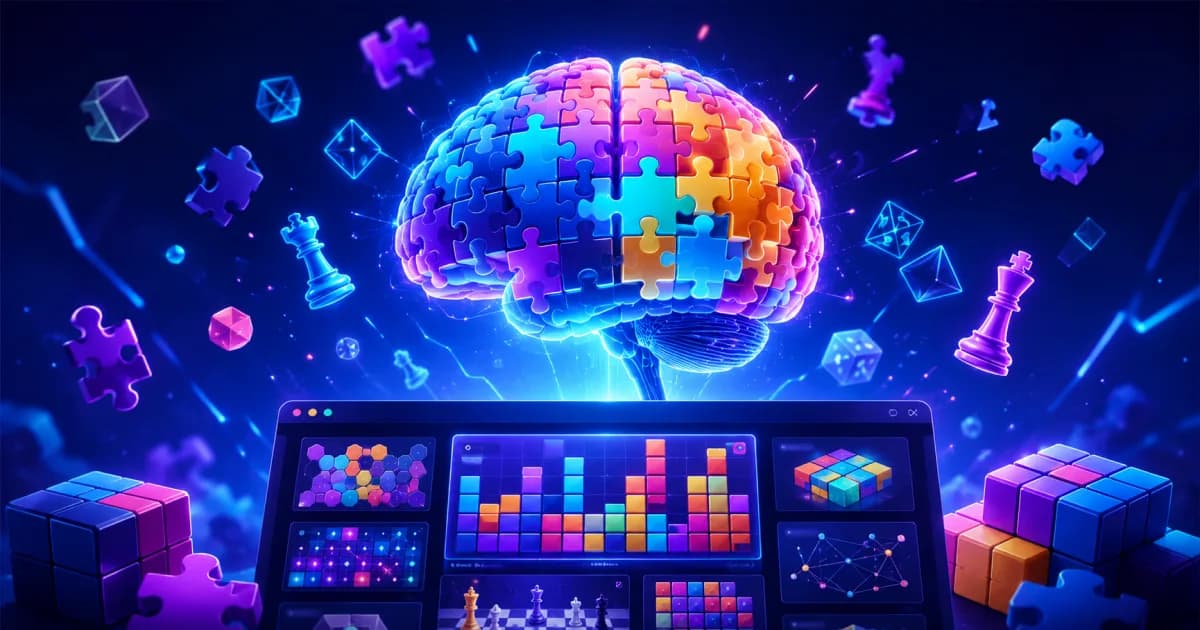
In an era where digital entertainment frequently leans toward passive consumption, puzzle browser games present an engaging alternative that transforms casual play into a workout for your mind. These lightweight, instantly accessible titles challenge the brain by demanding creative problem-solving, real-time pattern recognition, and strict logical deduction. Rather than requiring complex high-end hardware or massive local downloads, browser-based puzzles deliver deeply engaging structural designs directly through your standard web browser. This frictionless delivery makes it incredibly convenient to substitute mindless scrolling with deliberate, mentally stimulating micro-sessions that naturally fit into any busy daily routine.
From a scientific perspective, consistently engaging with complex mental challenges promotes neuroplasticity, which is the biological ability of the brain to form new neural connections and restructure existing pathways in response to environmental demands. When you work through a challenging puzzle, you are actively exercising multiple overlapping mental frameworks, including working memory, spatial reasoning, and executive functioning. Over time, regular participation in these interactive problem-solving scenarios helps fortify your mind against cognitive decline, sharpening your focus and improving your general problem-solving capabilities for real-world applications.
The Crucial Mechanics of Spatial Reasoning in Grid-Based Logic Games
Spatial reasoning is a foundational aspect of human intelligence that dictates how well we can visualize, manipulate, and mentally organize complex structural layouts. Grid-based logic games are exceptionally efficient at developing this skill, forcing players to look past immediate patterns and accurately anticipate how moving pieces will impact the broader visual ecosystem. These experiences require a balanced blend of deliberate forward-thinking and visual manipulation, making them excellent training tools for the parts of the brain responsible for structural organization and fluid geometric planning.
As players progress deeper into these geometric challenges, they naturally build an internal framework for assessing multi-layered dependencies. You learn to recognize how a single action in one corner of the board can trigger an unavoidable chain reaction across the entire layout. This demanding mechanical loop helps sharpen working memory, as players must mentally hold several different spatial configurations simultaneously before committing to an official move. The cognitive advantages gained here stretch far beyond the digital screen, translating directly into better spatial organization, heightened situational awareness, and faster mechanical problem-solving in everyday life.
Why Pattern Recognition and Word-Based Puzzles Build Stronger Mental Agility
Language and pattern recognition form the cornerstone of how we process daily information, communicate complex ideas, and evaluate abstract scenarios. Word-based browser puzzles utilize these linguistic pathways to test your active vocabulary, analytical retrieval speed, and structural fluid thought. By requiring you to dissect jumbled letters or decipher obscure linguistic hints under strict structural constraints, these games train your brain to rapidly crawl through its mental database, strengthening the neural connections that manage language processing.
Beyond expanding your everyday vocabulary, these accessible text puzzles significantly improve mental agility by forcing you to look at common phrases and words from entirely new analytical angles. Players must consciously reject obvious answers and actively search for subtle, non-linear relationships between abstract concepts. This regular practice builds a highly adaptable cognitive style that can quickly shift between entirely different structural rules. It proves that the best brain-training exercises are often the ones that rely on familiar tools like language to push your logical capabilities into completely new territory.
The Power of Math and Number-Based Challenges in Boosting Analytical Efficiency
Numerical literacy and sharp analytical thinking are critical assets in both professional productivity and everyday decision-making processes. Number-based puzzle browser games provide an excellent platform for practicing these skills, stripping away tedious rote calculations and replacing them with engaging, logic-driven structural systems. Whether you are balancing intricate numerical grids or managing mathematical equations under strict spatial rules, these challenges train your mind to look at numbers as deeply interconnected building blocks within a larger systematic puzzle.
Working through these numerical problems regularly helps demystify abstract math, training the brain to calculate potential outcomes with greater speed and accuracy. These games encourage the development of personal shortcuts and strategic mental algorithms, optimizing how your working memory processes complex quantitative data. By turning systematic calculation into an engaging, interactive journey, these browser titles help eliminate numerical anxiety and build a sharper, more confident analytical mindset that can effortlessly break down large, intimidating real-world data points.
Physics-Based Enigmas and Their Direct Impact on Real-World Dynamic Thinking
Physics-based browser games require players to navigate realistic environmental simulations governed by gravity, momentum, structural friction, and weight distribution. These games present open-ended scenarios where there is rarely a single, predetermined path to victory. Instead, players are encouraged to experiment with the environment, observing how interactive objects behave under dynamic forces and iterating on their designs based on tangible structural feedback.
This experimental loop builds a resilient, highly adaptive cognitive approach centered on trial and error. When a carefully planned physical bridge collapses or a complex structural mechanism fails, you are forced to analyze the physical failure, adjust your variables, and try again with a refined strategy. This continuous testing process improves your intuitive understanding of physical cause-and-effect relationships, while sharpening your spatial prediction skills. It carefully teaches the mind to embrace setbacks as valuable learning points, cultivating a strategic mindset that excels at navigating unpredictable, fast-moving real-world situations.
Elevating Cognitive Endurance with Multi-Layered Deduction Adventures
In a modern digital landscape dominated by short-form content and quick dopamine hits, sustained cognitive endurance has become a rare and valuable skill. Multi-layered deduction adventures provide an excellent antidote to short attention spans, requiring players to invest focused attention into unraveling complex web-based mysteries. These narrative-rich experiences demand that you track intricate plot threads, cross-reference subtle environmental clues, and maintain a clear mental map of various interconnected character motivations over extended periods of time.
The mental effort required to solve these long-form puzzles builds deep intellectual focus and critical thinking stamina. You cannot rely on casual guesswork; instead, you must systematically gather evidence, eliminate false leads, and formulate cohesive logical theories based on verified observations. This comprehensive methodology helps condition your brain to maintain deep focus on intricate, multi-step projects without succumbing to external distractions. It serves as a powerful reminder that true mental fitness requires enduring patience, careful observation, and a willingness to explore deep beneath the surface.
The Hidden Cognitive Benefits of Strategic Management and Resource Puzzles
Resource management and strategic optimization puzzles challenge players to maximize their operational efficiency while working within strict, unforgiving limitations. These browser games simulate complex systems where every single choice carries an implicit opportunity cost, forcing you to constantly weigh short-term survival needs against long-term operational goals. Managing these digital trade-offs exercises the prefrontal cortex, which is the specific command center of the brain responsible for high-level decision-making, emotional self-regulation, and long-term planning.
By forcing you to navigate conflicting priorities with limited assets, these systemic puzzles help refine your logistical planning and organizational foresight. You learn to spot subtle operational bottlenecks before they derail your progress, allocate your resources with surgical precision, and maintain a flexible strategic vision that can quickly adapt to sudden environmental changes. This immersive long-term strategic training translates beautifully into professional environments, giving you the mental tools required to manage complex workflows, optimize budgets, and lead multi-faceted long-term projects with absolute confidence.
How Streamlined Browser Accessibility Transforms Daily Cognitive Workouts
The true genius of modern puzzle browser games lies in their seamless, uninhibited accessibility across different devices and locations. Because these experiences operate entirely within standard HTML5 and WebGL web frameworks, they can run flawlessly on nearly any device—from a high-powered desktop setup to an everyday smartphone. This cross-platform fluidity means your personalized brain-training regime is never tied to a specific physical space or a single piece of hardware.
This frictionless access makes it incredibly easy to turn common moments of downtime into productive mental breaks. Whether you are waiting out a daily transit commute, standing in a long checkout line, or unwinding during a brief lunch break, you can instantly launch a sophisticated puzzle and give your mind a quick, constructive workout. Platforms like Unihfy Games specialize in delivering these optimized, highly engaging web experiences, ensuring that top-tier mental stimulation is always just a single click away for players around the globe.
Abstract Minimalism and Visual Deception as Tools for Neuroplastic Development
Minimalist puzzle browser games deliberately strip away loud sensory distractions, focusing your full attention on elegant mechanics, geometric shapes, and clean visual design. These abstract experiences often play with optical illusions, perspective shifts, and hidden paths, challenging your fundamental assumptions about spatial geometry and visual reality. By presenting logic problems in an unfamiliar, stripped-back environment, these titles force your brain to discard worn-out mental heuristics and think outside the box.
Learning to successfully navigate these shifting, deceptive environments provides a fantastic workout for your brain's cognitive flexibility. Your mind is forced to quickly abandon outdated assumptions the moment the rules of perspective change, rapidly adjusting its visual logic to solve the problem at hand. This rigorous mental stretching builds a highly creative, versatile style of problem-solving that refuses to be constrained by traditional boundaries. It teaches you to look past surface-level appearances and uncover elegant, unconventional solutions to deeply complex challenges.
The Collaborative Power of Community-Driven Web Puzzles and Social Logic
While many puzzle games are designed as solo intellectual journeys, the modern web browser has introduced a vibrant social dimension to digital problem-solving. Community-driven puzzle hubs and competitive daily challenges encourage players to collaborate on complex enigmas, share unique strategies, and compare their scores across global leaderboards. This shared experience adds a layer of social motivation that keeps players returning to test their skills day after day.
Engaging with a global community of fellow puzzle enthusiasts exposes you to entirely different viewpoints and problem-solving methodologies that you might never have discovered on your own. Analyzing how another player approached the exact same logical challenge broadens your cognitive horizons and encourages you to critically evaluate your own analytical biases. This collaborative, socially connected environment transforms brain training from a solitary routine into an engaging, community-driven pursuit that satisfies our fundamental human needs for learning, competition, and social connection.
Curating Your Ideal Browser-Based Brain Training Routine for Maximum Results
To get the absolute most cognitive value out of puzzle browser games, it is highly effective to approach them with a structured, well-balanced strategy. Just as a well-rounded physical workout targets different muscle groups, a balanced mental fitness routine should intentionally challenge various cognitive domains. Combining word puzzles, spatial reasoning challenges, numerical grids, and physics simulations ensures that your entire brain receives a thorough, comprehensive workout that keeps you sharp across the board.
• Diversify Your Gameplay: Avoid sticking exclusively to one specific sub-genre; mix spatial, verbal, and mathematical puzzles to challenge different areas of your brain. • Set Manageable Daily Limits: Dedicate 15 to 30 minutes of focused, uninterrupted play per day rather than indulging in hours of exhausting, non-stop sessions. • Embrace Increasing Difficulty: Actively seek out puzzles that push you to the absolute edge of your current comfort zone, as true cognitive growth requires consistent, progressive challenge. • Track Your Personal Progress: Monitor how your solving speed, accuracy, and strategic efficiency improve over time to stay motivated and engaged.
By embedding this intentional, diversified approach into your weekly habits, you turn casual browser gaming into a powerful lifelong tool for self-improvement. The key to long-term cognitive vitality is not found in tedious, repetitive exercises, but in the joyful, consistent exploration of new intellectual challenges. With the incredible variety of puzzle browser games available today at Unihfy Games, keeping your mind sharp, adaptable, and energized has never been more enjoyable or accessible.
Frequently Asked Questions About Puzzle Browser Games
* Can playing puzzle browser games genuinely increase my real-world intelligence? While puzzle games may not automatically elevate your general IQ score overnight, they significantly improve vital cognitive sub-skills like working memory, rapid pattern recognition, and fluid spatial reasoning. These enhanced mental faculties directly translate into sharper focus, better analytical decision-making, and superior problem-solving capabilities when tackling real-world personal and professional challenges.
* How many minutes per day should I spend playing brain-training puzzles to see real benefits? Consistency is far more important than raw volume when it comes to effective cognitive training. Dedicating just 15 to 20 minutes of focused, distraction-free gameplay each day is more than enough to stimulate neuroplasticity, keep your mind engaged, and build lasting improvements in your mental agility and long-term memory.
* Are free puzzle browser games safe to play on older computers and mobile devices? Yes, the vast majority of modern puzzle browser games are built utilizing highly optimized HTML5 and WebGL web standards. This lightweight architecture allows them to run safely, smoothly, and efficiently across almost all modern web browsers without requiring expensive hardware upgrades, external plugins, or risky local software installations.
* What specific types of puzzle games are most effective for improving memory? Grid-based logic games, sequence repetition challenges, and multi-layered deduction adventures are exceptionally good for boosting memory. These genres force your brain to actively retain, track, and manipulate multiple pieces of visual and structural information simultaneously, giving your short-term working memory an intensive workout.
* Is it better to master one puzzle game completely or constantly switch to new ones? For optimal brain training, it is best to transition to a new game or higher difficulty tier once you have completely mastered a specific puzzle style. True cognitive growth occurs when your brain is actively struggling with new, unfamiliar rules and patterns; staying comfortable with a game you have already mastered minimizes the neuroplastic benefits.
Related Articles
Gaming
Best Relaxing Browser Games After a Long Day
Discover how to choose the right relaxing browser games to unwind after a tiring day. Explore the balance between calm thinking and simple arcade action for evening gaming.
Gaming
Best Online Games for Kids
Discover some of the best online games for kids by comparing gameplay, controls, reading requirements, challenge level, and online features. Learn how to choose games that match different interests, abilities, and play styles rather than assuming one game suits every child.
Gaming
Best Free Games to Play During Work Breaks
Discover free browser games that fit different kinds of work breaks, from quick pauses between tasks to longer lunch breaks. Learn how to choose games that are easy to start, simple to pause, and enjoyable without demanding your entire afternoon.
Gaming
Best Free Browser Games for Low-End PCs and Laptops
Choosing browser games for an older or modest computer is about more than finding titles that run in a browser. Learn what affects browser-game performance, which game styles are sensible starting points, and discover free games worth trying first.
Continue Exploring
Ready For More?
Jump into browser games or challenge yourself in Quiz Arena. There's always something new to discover.