Quiz
The Science of Retrieval: How Quizzes Radically Improve Memory and Learning
Explore the psychological and neurological mechanisms behind active retrieval, the testing effect, and how interactive quizzes accelerate long-term knowledge retention.
Written by
Omik Babariya
Developer · Quiz Editor
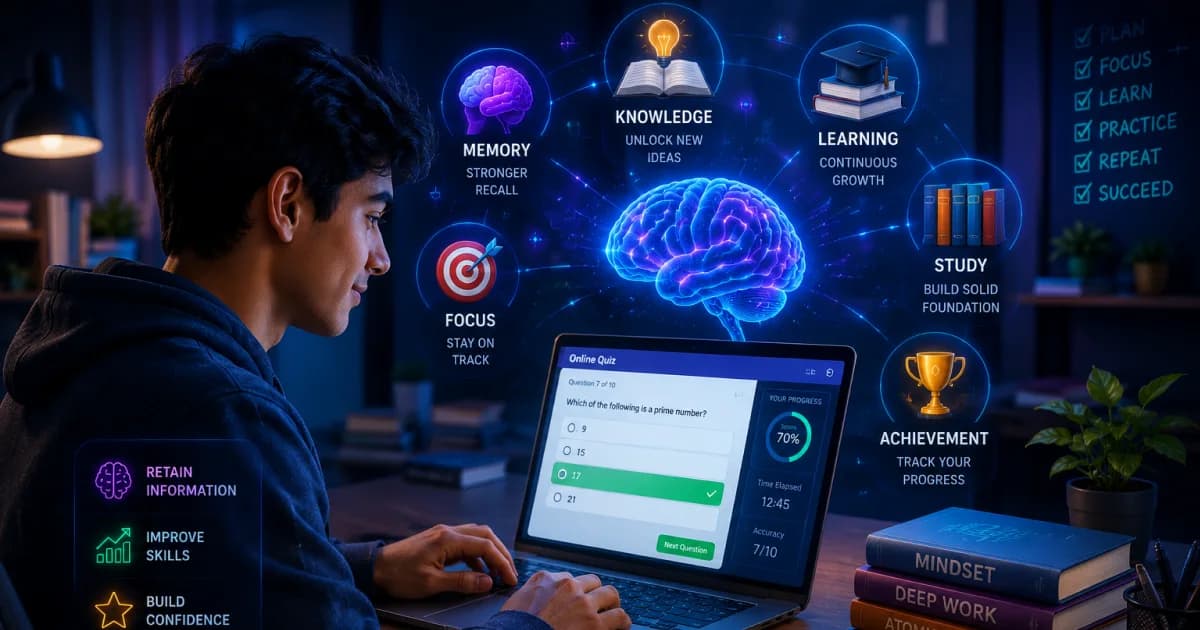
The Shift from Passive Review to Active Retrieval Practice
For generations, traditional study habits have leaned heavily on passive consumption techniques, such as highlighting text, re-reading chapters, and listening to long lectures. While these practices can make a learner feel comfortable and familiar with the material, cognitive psychologists have proven that they often create a false illusion of competence. Merely scanning your eyes over information repeatedly confirms recognition rather than conceptual mastery, leading to rapid memory decay once the textbook is closed or the lecture ends.
Interactive quizzing forces a complete shift from passive ingestion to active retrieval practice, demanding that the brain actively mine its neural pathways to reconstruct a piece of information. This mental exertion forces the brain to treat the target data as vital for survival, modifying physical neural structures to optimize future access speeds. By reframing a quiz not just as an assessment tool, but as a core engine of the learning process itself, we unlock a far more potent and resilient method of building lifelong knowledge.
Decoding the Testing Effect and Its Neurobiological Impact
At the heart of cognitive psychology lies a robust phenomenon known as the testing effect, which proves that taking a test or quiz provides significantly greater long-term retention than spending an equivalent amount of time studying the same material. Every time you answer a quiz question, you are not merely measuring how much you know; you are actively altering your memory trace. The psychological strain required to pull a fact from deep storage acts as a structural catalyst, thickening the myelin sheath around relevant neural pathways and making future recall significantly more efficient.
Neurobiological research indicates that active retrieval engages the prefrontal cortex and hippocampus in tandem, reinforcing the contextual cues that link disparate concepts together. When a learner successfully navigates a quiz question, the brain releases a micro-dose of dopamine, a neurotransmitter deeply intertwined with satisfaction, focus, and the physical consolidation of memory. This chemical reward system flags the retrieved information as highly valuable, ensuring it is prioritized during the brain's overnight memory consolidation processes.
How Spaced Repetition via Quizzing Halts the Forgetting Curve
In the late nineteenth century, psychologist Hermann Ebbinghaus charted the systematic rate at which human beings lose new data, creating the famous mathematical concept known as the Forgetting Curve. His research demonstrated that without conscious reinforcement, the human mind discards up to seventy percent of newly acquired data within a mere forty-eight hours. This aggressive pruning mechanism is an evolutionary adaptation designed to keep our brains from becoming overwhelmed by useless sensory inputs, but it presents a major obstacle for modern educational pursuits.
Integrating strategically timed quizzes introduces spaced repetition into the learning cycle, interrupting the natural descent of the forgetting curve precisely at the moment the brain is beginning to lose its grip on the data. Pushing the mind to recall information just as it starts to fade forces a deep structural reorganization of the memory trace, resetting the decay timeline and flattening the curve over time. Platforms like Unihfy Games utilize these engagement principles to design compelling, quiz-driven interactive systems that make maintaining long-term knowledge retention feel entirely natural and deeply rewarding.
The Metacognitive Advantage of Identifying Immediate Knowledge Gaps
Metacognition, or the ability to accurately analyze and evaluate one's own thought processes, is a critical hallmark of a highly effective learner. Left to their own devices, most students are notoriously poor judges of what they actually understand versus what they simply recognize on the surface. This cognitive blind spot often leads individuals to allocate precious study hours to topics they have already mastered while completely ignoring severe vulnerabilities in their foundational knowledge.
Quizzing acts as an uncompromising, objective mirror that instantly shatters this illusion of competence by forcing a direct performance check. Failing to answer a specific query clearly highlights an immediate knowledge gap, providing unambiguous data on exactly what needs to be reviewed. This instant diagnostic feedback allows learners to abandon generic, inefficient study strategies in favor of hyper-targeted remediation, maximizing their intellectual growth while saving significant time and emotional energy.
Hypercorrection Effect: Why Making Mistakes Accelerates Mastery
Many traditional educational environments have accidentally conditioned students to fear mistakes, treating incorrect answers as painful indicators of intellectual failure. However, cognitive science reveals a fascinating counterintuitive psychological phenomenon known as the hypercorrection effect. This principle shows that when a highly confident student makes an error on a test and is immediately presented with the correct factual feedback, the resulting surprise deeply carves the correct answer into their long-term memory.
The mild emotional jolt of being wrong spikes intellectual attention, rendering the brain exceptionally receptive to incoming corrections. When you guess incorrectly on a quiz, your brain actively analyzes the gap between your expectation and reality, initiating a deep memory rewrite to ensure the mistake is not repeated. Embracing regular, low-stakes quizzing environments reframes errors as essential stepping stones toward absolute mastery, stripping away performance anxiety and replacing it with a healthy curiosity.
Elaborative Interrogation and the Generation of Contextual Links
High-fidelity learning requires more than just memorizing isolated facts; it demands that you weave new data into the complex, pre-existing web of knowledge stored inside your mind. Well-constructed quizzes stimulate a process known as elaborative interrogation by presenting challenging multi-choice scenarios, situational logic prompts, and structural comparisons. These questions push learners to actively evaluate why a particular answer is valid while systematically defending against enticing, highly plausible distractors.
This analytical processing forces the mind to construct rich contextual anchors and cross-references between the new material and older memories. By constantly evaluating relationships, identifying subtle anomalies, and justifying logical choices during a quiz, you build multiple distinct pathways back to that specific piece of information. Should one mental pathway fade over time, your brain can easily utilize an alternative associative route to retrieve the memory, rendering your accumulated knowledge highly resilient against everyday forgetfulness.
Reducing Performance Anxiety Through Desirable Difficulty
The concept of 'desirable difficulty,' coined by educational researcher Robert Bjork, suggests that learning experiences that require deliberate, comfortable strain yield far more durable long-term retention than effortless study methods. Quizzes introduce this beneficial struggle by forcing the brain to work through complex problem-solving loops under controlled conditions. This structured exertion trains your mind to remain calm, focused, and analytical when operating under cognitive pressure.
Regularly engaging with low-stakes interactive quizzes helps desensitize learners to the psychological dread typically associated with formal examinations. When a quiz is decoupled from harsh, punitive grading systems and repositioned as a safe playground for mental experimentation, it builds profound intellectual resilience. Over time, students who normalize active testing as a routine part of their learning lifestyle exhibit substantially lower levels of academic anxiety and superior composure during high-stakes real-world assessments.
The Role of Micro-Learning and Gamification in Modern Engagement
Modern digital lifestyles have dramatically altered how information is consumed, making it increasingly difficult for individuals to sustain attention through hours of dense text or lengthy video presentations. Micro-learning addresses this cultural shift by breaking complex educational frameworks down into highly bite-sized, easily digestible modules. Interactive quizzes serve as the ideal backbone for this approach, transforming large subjects into structured series of quick, highly engaging cognitive milestones.
When infused with thoughtful gamification elements—such as progression bars, friendly leaderboard competitions, and instant rewards—quizzing taps into fundamental human drives for mastery and achievement. This gamified framework turns the pursuit of knowledge into an addictive, self-reinforcing journey. Unihfy Games applies these exact psychological principles to create polished digital experiences, proving that educational content can easily compete with mainstream entertainment when designed with a deep respect for user engagement and modern interface accessibility.
Optimizing the Pre-Testing Strategy to Prime the Brain for New Data
One of the most remarkable discoveries in modern educational psychology is that taking a quiz on a completely unfamiliar topic before you even begin studying the material significantly boosts subsequent learning. While it may seem counterproductive to test yourself on things you have never been taught, this pre-testing strategy serves as an incredibly powerful tool for priming the brain's focus and curiosity.
When you encounter a pre-test question, your brain naturally searches its existing memories for clues, cataloging its own ignorance and identifying the core structural themes of the upcoming subject. When you finally sit down to read the textbook or listen to the presentation, your mind acts like a highly targeted radar, instantly latching onto the specific facts that match the pre-test questions. This heightened situational awareness transforms passive listening into an active, aggressive search for answers, drastically increasing the amount of information you absorb on your very first pass.
The Long-Term Cognitive Dividends of a Structured Quiz Habit
Committing to a structured, quiz-heavy approach to personal growth yields immense cognitive dividends that extend far beyond simply passing a specific academic or professional certification. By consistently pushing your brain to practice active recall, you are systematically optimizing your overall cognitive processing speed, expanding your working memory capacity, and sharpening your mental agility across all aspects of life.
• Improves Executive Functioning: Managing diverse puzzle rules and complex quiz logic exercises the prefrontal cortex, boosting daily prioritizing and strategic planning skills. • Enhances Transfer of Knowledge: Active retrieval builds deep conceptual understanding, enabling you to effortlessly apply abstract principles to novel, real-world scenarios. • Fosters Lifelong Curiosity: Regular intellectual victories trigger healthy dopamine release, transforming learning from a tedious chore into a fulfilling, lifelong pursuit.
Ultimately, the mind behaves much like physical muscle tissue: it requires consistent, structured resistance to grow stronger and maintain its tone over time. Relying solely on passive reading is the mental equivalent of watching someone else lift weights at the gym—it simply cannot produce tangible structural growth. By actively embracing interactive quizzes as your primary vehicle for mental development, you ensure your brain remains sharp, adaptable, and fully prepared to navigate the immense complexities of our fast-moving modern world.
Frequently Asked Questions About Quizzing and Memory
* Why does passive re-reading feel so effective if cognitive science proves it is inefficient? Re-reading feels incredibly effective because it rapidly builds 'perceptual fluency,' a psychological state where the text becomes familiar to your eyes. This surface-level recognition tricks your brain into experiencing an illusion of competence, making you confuse the ease of reading with actual conceptual mastery and deep long-term recall storage.
* Should quiz feedback be delivered immediately, or is it better to wait until the end of the session? Research shows that immediate feedback is highly effective for casual learning and low-stakes environments, as it quickly corrects errors before they can take root in your memory. However, slightly delayed feedback can sometimes offer greater long-term retention benefits by forcing the brain to work harder to recall the context of the original question.
* Can interactive quizzes protect older adults from age-related cognitive decline? Yes, absolutely. Consistently engaging with challenging interactive quizzes stimulates neuroplasticity and helps maintain a robust cognitive reserve. Forcing the brain to practice active recall, logical deduction, and spatial reasoning helps preserve vital neural connections, protecting mental sharpness as you age.
* How can I start implementing the pre-testing strategy in my independent daily studies? Before opening a new book or starting an instructional video, spend five minutes writing out a few predictive questions about what you think the topic will cover, or try to answer the chapter-end review questions completely cold. This simple exercise alerts your brain to focus on the key concepts, maximizing your absorption rate.
* Is it better to take multiple short quizzes or one comprehensive practice exam? For durable long-term retention, frequent short quizzes distributed over an extended timeline are significantly better than a single massive exam at the end. Distributed short sessions leverage the power of spaced repetition, continuously interrupting the forgetting curve and converting short-term data into permanent memory.
Related Articles
Quiz
Daily Quiz Challenges: The Surprising Science of Why Consistency Matters
Discover the psychological and neurological reasons why a consistent daily quiz habit outperforms sporadic cramming, accelerates neuroplasticity, and transforms your long-term memory retention.
Quiz
The Best Quiz Categories to Systematically Improve Your General Knowledge
Discover the most impactful trivia and quiz categories designed to broaden your global perspective, sharpen memory retention, and build a versatile foundation of general knowledge.
Quiz
Mastering the Digital Arena: Strategic Tips to Score Higher in Online Quiz Games
Unlock advanced cognitive strategies, time-management techniques, and logical deduction methods designed to maximize your scores in competitive online trivia and quiz games.
Game Reviews
Best Games of 2026 So Far: The Year Nobody Predicted
Seven months into 2026 and the year looks nothing like the one everybody predicted in January. Here are the seven games that actually mattered, why the lists and the players disagreed so badly, and what else is worth your time.
Continue Exploring
Ready For More?
Jump into browser games or challenge yourself in Quiz Arena. There's always something new to discover.