Quiz
Mastering the Digital Arena: Strategic Tips to Score Higher in Online Quiz Games
Unlock advanced cognitive strategies, time-management techniques, and logical deduction methods designed to maximize your scores in competitive online trivia and quiz games.
Written by
Omik Babariya
Developer · Quiz Editor
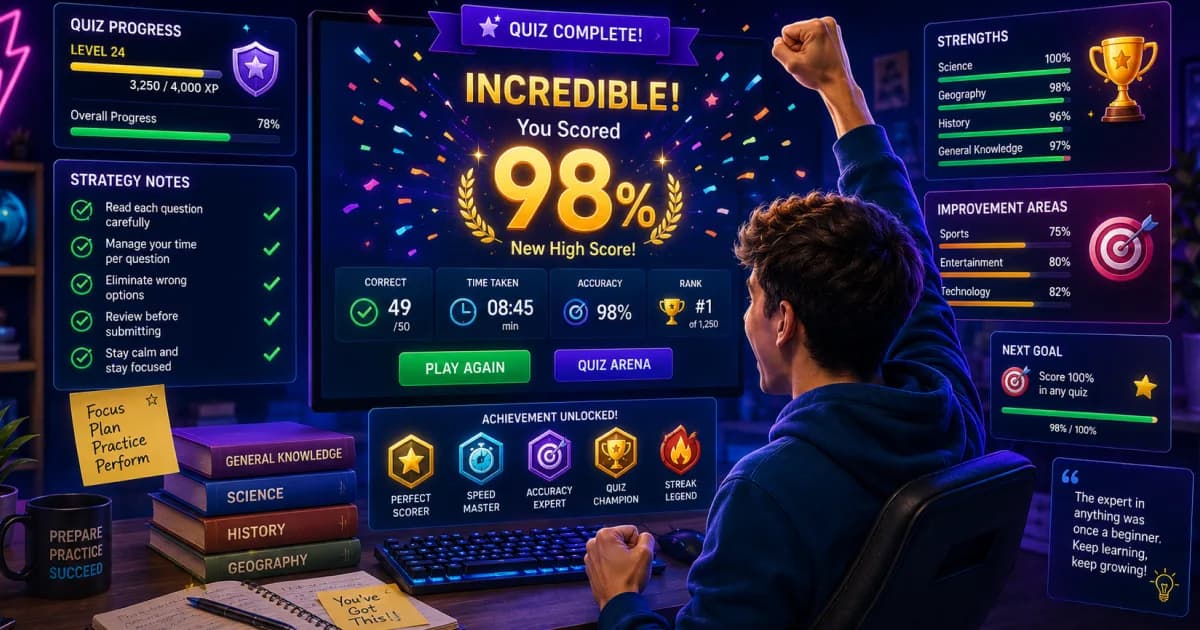
The Anatomy of Modern Competitive Online Trivia Formats
The landscape of digital trivia has evolved from simple text-based multiple-choice questionnaires into high-stakes, fast-paced competitive environments that test far more than mere encyclopedic knowledge. Modern web-based quiz platforms incorporate real-time multiplayer tracking, dynamic scoring algorithms based on reaction times, and complex multi-layered distraction mechanics. To consistently reach the top of global leaderboards, a casual player must look past standard memorization and develop a comprehensive competitive methodology that treats online quizzing as a demanding mental sport.
Success in this fast-moving arena requires a deep understanding of how modern quiz software is structured. Most digital platforms reward a combination of factual accuracy, prompt decision-making, and psychological endurance, meaning that a split-second delay or a momentary lapse in concentration can drop you several placement spots down the rankings. By analyzing the core mechanics of online trivia—including adaptive question difficulty, point-decay timers, and visual presentation styles—you can build a highly structured, strategic approach that maximizes your scoring efficiency across any platform or category.
Deconstructing the Time-to-Reward Ratio in Dynamic Scoring Systems
One of the most critical structural mechanics found in modern competitive trivia platforms is the dynamic point-decay timer, which continuously reduces the maximum available points for a question every millisecond that passes. Under this system, simply choosing the correct answer is no longer sufficient for securing a top ranking; you must arrive at the correct deduction faster than your global competitors. This high-pressure requirement creates a major psychological trade-off between the security of careful analysis and the financial benefit of rapid execution.
To optimize your performance within these time-sensitive frameworks, you must train your mind to calculate the exact risk profile of every split-second choice. If a question carries an unusually high point multiplier but a punishing penalty for incorrect inputs, a slightly more measured approach is mathematically safer. Conversely, during standard rounds where point values decrease aggressively second by second, training your eyes to spot key anchor terms instantly allows you to lock in your selection early, accumulating a significant lead over slower players who lose valuable points over-analyzing obvious scenarios.
Advanced Reading Strategies: Spotting Syntactic Cues and Anchor Terms
Under the extreme pressure of a ticking clock, many casual quiz players fall victim to a bad habit known as frantic reading, scanning text haphazardly and overlooking subtle linguistic trapdoors hidden within the prompt. Well-crafted quiz questions are often deliberately engineered to exploit this haste, utilizing double negatives, misleading introductory clauses, or shifting qualifiers to redirect careless minds toward enticing but incorrect conclusions. Developing an analytical reading methodology is your first and most effective line of defense against these subtle cognitive traps.
To read with clinical precision without sacrificing your velocity, train your eyes to instantly look past stylistic filler words and zero in on semantic anchor terms. Look closely for absolute qualifiers like 'always', 'never', 'except', or 'least', which instantly reverse the logical requirements of the question. By isolating the exact core verb and historical noun within the first fraction of a second, you can accurately categorize the structural intent of the query, blocking out external distractions and allowing your brain's memory systems to execute a clean, targeted retrieval process.
The Art of Logical Elimination and Mitigating the Distractor Factor
In a standard four-option multiple-choice trivia framework, trivia authors rarely design incorrect choices at random; instead, they craft highly advanced options known in educational psychology as distractors. These choices are explicitly engineered to look intensely plausible, often featuring names, dates, or phrases that are closely related to the subject matter but factually incorrect in the specific context of the prompt. Overcoming these traps requires abandoning the habit of searching for the correct answer immediately, replacing it with a rigorous methodology of logical elimination.
The moment options appear on your screen, immediately identify and discard the two choices that contain logical contradictions, historical anachronisms, or extreme qualifiers that violate the rules of the prompt. This rapid reduction instantly transforms a difficult 25% guess into a manageable, highly calculated 50/50 coin flip, substantially increasing your baseline mathematical probability of success. Even if you are completely unfamiliar with the specific fact being tested, analyzing the structural relationships between the remaining options will often reveal subtle context clues that point directly to the correct path.
Optimizing Your Digital Environment and Input Layout for Peak Velocity
When competing at the highest levels of global trivia platforms, physical performance bottlenecks like input latency, interface layout, and local network instability can turn a perfect strategic run into a frustrating defeat. Operating on an unstable wireless connection or navigating a cluttered, ad-heavy interface introduces systemic delay that bleeds valuable points over the course of an intense match. Treating your digital gaming environment with the same meticulous care as a competitive esports player is essential for maximizing your scoring efficiency.
• Secure a High-Throughput Connection: Whenever possible, use a stable connection to minimize data packet loss and ensure your inputs register instantly on the server. • Eliminate Interface Friction: Close background system processes, disable intrusive desktop notifications, and optimize your browser cache to prevent sudden frame drops during critical matches. • Standardize Your Physical Grip: When playing on mobile devices, use a balanced two-thumb grip to minimize the distance your fingers must travel to hit an option. • Utilize Clean Web Platforms: Choose optimized, streamlined gaming portals like Unihfy Games that deliver lightweight web architecture, stripping away frustrating lag and ensuring a smooth interactive experience.
By systematically eliminating these micro-frictions from your hardware and software setup, you ensure that your physical inputs perfectly match your mental processing speed. In a competitive arena where a difference of fifty milliseconds determines leaderboard supremacy, optimizing your interactive workflow converts your mechanical reflexes into a clean, highly reliable competitive advantage.
Managing Cognitive Fatigue and the Psychology of Performance Under Pressure
Sustaining absolute mental focus across multiple consecutive quiz rounds is an intense cognitive journey that drains your mental energy reserves rapidly. As cognitive fatigue sets in, the prefrontal cortex experiences a measurable decline in processing efficiency, leading to slower reading speeds, increased impulsivity, and a tendency to second-guess valid intuitions. Recognizing the early onset of intellectual fatigue is crucial for protecting your win streaks and preventing avoidable errors.
To combat this psychological decline, modern trivia players must practice conscious breathing techniques and mental grounding exercises between matches. If you find yourself recovering from a frustrating mistake on a previous question, you must immediately execute a mental reset, completely wiping your cognitive slate clean before the next prompt displays. Allowing a past error to linger creates an emotional chain reaction that clouds your judgment, while maintaining a calm, objective focus ensures your memory retrieval systems continue to operate at absolute peak performance.
Cultivating Contextual Association Over Rote Memorization
Rote memorization is an incredibly fragile, high-maintenance study method that frequently crumbles when a quiz question frames a topic from an unusual perspective or focuses on alternative relationships. Highly effective quiz competitors rely instead on a strategy known as contextual association, building rich, multi-dimensional networks of meaning around historical eras, scientific laws, and cultural movements. By connecting facts together into logical narratives, you create multiple distinct pathways back to that data.
When you learn about a historical event, do not simply memorize an isolated calendar date; instead, consciously connect it to the artistic movements, technological breakthroughs, and economic climates that occurred globally at that exact moment. Understanding these broader connections transforms individual facts into an ordered, highly cohesive web of knowledge. Should your brain fail to recall a specific direct date under pressure, it can easily follow a contextual path from a related scientific or literary milestone, allowing you to deduce the correct answer with absolute certainty.
The Strategic Advantage of Specialization and Category Mapping
While a balanced general knowledge base is essential for survival, achieving legendary status on competitive web leaderboards requires a thoughtful strategy of intellectual specialization. Every trivia player possesses unique cognitive strengths rooted in their personal passions, educational backgrounds, and daily habits. Identifying your natural fields of expertise allows you to transform these categories into guaranteed high-scoring zones where you can execute lightning-fast answers with minimal risk.
Simultaneously, you must perform regular diagnostic checks on your intellectual blind spots, mapping out the specific categories where your accuracy consistently drops. Rather than avoiding these difficult subjects entirely, spend brief, targeted training sessions exploring basic overviews, timelines, and primary concepts within those fields. Platforms like Unihfy Games offer a diverse, incredibly rich library of specialized quizzes that serve as the perfect training ground, allowing you to systematically patch up your vulnerabilities while continuously polishing your favorite categories into unstoppable competitive assets.
Leveraging the Hypercorrection Effect to Turn Failures Into Future Points
Making a mistake during a high-profile online match can feel intensely discouraging, but cognitive science proves that these specific moments represent your greatest opportunities for permanent memory optimization. The psychological phenomenon known as the hypercorrection effect shows that when a player makes an error on a question they felt intensely confident about, the resulting surprise sharply focuses their intellectual attention, making the mind highly receptive to incoming corrections.
Instead of closing a match immediately after a loss, take a deliberate, analytical moment to review every single question you missed, deconstructing the exact logic behind the correct answer. This structured review process rewires the faulty memory trace inside your mind, ensuring that the correct information is stored securely for future encounters. Embracing this habit transforms every mistake from an emotional failure into a highly valuable data collection exercise, ensuring that you never miss the exact same trivia prompt twice.
Designing a Sustainable Training Regime for Continuous Trivia Progression
Elevating your competitive trivia rank is a long-term journey of self-improvement that requires a sustainable, well-structured habit rather than occasional hours of exhausting cramming. The human brain consolidates memories, strengthens neural pathways, and optimizes processing speeds far better when stimulated through consistent, bite-sized daily exercises distributed over an extended timeline.
Commit to spending 15 to 20 minutes each day engaging with diverse interactive quizzes, consciously practicing your reading techniques, elimination strategies, and time-management habits under controlled conditions. Track your performance metrics closely over time, celebrate your incremental improvements in speed and accuracy, and keep pushing your boundaries by exploring unfamiliar subjects. By turning cognitive development into a structured, deeply enjoyable daily routine, you unlock a formidable mental edge that will naturally propel you to the absolute pinnacle of the digital trivia world.
Frequently Asked Questions About Scoring Higher in Online Quizzes
* Is it always better to answer a question instantly, or should I wait to read all options? While speed is highly critical in dynamic scoring systems, you should never lock in an answer without performing a rapid visual scan of all available options. Spending a fraction of a second to read every choice protects you from falling into advanced distractor traps and ensures you do not mistake a highly plausible option for the absolute correct answer.
* How can I stop second-guessing my answers and ruining my streaks? Second-guessing is often a symptom of performance anxiety and cognitive fatigue. Trust your primary intuitive response, as your subconscious brain can recognize patterns and retrieve data faster than your conscious analysis can process them. Unless you spot an indisputable factual contradiction in your first choice, stick with your initial instinct.
* Do background noises and music impact my quiz performance? Yes, absolutely. High-tempo music or sudden ambient sounds consume vital working memory capacity and increase your processing latency. For peak performance, compete in a quiet, distraction-free environment that allows your prefrontal cortex to dedicate 100% of its resources to text comprehension and rapid memory retrieval.
* How can I quickly improve my accuracy in my worst trivia categories? Avoid diving straight into dense academic textbooks; instead, start by engaging with introductory educational videos, children's history timelines, or basic overview summaries. Building a clean, simple mental framework first makes it significantly easier to organize, understand, and retain complex trivia facts later on.
* Do online trivia games provide authentic, long-term benefits for real-world memory? Yes, consistent participation in online quiz games provides excellent cognitive exercise. Forcing your mind to practice active retrieval, speed-reading, and logical elimination builds a robust cognitive reserve, optimizing your overall focus, data processing speeds, and real-world problem-solving efficiency.
Related Articles
Quiz
The Best Quiz Categories to Systematically Improve Your General Knowledge
Discover the most impactful trivia and quiz categories designed to broaden your global perspective, sharpen memory retention, and build a versatile foundation of general knowledge.
Quiz
The Science of Retrieval: How Quizzes Radically Improve Memory and Learning
Explore the psychological and neurological mechanisms behind active retrieval, the testing effect, and how interactive quizzes accelerate long-term knowledge retention.
Quiz
Daily Quiz Challenges: The Surprising Science of Why Consistency Matters
Discover the psychological and neurological reasons why a consistent daily quiz habit outperforms sporadic cramming, accelerates neuroplasticity, and transforms your long-term memory retention.
Game Reviews
Best Games of 2026 So Far: The Year Nobody Predicted
Seven months into 2026 and the year looks nothing like the one everybody predicted in January. Here are the seven games that actually mattered, why the lists and the players disagreed so badly, and what else is worth your time.
Continue Exploring
Ready For More?
Jump into browser games or challenge yourself in Quiz Arena. There's always something new to discover.