01
The Legend of Zelda
Specifically Link to the Past and Link's Awakening. The top-down structure, the interconnected island, the hidden paths on almost every screen, and a jump button that feels lifted straight out of the Roc's Feather.
No games found
Unihfy Games
Loading identity...
Quick Access
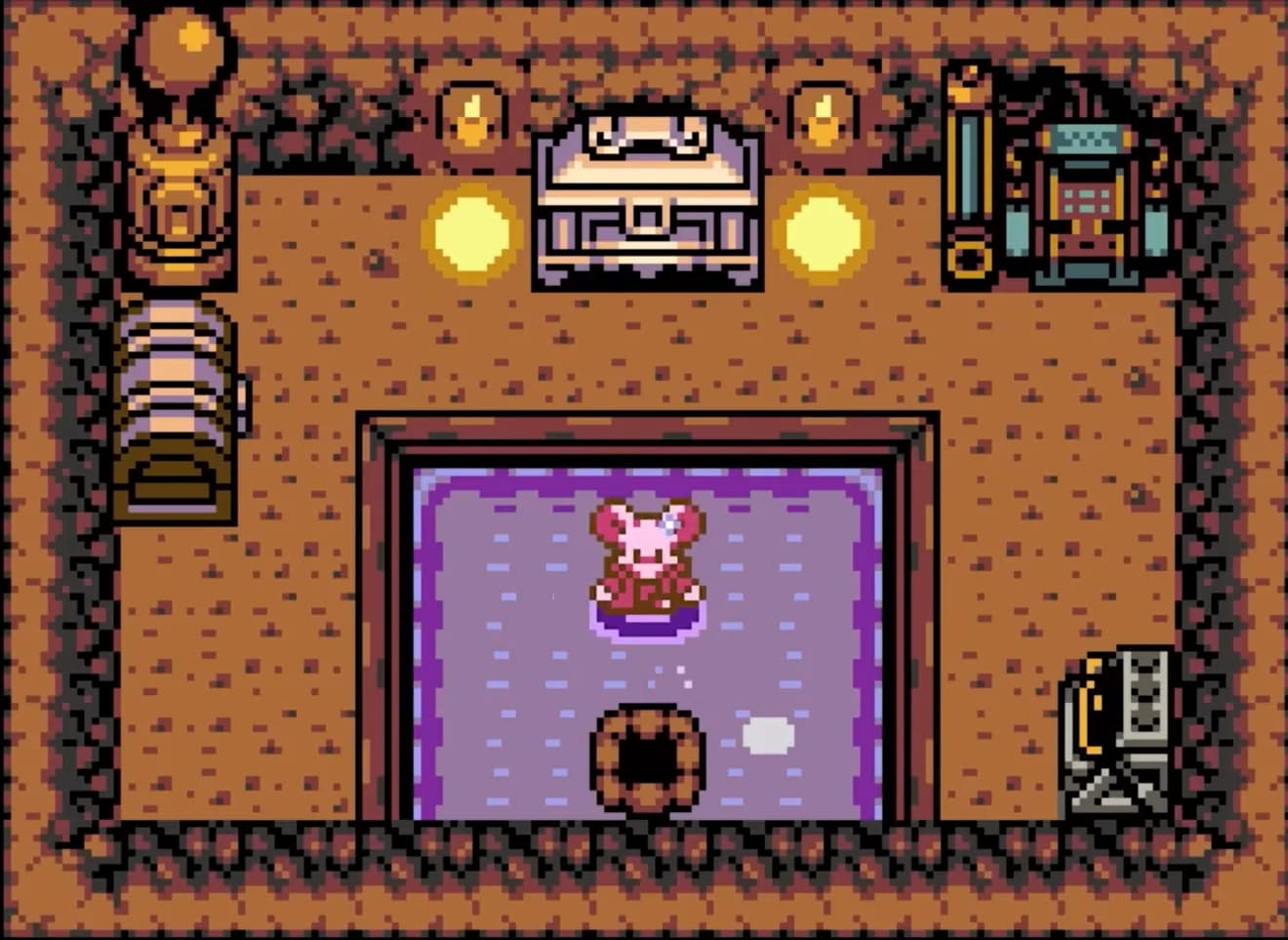
Yacht Club Games followed Shovel Knight with a gothic top-down adventure that some people scored a 9 and others could not wait to finish. Both reactions are right, and the reason why is the most interesting thing about it.
Developer
Yacht Club Games
Genre
Top-Down Action Adventure
Platforms
PC · Switch · Switch 2
Release
To be announced
Written by
Developer · Game Reviewer
Kaushik Hirpara is a full-stack developer and game reviewer at Unihfy Games. He does most of the work of bringing games to the site — adapting them to run properly in a browser, getting them working on phones, playing them, and writing up what players need to know.
Mina the Hollower finished third in this year's biggest player poll and picked up some of the highest review scores of 2026. It has also been called overrated by people who finished it and did not enjoy the last few hours. We have seen the same game described as a masterpiece and as a frustrating exercise in archaic design, and after playing it, we think both descriptions are accurate.
Here is why. Yacht Club Games did not make a game that looks like a Game Boy game. They made a Game Boy game. The four-direction attacks, the punishing knockback, the screens that reset when you fall, the grind before you are strong enough to survive — none of that is an accident or an oversight. It is the genre, faithfully rebuilt, including the parts that people have spent thirty years quietly agreeing were annoying.
Whether that is a triumph or a mistake depends entirely on what you wanted. What we can tell you is that this is the most beautiful, most confident, most irritating game we have played this year, and that there is a menu buried in the options that can change almost all of it.
The Basics
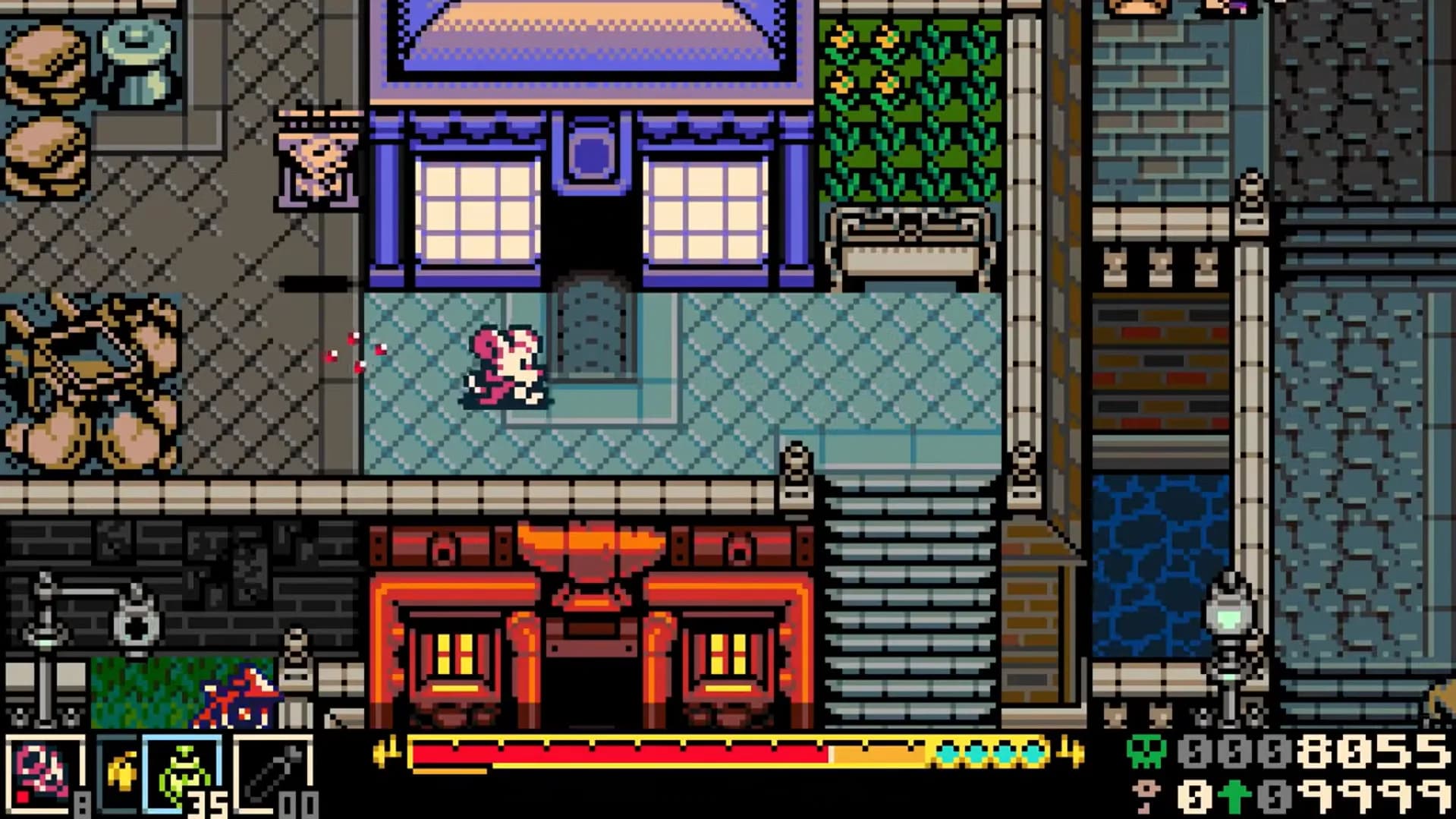
Start with the part nobody argues about. This is one of the best-looking pixel art games ever made, and the detail is genuinely absurd. Roof tiles. Gravel on a pavement. Character portraits. NPCs walking their own routes through the capital who you will stand and watch out of pure curiosity. It uses a Game Boy Color palette and it is doing things with that palette that no actual Game Boy Color game could have dreamed of.
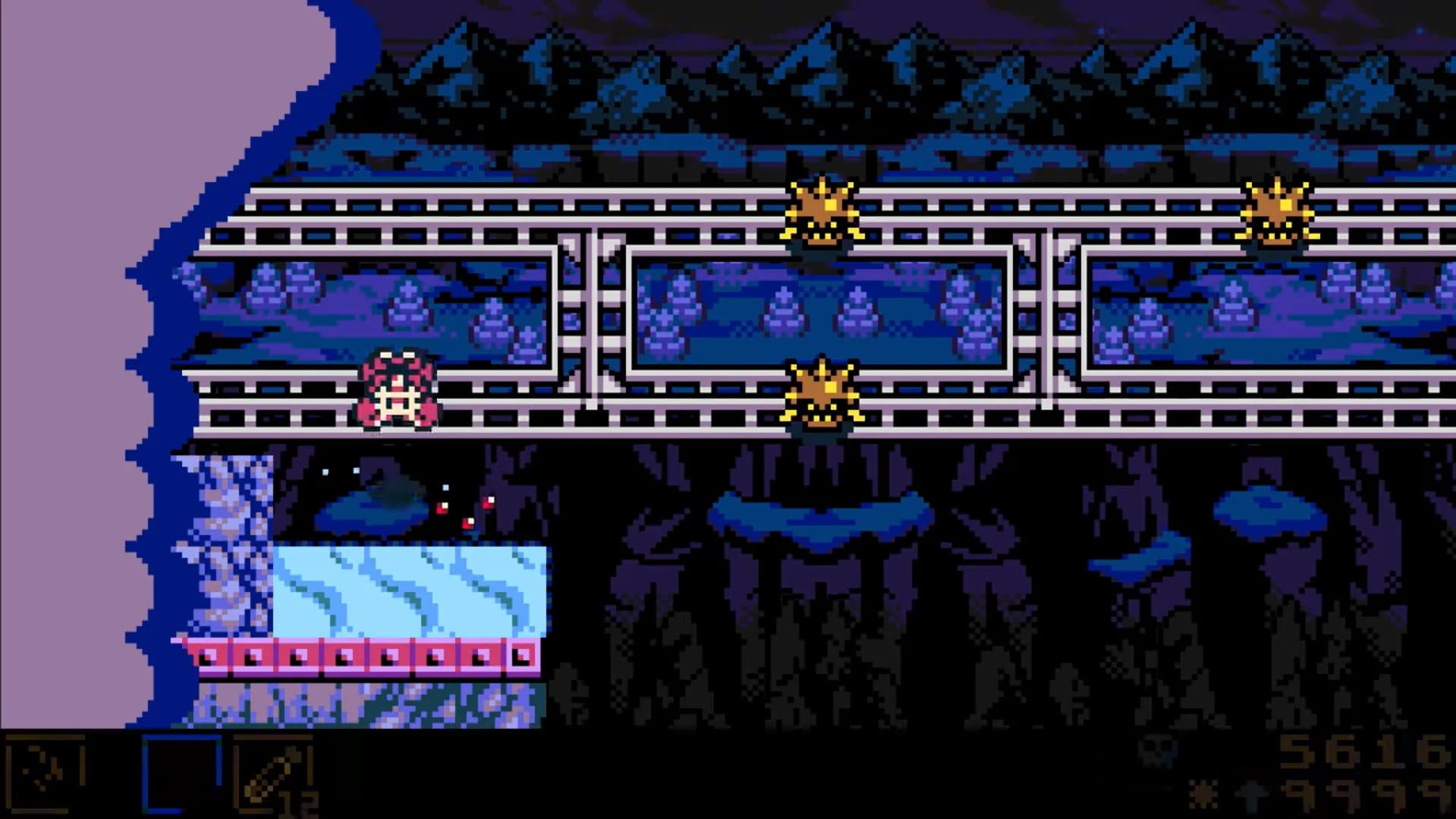
The regions are all mechanically and visually distinct. A swamp with water levels that rise and fall. An autumn town where the wind decides whether your jump lands. A graveyard that descends into a ruined underground palace. The dead insides of something enormous. Each one has its own rules and its own look, and the art is doing half the level design's job, telling you where you can burrow and what you can break without ever putting an icon on it.
The music matches it. Jake Kaufman is back from Shovel Knight, this time working with Yuzo Koshiro of ActRaiser and Streets of Rage, and the result is chiptune that carries the mood of each region without ever drowning out what you are doing. We noticed the boss themes before we noticed the bosses.
The writing is better than it needs to be too. Mina is an inventor whose own spark generators have failed across the island, and she has been called back by an old friend who is behaving oddly about it. It is a straightforward setup surrounded by genuinely strange side material — a possessed house that tries to crush you, farmers slowly turning into tomatoes, a funeral held for a sentient leaf that you personally landed on. It knows exactly when to be silly and when to stop.
The Big Picture
Mina wears its influences openly, and understanding which part came from where explains a lot about why it feels the way it does.
Specifically Link to the Past and Link's Awakening. The top-down structure, the interconnected island, the hidden paths on almost every screen, and a jump button that feels lifted straight out of the Roc's Feather.
The European gothic setting, the whip as your default weapon, and a tone that treats monsters as tragic as often as it treats them as targets.
Bones as a currency you drop on death and can lose permanently if you die again before retrieving them. A looping map that folds back on itself. Bosses that expect near-perfect play.
Trinkets that give passive buffs and can be combined. They are closer to loadouts than builds, because nothing here is especially complicated, but the combinations matter.
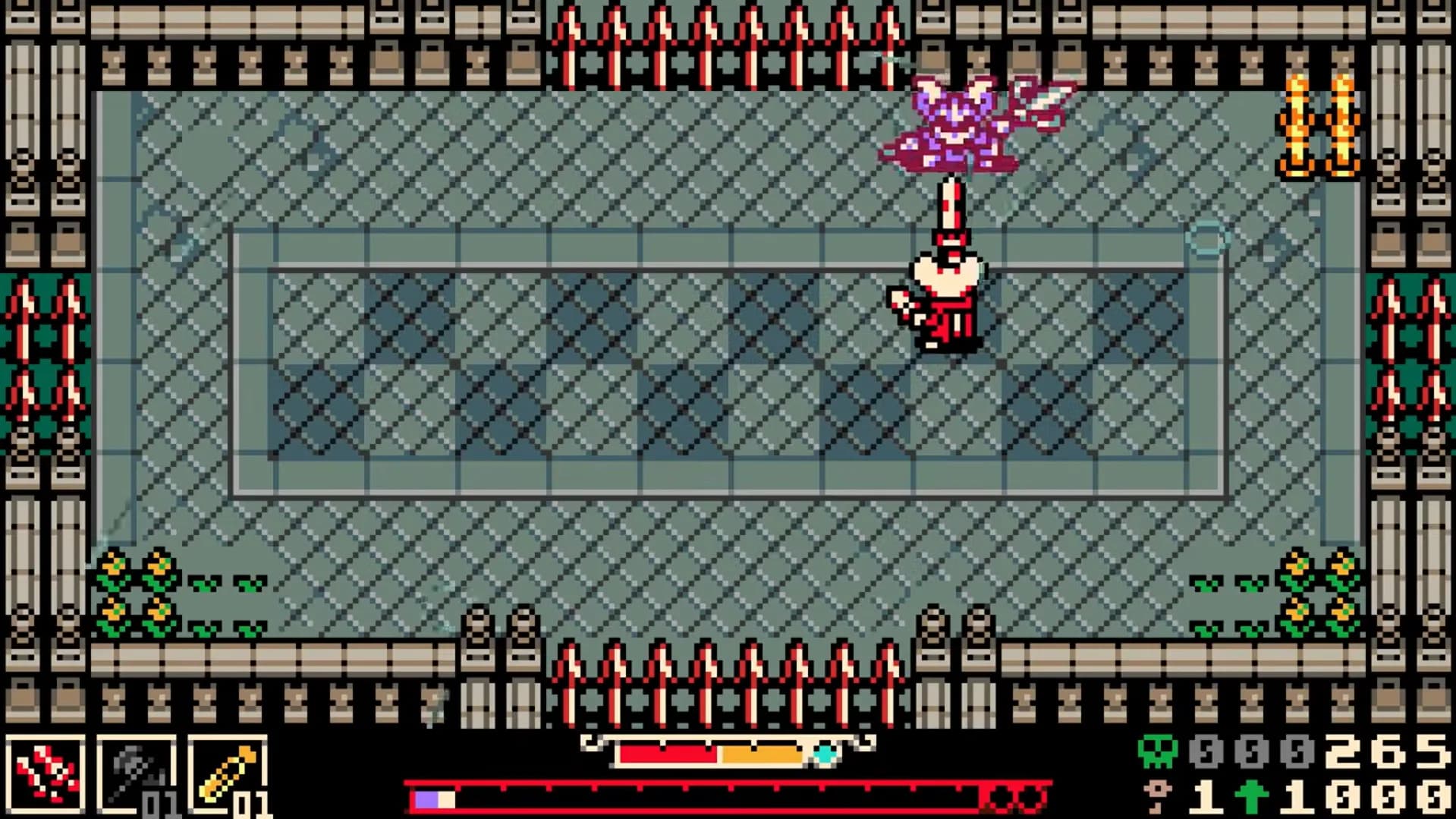
Mina can burrow into the ground and burst back out, launching herself into the air. That single move is the whole game. It is your dodge, it is your jump, it is your traversal, and it is how you get behind things. Burrowing away from something as it swings, coming up behind it and catching it with the whip is a genuinely great feeling, and the game keeps finding new uses for it — swimming through a bayou, timing a launch against the wind, cutting up through a forest canopy.
The combat around it is deliberately simple. You attack in four directions. That is it. Enemies, meanwhile, come at you from every angle they like, and if something approaches from the top-right you have no clean answer to it. Some weapons and sidearms partially solve this, but not many, and it never stops feeling like a restriction rather than a design choice. This is the single most divisive thing in the game and it is worth being clear about: it is not a bug, it is fidelity to an era, and whether you can accept that is going to decide your entire experience.
Healing is the other sticking point. Damaging enemies fills a yellow recoverable portion of your health bar, which you then convert with a vial — but using a vial means disengaging, and plenty of enemies close that gap faster than you can drink. The intention is clearly Bloodborne's rally system, where aggression is its own reward. In practice it often becomes hit something twice, retreat, apologise, drink, return. It works. It is just never as satisfying as the thing it is imitating.
A chain whip, and the most complete weapon in the game. Good reach, good speed, and it makes you feel like a Belmont, which is clearly the point. If you are not sure what to commit to, commit to this.
A defensive coffin that parries. Landing a clean parry and firing back the counterattack is the single most satisfying moment the combat system produces, and it partially fixes the four-direction problem by making enemy approach angles matter less.
Fast dagger-based attacking. Lower reach and lower damage, but the attack speed means you build recoverable health quickly, which takes real pressure off the healing system.
Slow, heavy and enormous when it lands. Excellent against anything that stands still. A liability against anything that does not, which unfortunately is most of the island.
Projectile-focused, and the most situational of the set. Genuinely useful for the aerial enemies that the four-direction melee handles badly, and not much use for anything else.
The platforming is the problem. Not the jumping itself, which is fine, but what happens around it. Enemies knock you a long way when they touch you, and there are a great many pits, and the two facts combine constantly. You will be crossing a difficult stretch, something will fly into you, and you will lose the screen. Then you do it again.
Several later areas also stack their gimmicks past the point of fun. One region asks you to judge the wind before every leap. Reasonable. Then it adds lightning that you have to shelter from on a timer. Then it adds indestructible balls that chase you. Then it puts all three in the same room before a boss, with a hazard that can throw you back to the beginning of the section. There is a dark area navigated by following a firefly whose light is also perfectly capable of knocking you into a pit. These are not hard in an interesting way. They are hard in an exhausting way.
The spark generator towers, which are meant to be each region's climax, have the same issue. You climb in one go while a surge chases you from below, burrowing into circuits to clear the way, and the horizontal movement is fiddly exactly when precision matters most. Get caught and you go back to the bottom.
And the ending does not land. The final region is the weakest in the game by a distance, arriving after most people will already feel the game should have wrapped up, and the final boss is a long, spongy fight that expects near-flawless execution. We finished it feeling relieved rather than triumphant, and that is the opposite of what this kind of game is supposed to do.
A cosy nostalgia trip through a prettier version of the past.
One of the hardest games of the year. Bosses expect near-perfect play and the early hours will kill you repeatedly while you are still too weak to fight back properly.
Eight-bit visuals mean simple systems underneath.
Five distinct main weapons with upgrade paths, a full sidearm set, trinkets that combine, a levelling currency and a healing economy. It is far deeper than it looks.
No map and no quest markers means glorious freedom.
It means genuine freedom and also genuine wandering. You will spend a while walking between the hub and paths you cannot open yet before it clicks that nearly every screen is hiding something.
Turning off fall damage in the options fixes the platforming.
It removes the damage but you still get returned to the start of the section, which is the part that actually costs you time. It helps. It does not solve it.
A high review score means the game is universally loved.
Scores on this one ranged from near-perfect to distinctly unimpressed, and the split is almost entirely about tolerance for old-school punishment rather than disagreement over quality.
There are over ninety modifiers in the options, they can be switched on or off at any point, and they change nearly every complaint in this review. Walk over pits and the platforming problem disappears. Increase the bones you earn and the early grind disappears. Slow the game down, raise your damage, lower theirs, give yourself a bigger jump. There is even a favourites system because there are too many to scroll. The only cost is achievements, and there are modifiers that make the game harder too, so this is not simply an easy mode. Our honest advice: play it straight until something stops being fun, then turn that one thing off. The game is clearly built expecting you to, and refusing on principle is how people end up giving up four hours from the end.
"Yacht Club did not make a game that reminds you of the Game Boy. They made one that remembers exactly how it felt, including the bits you had forgotten on purpose."
Our Verdict
A gorgeous, deep, uncompromising love letter to top-down action adventures that recreates the era so faithfully it inherits its frustrations too, rescued by a modifier menu generous enough to let you fix whichever part is ruining it for you.
What Works
What Concerns Us
Who It's For
Anyone who genuinely loved Link's Awakening and Castlevania and wants that exact feeling rebuilt with modern polish. Also anyone happy to use the modifiers, because with three or four of them switched on this becomes a much easier game to recommend without caveats.
Who Should Wait
People who bounce off precision platforming, and anyone expecting Shovel Knight's carefully balanced difficulty. This is a harsher, less forgiving game than that one. If you refuse to touch difficulty options on principle, the last few hours are likely to sour the whole thing for you.
How We Reviewed This
This is a review of the finished, released game. We played through the main campaign, reignited every spark generator, and spent time with the post-game content and the modifier menu. The opinions here are ours and the wording is ours. This game has produced an unusually wide spread of reactions, from near-perfect scores to open disappointment, so rather than pick a side we have tried to explain what each camp is actually responding to — in our view it is the same set of design decisions being valued differently, not a disagreement about facts. Place names in this article follow the spellings used in the game's own text. Prices and platform availability change, so treat those as accurate at the time of writing. All images on this page are in-game screenshots captured from the released version during our review. We have not used AI-generated artwork or promotional renders in place of gameplay.
Reviewer
Time with the released version on PC and Switch 2
Official
In-game modifier menu, manual and post-game content
Store
Storefront listings, pricing and platform availability
Community
Player discussion around difficulty, platforming and scoring
Opinions reported by other reviewers and players are attributed as theirs. Read our review process for how we handle games we cannot test ourselves.
Game Reviews
Seven months into 2026 and the year looks nothing like the one everybody predicted in January. Here are the seven games that actually mattered, why the lists and the players disagreed so badly, and what else is worth your time.
Game Reviews
A hide-and-seek game where you paint yourself into the wall. It is rough, it is cheap, nobody saw it coming, and it is one of the most fun things released in 2026. Here is what it actually plays like.
Game Reviews
Critics gave Crimson Desert middling scores. Players put it in 2026's top five anyway. Having spent a very long time in it, we think both camps are describing the same game — they just stopped playing at different points.
Game Reviews
Requiem splits itself between a terrifying stealth game as Grace Ashcroft and a chainsaw-swinging action game as Leon Kennedy. Both halves are excellent. Whether they belong in the same game is the real question.
Continue Exploring
Browse more game coverage, jump into browser games, or test yourself in Quiz Arena.