01
Step 01
The smoke goes down
A smoke pod kills everyone's vision for a few seconds. You are not hiding, you are buying room to work.
No games found
Unihfy Games
Loading identity...
Quick Access
IO Interactive built a Bond game on Hitman's foundations and then made sure it plays nothing like Hitman. A review of the stealth, the improvised brawling, the Q Lab, and the one thing everybody argues about.
Developer
IO Interactive
Genre
Third-Person Stealth Action
Platforms
PC · PS5 · Xbox Series
Release
To be announced
Written by
Developer · Game Reviewer
Kaushik Hirpara is a full-stack developer and game reviewer at Unihfy Games. He does most of the work of bringing games to the site — adapting them to run properly in a browser, getting them working on phones, playing them, and writing up what players need to know.
The worry was obvious the moment this was announced. IO Interactive has spent well over a decade building one very specific thing — enormous social sandboxes where you circle a target, learn a routine, and eventually kill someone with a chandelier. James Bond is a bald assassin's opposite in almost every way that matters. He is loud, he is charming, he gets recognised, and he is frequently in a fight he did not plan.
So the reasonable prediction was Hitman with a nicer suit. That is not what this is. First Light borrows IO's level design instincts and then spends the rest of its runtime building something the Hitman games have never had, which is a proper melee combat system with real physicality in it. And the strange, brilliant result is that this is a stealth game that gets better when the stealth fails.
It is also an origin story, which is usually a warning sign, and here it is not. This is the second most popular game of the year with players for a reason. It understands that being Bond is not a set of skills but a way of behaving when things have already gone wrong.
The Basics
It is more than an hour before you go on a proper mission. There is training, there is recruitment, there is a montage. A lot of people are going to bounce off that, and if you want to be shooting inside five minutes you should know it going in.
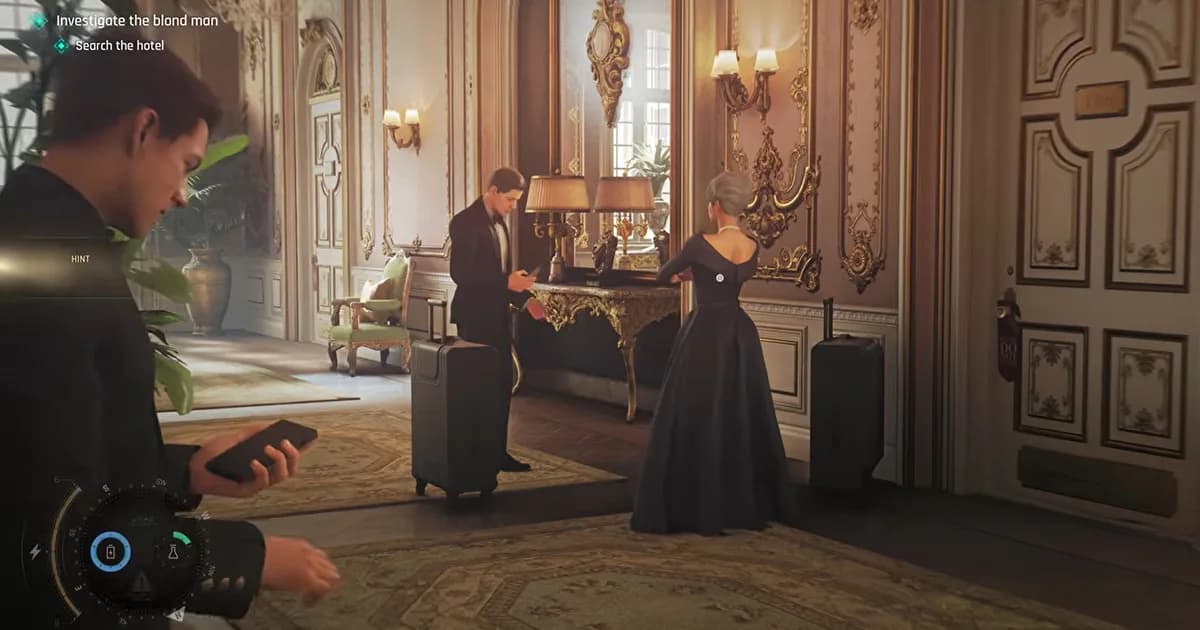
We think it is the right call. First Light is trying to show you a Bond who is not finished yet, and that only works if the game is willing to spend time on him before he has the gadgets and the confidence. The version of Bond you get here is cocky rather than composed, and you can see the iron discipline of the older character starting to form underneath rather than arriving fully assembled. Patrick Gibson plays him as clever, a little reckless and constantly amused by himself, and the quips land, which is genuinely difficult to pull off in 2026 without becoming insufferable.
The game also keeps stopping between missions for quieter scenes. Moving into a shared flat with other new agents. A night out. Dropping your boss at a London pub. None of it is gameplay in any meaningful sense and all of it is doing real work, because by the time the back half of the story starts pulling people apart you actually know who these people are. Very few action games bother with this any more.
Setup
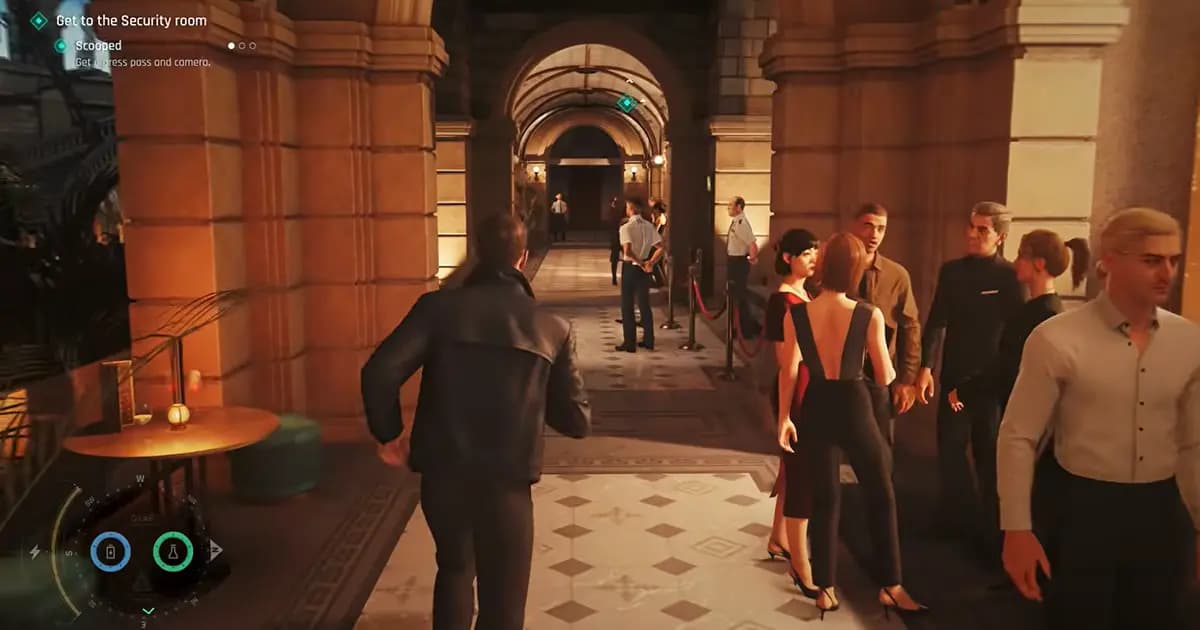
You have picked a pocket, walked through a door you should not have, and a guard has just turned round and clocked you standing somewhere no guest should be.
What We Thought
In almost any other stealth game this is over. The alarm goes up, the level resets around you, and you reload a save from four minutes ago while quietly resenting the whole genre.
What We Realize Now
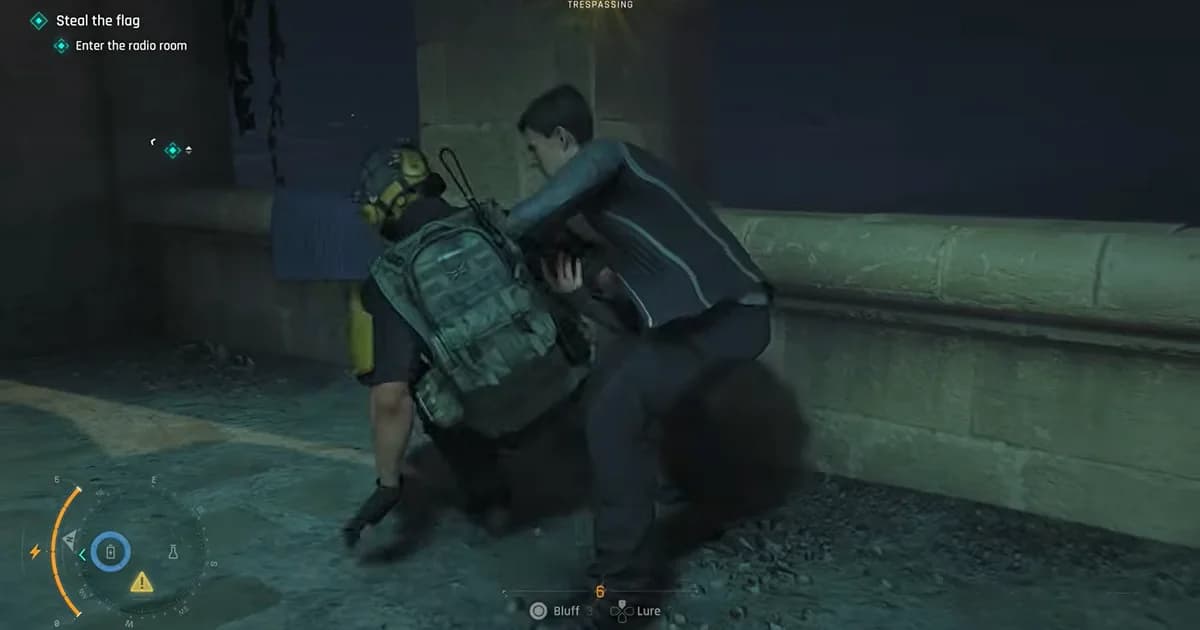
Bond talks. You spend a bluff, he says something confident and slightly stupid, and the guard hesitates. It buys you seconds, not safety — certain enemy types cannot be bluffed at all, you only have so many uses, and the window is short. But it turns being caught into a problem you play through rather than a mistake you undo, and it is the single smartest thing in the game.
Here is the thing nobody expected from an IO Interactive game. The stealth is very good. The fighting is better.
On paper the melee is basic. Yellow means parry, red means dodge, and the punches themselves are simple and would get repetitive on their own. What makes it sing is that almost everything in the room is a weapon and almost every enemy is an object. You can grab a man and shove him across a table. You can throw him down a vent shaft or into a server rack and watch it finish the job. You can pick up a bottle, a snooker ball, a brick, a dropped pistol, and throw any of them. You can shoot a gun out of someone's hands and catch it out of the air.
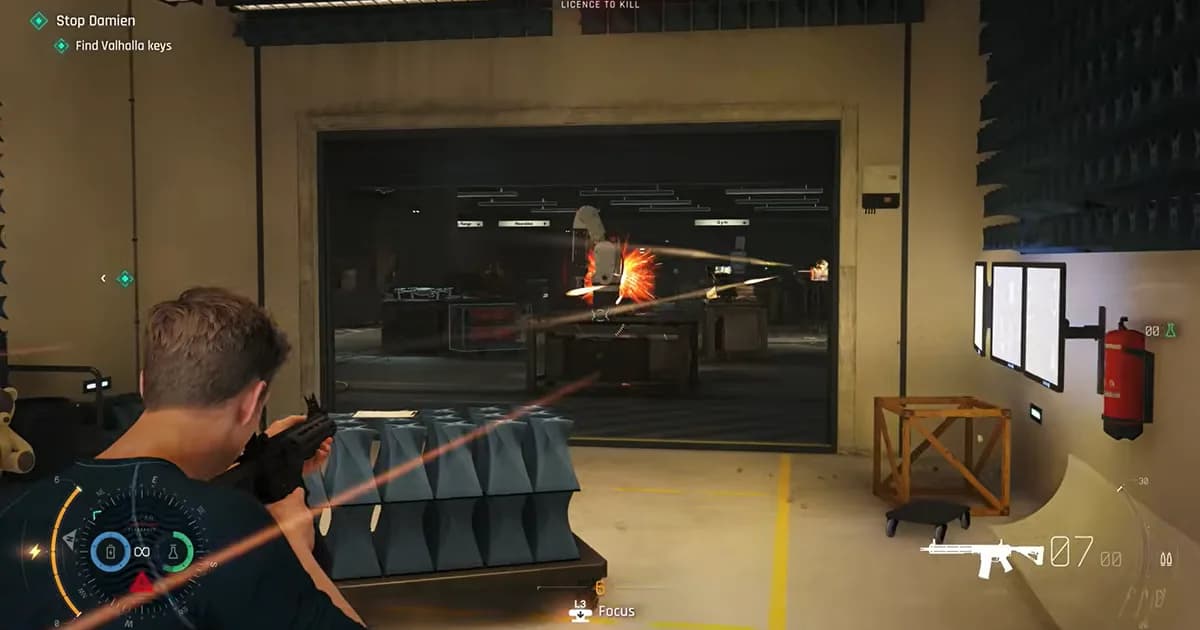
Ammunition is deliberately scarce, so you are never allowed to settle into being a shooter. You empty a pistol, throw it at someone's head, take three men apart with your hands, pick up whatever the last one dropped, and repeat. It is improvisational in a way that very few big-budget action games manage, and after fifteen hours we were still not bored of it. Getting caught stopped feeling like failure about three missions in and started feeling like permission.
How It Flows
None of this is scripted. This is a normal encounter in a normal room, built entirely out of whatever happened to be lying around.
A smoke pod kills everyone's vision for a few seconds. You are not hiding, you are buying room to work.
Bare hands, no noise, while nobody can see far enough to help them. This is the only calm part of the next thirty seconds.
One shot into something explosive takes a third man off his feet and tells the rest of the building exactly where you are.
Grab the nearest one, shove him over a crate, hit him in the back. He is no longer a threat and he was briefly a very effective piece of furniture.
The pistol is empty. It is now a thrown object. The man you throw it at drops his own gun, which you catch on the way past.
A brick to stun, a grab, and a short trip over the nearest railing. Then you straighten your jacket and go back to being subtle.
Brand new recruit, extremely sure of himself
Patrick Gibson plays him as clever and a bit reckless, with the discipline still forming. The quips are Roger Moore silly and somehow never annoying, which is the hardest trick in the game.
Mentor and handler
The best character in the game and it is not close. Lenny James gives him a weight that the plot leans on repeatedly, and every scene he is in is better than the scenes he is not.
Quartermaster
Reworked into someone genuinely cool rather than a fussy man handing you a pen. The lab is his character more than his dialogue is, and it is full of prototypes you can pick up and set off.
The boss
The weakest of the returning names for us. Present, functional, and never given a scene that justifies the character's history the way Greenway's are.
MI6 supporting staff
Both good, both underused. This is a long game and there was room to give at least one of them a proper thread of their own.
The driving is the biggest miss. Not the truck sequences, which are loud, destructive and exactly right — the sports car sections. Handling is floaty and arcade-ish in a year that also gave us Forza Horizon 6, and the fantasy of properly throwing an Aston Martin around never quite arrives. There is not much driving in the game overall, which softens it, but it is the one part that clearly needed another pass.
There is also one level that is padded. You will know it when you reach it, because everything around it is sharper. And the game joins a long, baffling tradition of big third-person action games that build excellent boss encounters and then whiff the final one. We liked the ending. The fight in front of it was the least interesting thing in fifteen hours.
Smaller things add up too. The gadget icons are genuinely poorly designed and take hours to learn, which is a real accessibility problem rather than a nitpick. There are more quick-time events than anyone asked for. The takedown input is an odd two-button combination. There is a lot of yellow paint telling you where to climb. And the camera gets confused in tight corridors, which is unfortunate in a game that wants you to fight in them.
Floaty and unsatisfying, and it undercuts one of the most recognisable things about the character. Saved from being worse by how little of the game it occupies.
A flat note right at the end, after a run of genuinely inventive set-piece encounters. It does not ruin the ending but it definitely deflates it.
Unreadable for the first several hours. If you are colourblind or dyslexic this crosses from irritating into an actual barrier, and it would have been a cheap fix.
Noticeably longer and less clever than everything around it. Not bad, just conspicuously ordinary in a game that is otherwise never ordinary.
There are more than there need to be, and none of them make a set piece better than it would have been without them.
Occasionally loses the plot in narrow spaces. Annoying rather than damaging, but it happens in exactly the situations where the combat is most fun.
We have seen this game praised for having smarter guards than almost any stealth game around, and criticised for having guards who are easily duped and inconsistent. Having played it, both readings are defensible and it depends heavily on difficulty. On the lowest setting the AI is generous to the point of being silly. On the highest it is genuinely attentive — bodies get noticed, one distraction can pull two guards instead of one, and improvising stops being optional. If you have played stealth games before, start on hard. The entire design assumes you are being pushed, and on easier settings you will never see the systems do their best work.
"Most stealth games punish you for being seen. This one hands you a bottle, points at the nearest server rack, and asks what you are going to do about it."
First Light is fifteen to twenty hours long and it costs full price, which has generated the usual argument. We think the argument is tired. This is a linear, story-led game with no filler in it except one level, and comparing it to a two-hundred-hour open world on a cost-per-hour basis is comparing two completely different things. Crimson Desert is enormous and Crimson Desert is also a mess. Length is not quality and it never was.
There is more here than the story anyway. Missions genuinely support being replayed a different way, though not to the extent Hitman does — you get a solid handful of approaches per level rather than dozens. More interesting is TAC-SIM, a separate challenge mode that drops you into combat and stealth scenarios with modifiers, scores you, and pays out points towards weapons, gadget upgrades and outfits. It has its own hub area. It is much better than a bolted-on extra has any right to be, and since the combat is the most replayable part of the game, it is aimed at exactly the right thing.
If IO supports it even a fraction as well as it supported Hitman, this becomes something people are still playing in two years. Driving challenges are already teased in the menu, which is either encouraging or slightly funny given that driving is the weakest part of the game.
Our Verdict
The best James Bond game ever made, built on Hitman's foundations and then pushed hard in the opposite direction, with improvised close-quarters fighting so good that getting caught becomes the reason to keep playing.
What Works
What Concerns Us
Who It's For
Bond fans first, obviously, but also anyone who wants a big third-person action game with actual craft in it. If you like Hitman's setups but always found its combat a chore, this was built for you specifically. It is also a completely reasonable entry point if you have never played an IO game in your life.
Who Should Wait
Anyone who wants Hitman's depth of replayability, because this is a story first and a sandbox second. If you need forty-plus hours to justify a full-price purchase, this is not going to change your mind. And if an hour of setup before the first mission sounds unbearable, that hour is not optional.
How We Reviewed This
This is a review of the finished, released game. We played the full story on PC and spent additional time in the challenge mode and replaying missions with different approaches. The opinions here are ours and the wording is ours. Where the game divides people — the length-versus-price argument and the quality of the enemy AI in particular — we have set out both positions and explained where we think the disagreement actually comes from, rather than picking whichever side was easier to write. Nothing in this article spoils a story beat. We tested on PC only, so we cannot speak to console performance, and you should read more than one review before buying on any platform. All images on this page are in-game screenshots captured from the released PC version during our review. We have not used AI-generated artwork or promotional renders in place of gameplay.
Reviewer
Time with the released version on PC
Official
IO Interactive announcements, patch notes and in-game material
Store
Storefront listings, pricing and platform availability
Community
Player discussion around length, difficulty and the ending
Opinions reported by other reviewers and players are attributed as theirs. Read our review process for how we handle games we cannot test ourselves.
Game Reviews
Seven months into 2026 and the year looks nothing like the one everybody predicted in January. Here are the seven games that actually mattered, why the lists and the players disagreed so badly, and what else is worth your time.
Game Reviews
Requiem splits itself between a terrifying stealth game as Grace Ashcroft and a chainsaw-swinging action game as Leon Kennedy. Both halves are excellent. Whether they belong in the same game is the real question.
Game Reviews
Critics gave Crimson Desert middling scores. Players put it in 2026's top five anyway. Having spent a very long time in it, we think both camps are describing the same game — they just stopped playing at different points.
Game Reviews
Horizon 6 was ranked last on one thirty-game hype list before release because everyone assumed it would just be fine. It is not fine. The Japan map is the best thing Playground Games has ever built, and the reason why is not the size of it.
Continue Exploring
Browse more game coverage, jump into browser games, or test yourself in Quiz Arena.