2012
2012M01
Forza Horizon
Colorado. The festival idea arrives — a racing game built around driving somewhere rather than around a track. Promising and rough.
No games found
Unihfy Games
Loading identity...
Quick Access
Horizon 6 was ranked last on one thirty-game hype list before release because everyone assumed it would just be fine. It is not fine. The Japan map is the best thing Playground Games has ever built, and the reason why is not the size of it.
Developer
Playground Games
Genre
Open World Racing
Platforms
PC · Xbox Series
Release
18 May 2026
Written by
Developer · Game Reviewer
Kaushik Hirpara is a full-stack developer and game reviewer at Unihfy Games. He does most of the work of bringing games to the site — adapting them to run properly in a browser, getting them working on phones, playing them, and writing up what players need to know.
Before release, one prominent rundown of 2026's thirty biggest open world games put Forza Horizon 6 in thirtieth place. Dead last. The write-up amounted to a shrug: unless something catastrophic happens, it will probably be excellent. Nobody was wrong about that. Everybody was wrong about how much it would matter.
Because this is not just another good Horizon game. Having spent a serious amount of time with it, we think it is the best one Playground Games has made, and one of the two or three finest things released this year. It does not reinvent anything. It does not need to. What it does instead is take a formula the studio has been sharpening since 2012 and finally give it a setting worth all that sharpening.
There is a lesson buried in this that 2026 kept teaching. Reliability gets punished by hype cycles. A series that delivers every single time becomes boring to write about, so it slides to the bottom of the list, and then the actual game arrives and is better than most of the things people were excited about instead.
The Basics
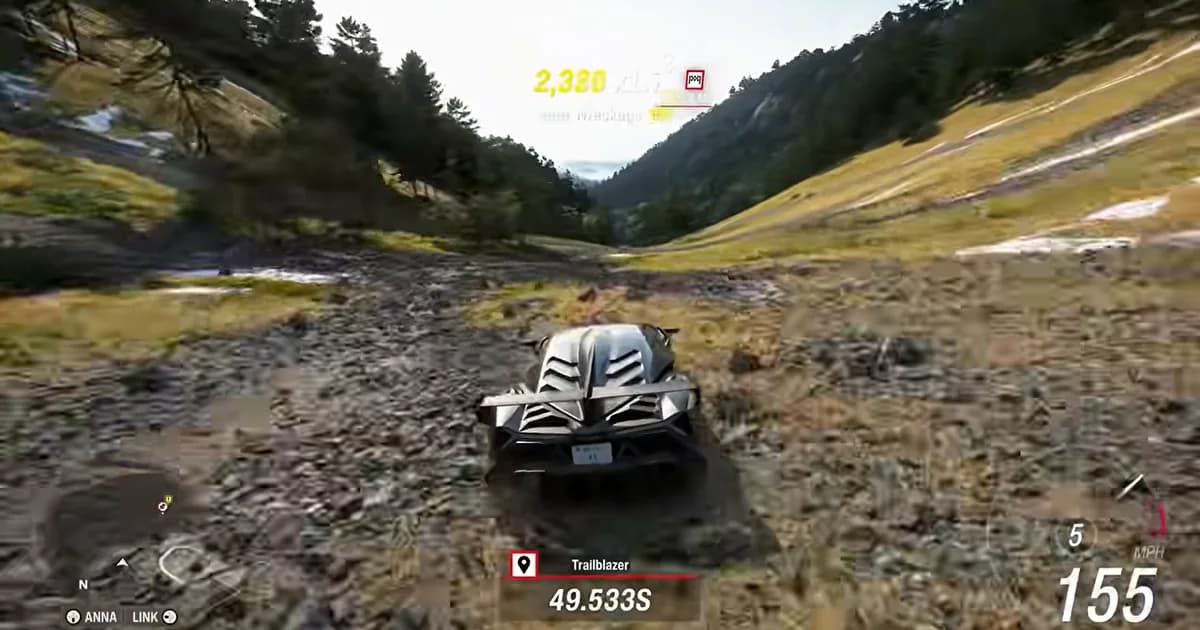
Here is the single most interesting thing about Forza Horizon 6, and almost nobody is talking about it. The Japan map is not dramatically larger than Horizon 5's Mexico. It feels roughly twice the size, and the reason is elevation.
In Horizon 5 you could pick a point on the far side of the map, aim your car at it, and drive there in a straight line, ignoring the roads entirely, because the terrain was flat enough to permit it. You cannot do that here. Mountains, ravines, sheer drops and switchbacks stand in the way constantly, so getting anywhere means actually following a road. That one decision changes everything downstream. Journeys take longer, roads matter, corners matter, and the map stops being a surface you cross and becomes a place you navigate.
On top of that it is dense in a way the series has not attempted before. Villages, petrol stations, temples, castles, farms, houses — there is always something in your eyeline. The game tracks every road you have driven for the first time and turns discovery into its own quiet progression system, and it works, because the roads themselves are worth discovering. Curves that beg to be taken at speed, shortcuts that only reveal themselves once, mountain passes that are essentially purpose-built drift courses at night.
Tokyo is the showpiece and it earns it. It is the largest and most carefully built urban environment the series has produced, with Tokyo Tower, Shibuya Crossing and the rest present without feeling like a checklist. Our one complaint is that it can feel slightly underpopulated — a city that dense deserves more traffic and more life moving through it. But the construction of the thing is outstanding.
Defining Moments
The reason Horizon 6 works is not innovation. It is the compound interest of six games spent refining one idea, each in a new place.
Colorado. The festival idea arrives — a racing game built around driving somewhere rather than around a track. Promising and rough.
Southern Europe. The open world opens properly, seasons and weather start mattering, and the series finds the tone it has kept ever since.
Australia. The variety of terrain jumps sharply, and the showcase events — racing aircraft, trains, anything ridiculous — become the series calling card.
Britain. Full seasonal rotation across a shared world. Structurally the most experimental entry, and the one that made the festival feel permanently alive.
Mexico. Enormous, beautiful, and so free-form that it could overwhelm you in the first hour. Still looks superb five years on, which is why 6 does not feel like a huge visual leap.
Japan. The setting fans have asked for since the beginning, a return to structured progression, and the best map the studio has ever built.
A lot of games move to a new country and change the scenery. Horizon 6 built event types around where it is. That distinction matters more than it sounds.
The progression around them is the wristband system returning from earlier entries, which means you work up through class tiers rather than being handed everything at once the way Horizon 5 did. It is more structured and it is the right call. Horizon 5 could dump the entire map on you in the first hour, which sounds generous and in practice was paralysing. Here there is always an obvious next thing without ever feeling like you are being marched.
The other quiet improvement is fast travel. The collectible boards are gone entirely. Drive a road once and you can fast travel along it for free, no property purchase required, no hunting down boards with a guide open in another window. It is the kind of change that sounds administrative and removes a genuine annoyance from every previous game in the series.
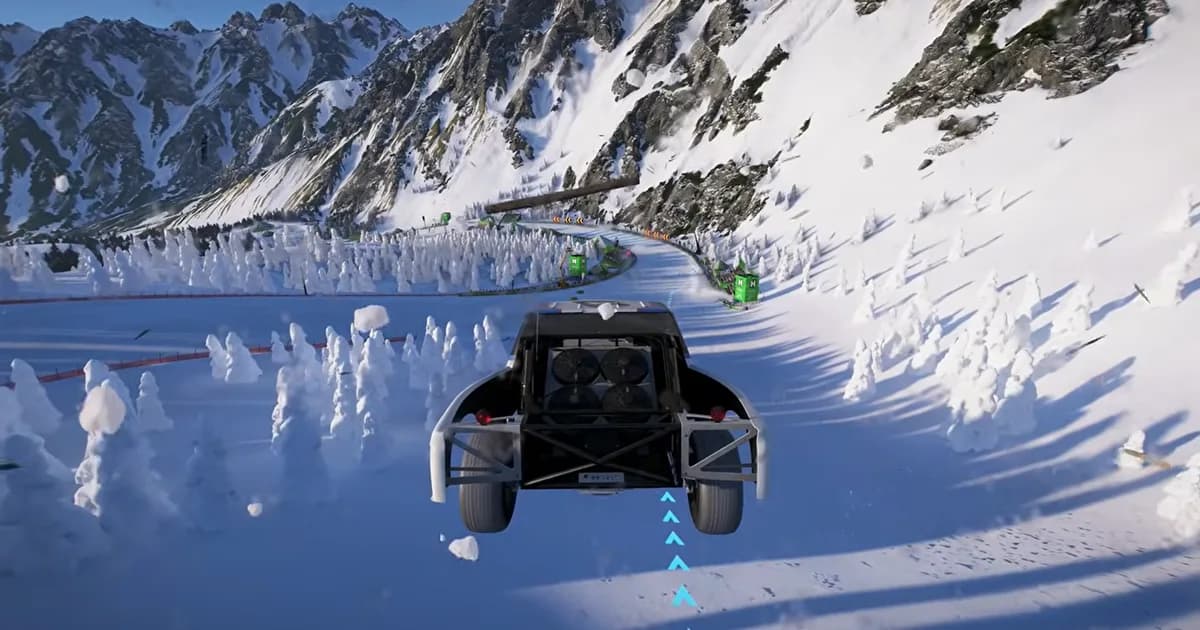
One-on-one downhill sprints on tight, winding mountain roads. The purest expression of what this map is for, and the events we kept going back to. Nothing else in the game asks for this much precision.
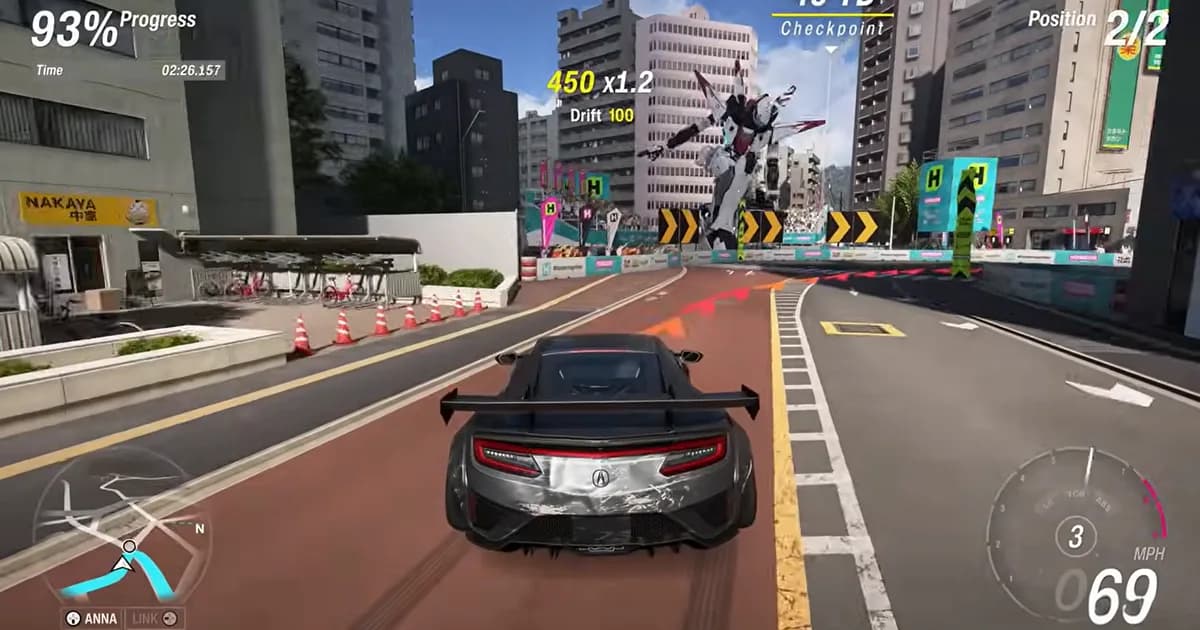
Still the series highlight and still gloriously stupid. Racing a giant mech is the headline; tearing through docks while shipping containers move around you is the one that actually got us shouting.
You drive a kei truck around completing delivery challenges, and the kei truck may genuinely be the most fun vehicle in a game with five hundred and fifty of them. Absolutely do not skip these.
Obstacle-course races on purpose-built technical courses. Excellent design work, and a good pressure valve when you want something tight after an hour of open-road cruising.
Guided tours through a region. Gentle, informative, and a smart way to push you into areas you would not have driven to. The weakest of the new set, but a pleasant thing to have.
The presentation is the same problem it has always been. You create a character who looks slightly wrong, and then two relentlessly upbeat racing acquaintances walk you through things in cutscenes that are stiff, oddly acted and impossible to care about. Horizon has been doing this for six games. It has never once improved. At this point we would genuinely rather it were removed than tolerated.
The radio is the other irritation. There is a good spread of English and Japanese stations and some genuinely great music on them, but the DJs talk constantly. Change the station and you get a DJ. Start a song and you get a DJ. It is a small thing and it grated on us long before the thirty-hour mark.
The property building is the most interesting near-miss. You now buy land rather than houses, and the toolset is enormous — tracks, dirt trails, drag strips, half-pipes, buildings, trees, entire street layouts, plus a fully customisable garage interior for displaying your cars. It is far more capable than anyone expected. The problem is that the game gives you almost no reason to use it beyond showing other players, and the tools are fiddly on a controller. The garage is the better half of the feature precisely because it is smaller and more focused.
Two smaller notes. The per-car skill trees are functional but dull, mostly stacking XP bonuses rather than anything that changes how a car drives. And there are manufacturers and individual cars missing that were present in earlier entries, which will annoy people with a favourite.
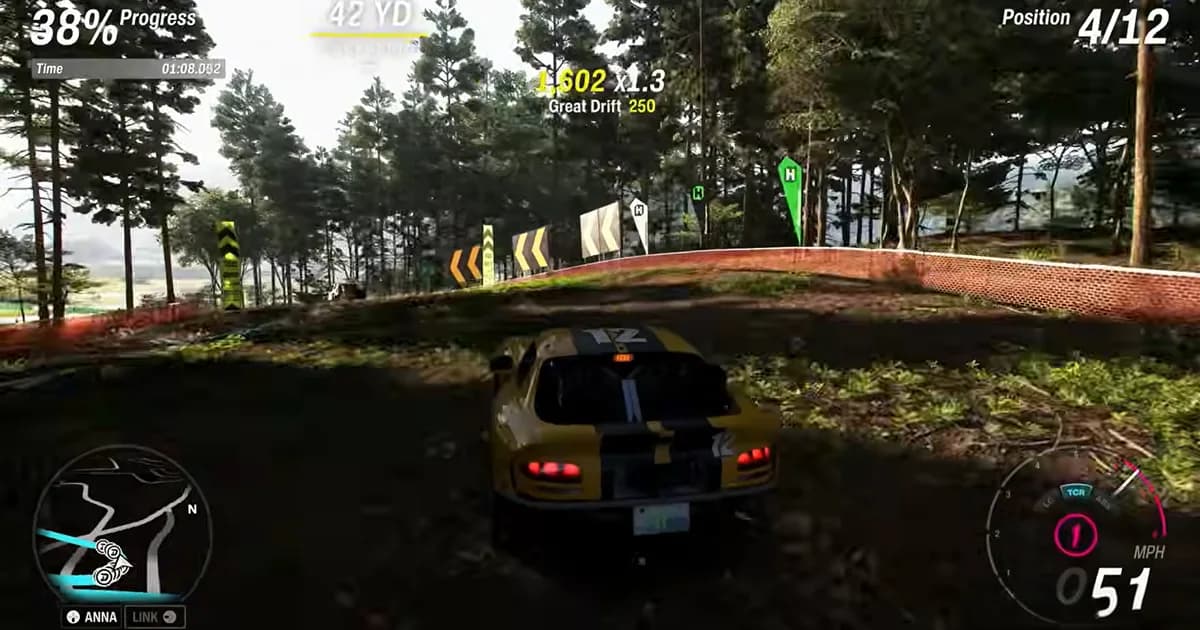
The race AI in Horizon 6 has been stepped up dramatically and this is the one thing likely to catch returning players out. In Horizon 4 and 5 the highest setting was called Unbeatable and was, with a well-built car, entirely beatable. Here it is not. Drive clean and the top-tier AI will simply be faster than you regardless of what you bring, and the only reliable way to win is to race dirty and shove people off the road. If you have muscle memory from previous games, start two settings lower than you think you need and work up. This is a genuine rebalance rather than a difficulty label, and nobody warns you about it.
"It does not reinvent anything, and it is superb. We have got so used to demanding novelty that we forgot execution was the hard part."
Our Verdict
The best game in a series that has been quietly excellent for fourteen years, carried by a Japan map whose elevation and density make it feel twice the size it actually is, and held back only by presentation nobody has liked since 2012.
What Works
What Concerns Us
Who It's For
Anyone who has ever enjoyed a Horizon game, and anyone who has never played one, since this is as good an entry point as the series has offered. If you have any interest at all in Japanese car culture, mountain roads or simply driving somewhere beautiful with the radio on, this is the easiest recommendation on our whole list.
Who Should Wait
People waiting for Horizon to reinvent itself, because this is emphatically evolution rather than revolution. And if you want a hardcore racing simulator, this is not that and has never pretended to be — though the assist settings go far enough that you can push it a surprisingly long way in that direction.
How We Reviewed This
This is a review of the finished, released game. We played on PC, worked through the wristband progression, and spent time on the new event types, the property tools and free exploration rather than only racing. The opinions here are ours and the wording is ours. Where the game divides people — chiefly the property building, which some find a generous new toolbox and others find an unmotivated distraction — we have explained both readings rather than picking one. We tested on PC only and cannot speak to console performance, so read more than one review before buying on any platform. The festival playlist content had not fully rolled out at the time of writing, so the amount of ongoing content will grow. All images on this page are in-game screenshots captured from the released PC version during our review. We have not used AI-generated artwork or promotional renders in place of gameplay.
Reviewer
Time with the released version on PC
Official
In-game progression, event types and property tools
Store
Storefront listings and platform availability
Community
Player discussion around difficulty and the festival playlist
Opinions reported by other reviewers and players are attributed as theirs. Read our review process for how we handle games we cannot test ourselves.
Game Reviews
Critics gave Crimson Desert middling scores. Players put it in 2026's top five anyway. Having spent a very long time in it, we think both camps are describing the same game — they just stopped playing at different points.
Game Reviews
Seven months into 2026 and the year looks nothing like the one everybody predicted in January. Here are the seven games that actually mattered, why the lists and the players disagreed so badly, and what else is worth your time.
Game Reviews
Requiem splits itself between a terrifying stealth game as Grace Ashcroft and a chainsaw-swinging action game as Leon Kennedy. Both halves are excellent. Whether they belong in the same game is the real question.
Game Reviews
IO Interactive built a Bond game on Hitman's foundations and then made sure it plays nothing like Hitman. A review of the stealth, the improvised brawling, the Q Lab, and the one thing everybody argues about.
Continue Exploring
Browse more game coverage, jump into browser games, or test yourself in Quiz Arena.