Unihfy Games

Complete Guide
Guides

Evolution of Online Games: From Simple Networks to Instant Browser Play

Explore how online games evolved from early networked computer experiments into today's connected ecosystem of multiplayer worlds, browser games, mobile play, cross-platform experiences, and live online communities.

Format

In-Depth Guide

Reading Time

12 min read

Published

July 4, 2026

Last Updated

July 4, 2026

Nikunj Hirpara

Written by

Nikunj Hirpara

Founder · CEO

Nikunj Hirpara is the Founder and CEO of Unihfy Games, where he leads the platform's direction, growth, and development as an online destination for browser games, quizzes, and gaming content.

View Author Profile

Gaming History

Online Gaming Grew Through Many Small Revolutions

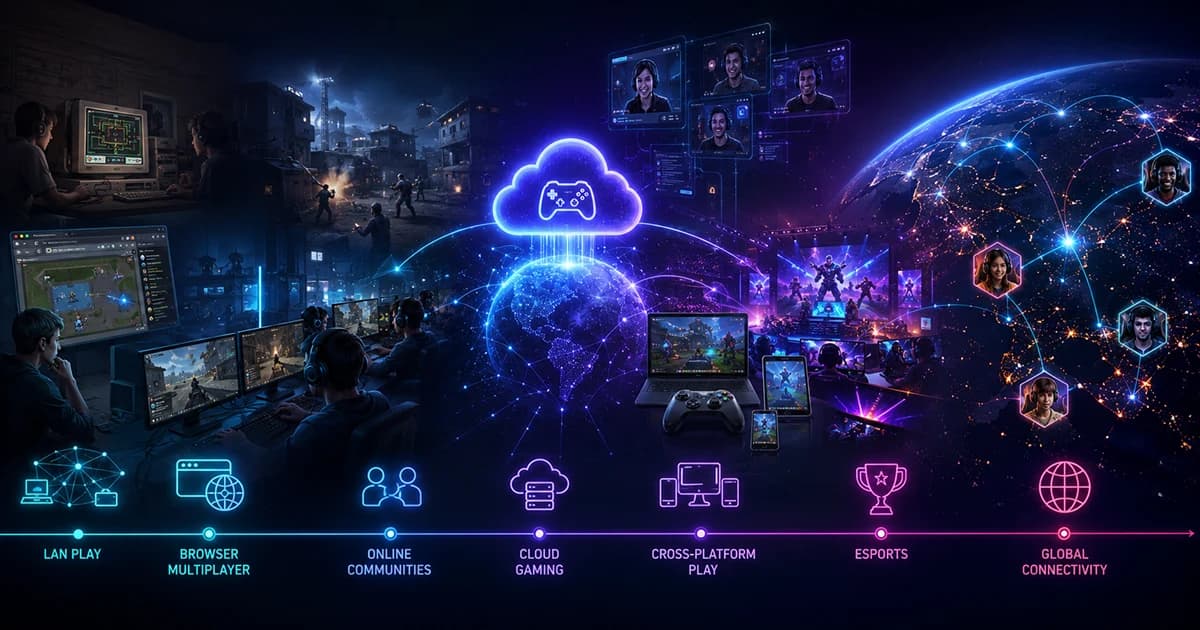
Modern online gaming wasn't created by a single invention or one groundbreaking game. It emerged as networking, internet access, hardware, software, browser technology, cloud infrastructure, and game design gradually developed together. Early breakthroughs simply allowed distant players to share the same game. Later, online experiences expanded into persistent worlds, competitive communities, mobile play, browser-based experiences, and accounts that followed players across multiple devices. Understanding this evolution helps explain why today's online games feel so connected, accessible, and continuously active.

What you will learn

01

Understand the major stages of online gaming

02

See why persistent worlds changed player expectations

03

Learn how easier access expanded online play

04

Discover how browser games fit into the larger story

05

Understand why modern online gaming spans many devices

Start with the fundamentals and move through the topic step by step.

Through Time

Major Eras That Shaped Online Gaming

Each period introduced new possibilities rather than replacing everything that came before.

01

1970s

Early Network Experiments

Connected computers demonstrated that players could share the same digital experience across a network. The technology was limited, but the idea of interactive multiplayer had begun.

The breakthrough was connection itself.

02

1980s

Shared Text-Based Worlds

Networked spaces evolved into environments where players could develop identities, cooperate, compete, and return to the same shared worlds over time.

03

1990s

The Internet Reaches More Homes

As internet access spread, multiplayer gaming expanded beyond specialized networks, allowing more players to compete and communicate across longer distances.

Remote play became practical for more households.

04

Early 2000s

Broadband and Persistent Online Worlds

More reliable connections supported larger communities, longer play sessions, and games built around ongoing progression instead of isolated matches.

05

Late 2000s–Early 2010s

Digital Access, Social Platforms, and Browsers

Finding and starting games became easier through digital distribution, social platforms, and browser-based experiences that reduced setup for many players.

06

2010s

Mobile Connectivity and Live Services

Smartphones, esports, streaming communities, and games that continued evolving after release reshaped how players interacted with online worlds.

Games became ongoing services rather than static releases.

07

Today

Cross-Platform Connected Ecosystems

Accounts, cloud services, browser technology, and cross-play increasingly allow players to move between devices while staying connected to friends and progress.

01

Connection

The First Revolution Was Connection

The earliest online experiences were impressive not because they looked advanced but because they connected people. Before networking, most games were limited to a single machine or players sitting together in the same room. Once computers could exchange information, entirely new possibilities appeared. Another human player introduces unpredictability that computer-controlled opponents rarely match. Every match becomes slightly different because people adapt, experiment, and surprise one another. That alone greatly increased replay value even when graphics remained simple. Connection also allowed cooperation. Instead of simply competing against the game, players could work together toward shared objectives, communicate across distance, and develop strategies that depended on teamwork. These ideas became foundations for many modern online genres. Early networked gaming was far from convenient. Connections were slower, hardware was expensive, and technical knowledge was often necessary just to begin playing. Yet those limitations did not reduce the importance of the breakthrough. They simply meant that the audience remained relatively small until networking became easier and more widely available.

Defining Moments

Turning Points That Changed Player Experiences

Each milestone solved a different limitation and expanded what online games could become.

1970s
1970sM01

Networked Play

Players could interact across connected computers instead of sharing only one physical machine.

1980s
1980sM02

Shared Online Worlds

Games became places players could revisit, building identities and communities over time.

1990s
1990sM03

Home Internet Multiplayer

Remote competition and cooperation became realistic for a much wider audience.

2000s
2000sM04

Broadband Expansion

More stable connections enabled larger matches, persistent progression, and richer online features.

2010s
2010sM05

Always-Connected Devices

Phones and tablets made online gaming available almost anywhere with an internet connection.

Today
TodayM06

Cross-Platform Ecosystems

Players increasingly move between devices while keeping friends, accounts, and progress together.

02

Communities

Online Games Became Places, Not Just Matches

One of the biggest changes in online gaming was the shift from temporary sessions to persistent spaces. Instead of starting over every time, players began returning to familiar worlds where progress, friendships, and achievements continued to exist. Persistent accounts allowed players to develop long-term identities. Characters, rankings, inventories, cosmetic items, and achievements gave people reasons to return. Friends lists, guilds, teams, and clans strengthened these connections by turning games into social spaces as well as entertainment. Communities eventually extended beyond the games themselves. Players shared guides, discussed updates, organized competitions, and built lasting friendships through forums, chat systems, voice communication, and later social media. A game increasingly became part of a wider community instead of existing as an isolated product. Persistence also introduced responsibilities for developers. Moderation, account security, reporting systems, and community guidelines became important because healthy online spaces require more than reliable technology. As games became places where people regularly gathered, maintaining respectful environments became just as valuable as adding new features.

Under the Surface

The Connected Technology Behind Modern Online Play

Several layers work together every time you join an online game.

Layer 1

Devices and Controls

Computers, phones, consoles, browsers, and input devices allow players to access the same online experiences from different platforms.

Layer 2

Game Client

The software running locally displays graphics, accepts player input, and communicates with online services.

Layer 3

Network Connection

Internet connections carry actions and updates between players and the systems coordinating the game.

Layer 4

Game Servers

Servers manage shared worlds, matchmaking, multiplayer synchronization, and many persistent online features.

Layer 5

Accounts and Data

Profiles, progression, settings, and saved information allow players to continue their journey across multiple sessions.

Layer 6

Content and Online Services

Updates, events, matchmaking, social systems, and seasonal content help games continue evolving after release.

Key Idea

Online Gaming Improved in Several Ways at Once

Its evolution wasn't driven by one invention but by multiple advances working together.

More people gained reliable internet access.

Shared worlds lasted beyond individual sessions.

Starting a game became progressively easier.

Communities formed around long-term play.

Players connected across more kinds of devices.

Online identities became increasingly persistent.

Continue the journey

03

Accessibility

Access Changed as Much as the Games

The evolution of online gaming is also a story of reducing friction. Earlier generations often required complicated setup, specialized hardware, or technical knowledge before players could even begin. Every improvement that simplified access allowed more people to participate. Home internet connections removed many barriers created by local-only gaming. Broadband later improved stability, making larger multiplayer experiences practical while reducing interruptions that had previously limited online sessions. Digital distribution made discovering, purchasing, and updating games much easier than relying solely on physical media. Players could join friends faster because obtaining the same game no longer depended entirely on visiting a store. Browser-based games became another important part of this accessibility story. Instead of downloading large installations, some experiences could begin almost immediately inside a web browser. Although browser gaming represents only one branch of online gaming, it demonstrated how reducing setup encourages experimentation and casual play. Smartphones expanded online gaming further by placing connected experiences into devices people already carried every day. Modern web technologies, app ecosystems, and cloud-supported services continue reducing the distance between discovering a game and joining it, making online play available in more situations than ever before.

The Big Picture

The Building Blocks of Modern Online Gaming

Today's connected experiences rely on several ideas working together.

What Makes Modern Online Gaming Possible?

zap

Reliable Connections

Stable networking allows players to interact smoothly across distance.

target

Shared Identity

Accounts keep players connected to friends and long-term progression.

trophy

Persistent Data

Game progress continues between sessions instead of starting over each time.

sparkles

Fast Distribution

Digital stores and browser access reduce the effort required to begin playing.

gamepad

Social Systems

Communication and communities encourage cooperation, competition, and lasting friendships.

lightbulb

Cross-Device Access

Many players can move between platforms while remaining connected to the same ecosystem.

04

Modern Era

From Products to Living Services

Many online games no longer remain unchanged after launch. Instead, they continue receiving updates, balance adjustments, new activities, seasonal events, and community improvements over months or even years. This ongoing approach keeps games feeling active. Developers can respond to player feedback, introduce fresh content, and adapt systems as communities grow. Players often return because the experience continues evolving rather than remaining exactly as it was on release day. The model also introduces trade-offs. Constant updates can make it difficult to preserve older versions of a game, and online services eventually reach the end of their lifecycle. If supporting infrastructure is removed, certain experiences may become unavailable even if the original software still exists. Limited-time events and seasonal progression can also create pressure for some players who feel they must participate before content changes. Others appreciate having regular goals that keep communities engaged. Neither perspective is universally correct because different players enjoy different rhythms of play. The important change is that many online games are now expected to grow alongside their communities. Modern online gaming often emphasizes continuous relationships rather than one-time purchases, reflecting the broader evolution toward connected experiences.

Myth vs Reality

Common Misunderstandings About Online Gaming

01

The Myth

Online gaming began with modern consoles.

The Reality

Connected computer experiments and shared networked games existed long before today's console ecosystems.

02

The Myth

Better graphics created online gaming.

The Reality

Networking, accessibility, infrastructure, and social design were just as important as visual improvements.

03

The Myth

Browser games and online games are the same thing.

The Reality

Browser gaming is one branch within the much broader world of connected online experiences.

04

The Myth

Every online game is massively multiplayer.

The Reality

Online experiences range from small cooperative sessions to enormous persistent worlds.

05

The Myth

Modern online gaming removed every technical challenge.

The Reality

Connection quality, latency, device capability, accessibility, and service availability still influence the experience.

Quick Overview

The Biggest Changes Across the Journey

01

Connection Came Before Complexity

Sharing a game with distant players was the first major breakthrough.

02

Persistence Changed Expectations

Accounts, progression, and shared worlds encouraged players to return regularly.

03

Broadband Expanded Possibilities

More reliable internet enabled larger and richer multiplayer experiences.

04

Access Became Simpler

Digital distribution, browsers, and mobile devices reduced barriers to entry.

05

Communities Became Central

Modern online games thrive through social interaction as much as gameplay.

06

Platforms Continue to Converge

Cross-platform systems increasingly connect players regardless of their preferred device.

Guide Complete

The Story Is About Reducing Distance

The evolution of online games is far more than a timeline of faster hardware or better graphics. It is a gradual reduction of distance between players, between devices, and between discovering a game and actually playing it. Early networking proved that shared experiences were possible. Persistent worlds encouraged lasting communities. Easier internet access, digital distribution, browser gaming, mobile connectivity, cloud infrastructure, and cross-platform systems each removed another layer of friction. Today's online gaming ecosystem combines these ideas into experiences that are easier to join, easier to continue, and more connected than ever before.

What to remember

Connection Remains the Foundation

Every major stage expanded how players could interact across distance.

Access Continues to Improve

Modern technologies reduce setup and make online play easier to begin.

Communities Shape the Experience

Long-term relationships have become as important as individual matches.

Many Paths Led Here

Browser play, mobile gaming, cross-platform systems, and persistent worlds all represent different outcomes of the same long evolution.

You reached the end of this guide

Related Articles