01
Arcade
React, retry, improve.
What defines it
- Fast reflexes and timing
- Quick to learn
- Frequent retries
- Immediate score feedback
- Skill through repetition
Best for
Short bursts of excitement, improving execution, and chasing higher scores.
No games found
Unihfy Games
Loading identity...
Quick Access
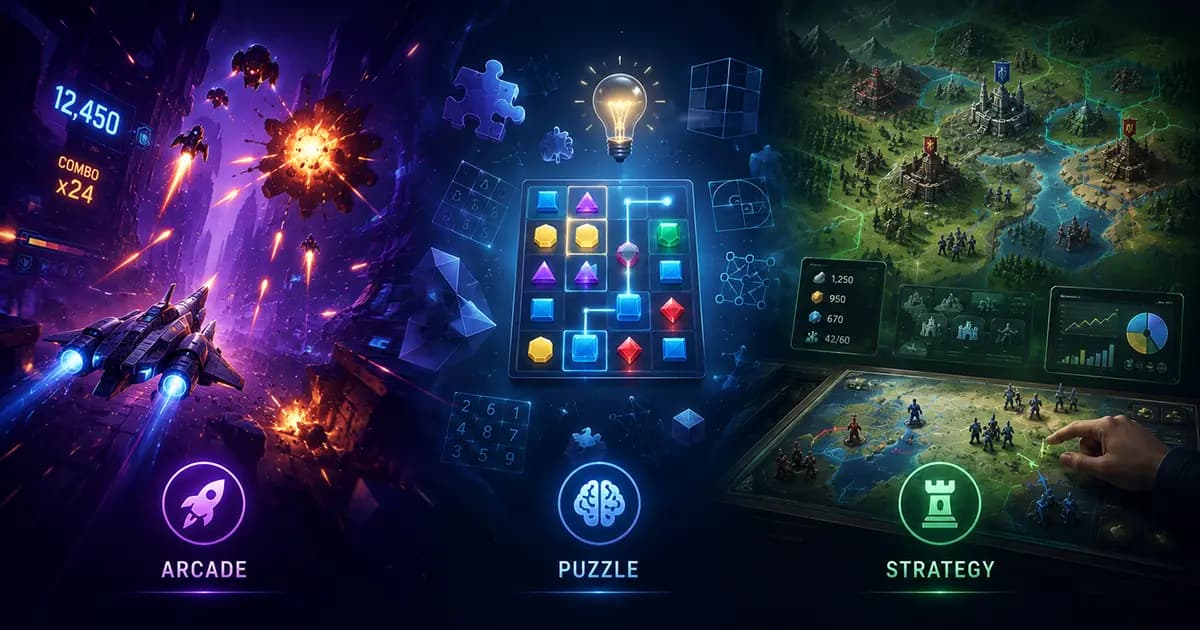
Learn the real differences between arcade, puzzle, and strategy games. Discover how each genre rewards different skills, suits different moods, and helps you choose the right game for every session.
Format
In-Depth Guide
Reading Time
11 min read
Published
July 3, 2026
Written by
Developer · Game Reviewer
Kaushik Hirpara is a full-stack developer and game reviewer at Unihfy Games. He does most of the work of bringing games to the site — adapting them to run properly in a browser, getting them working on phones, playing them, and writing up what players need to know.
View Author ProfileGame Genres
Choosing a game is often less about graphics or popularity and more about deciding how you want to spend the next few minutes. Some days you want immediate action, other times you want to untangle a clever problem, and occasionally you're ready to build a plan that pays off later. Arcade, puzzle, and strategy games each deliver satisfaction in different ways because they ask different things from the player. Understanding those differences makes it much easier to find a game that matches your mood instead of forcing yourself into a style that doesn't fit the moment.
Understand what each genre expects from the player
Compare session length and learning curves
Choose a genre based on mood instead of trends
Recognize why many games combine multiple genres
Pick a better starting point as a new player
Choose Your Path
Each genre rewards a different style of thinking and creates a different rhythm during play.
React, retry, improve.
What defines it
Best for
Short bursts of excitement, improving execution, and chasing higher scores.
Understand before you move.
What defines it
Best for
Players who enjoy solving problems one step at a time with careful thinking.
Today's choice shapes tomorrow's result.
What defines it
Best for
Longer sessions where planning and balancing several choices are rewarding.
Core Idea
People often judge genres by appearance, but the real distinction comes from the actions you repeat while playing. A colorful game can demand careful planning, while a realistic game may revolve around split-second reactions. Looking at the player's main responsibility reveals far more than the art style ever could. In an arcade game, your repeated task is usually execution. You react, dodge, aim, jump, survive, or chain actions together. Success comes from improving how accurately and consistently you perform those actions. Failure usually arrives quickly, giving you another chance to refine your timing. Puzzle games shift attention toward understanding. Instead of asking whether your fingers are fast enough, they ask whether you've noticed an important relationship or discovered the rule behind a challenge. Progress often happens after a moment of observation rather than a burst of speed. Strategy games focus on decisions whose effects may not appear immediately. Choosing where to spend resources, which objective deserves attention, or when to wait instead of acting can matter more than mechanical precision. The interesting part isn't simply making choices but understanding how one choice influences another later. Modern games frequently combine these approaches. A puzzle may include a countdown timer, an arcade game may introduce resource management, and a strategy title may occasionally demand quick reactions. Genre labels describe the dominant experience rather than every mechanic inside the game.
The Big Picture
Think about what you want from your next session before choosing a genre.
Arcade games usually deliver excitement within seconds through direct interaction.
Puzzle games reward careful observation until the solution becomes clear.
Strategy games let you shape future outcomes through thoughtful decisions.
Arcade games often fit naturally into short sessions with quick restarts.
Puzzle and strategy games both encourage learning rules instead of relying only on speed.
Player Experience
The difference between genres becomes especially clear once you notice how they create progress from one moment to the next. Arcade games usually begin immediately. Within seconds you're moving, reacting, or avoiding danger. Feedback loops are extremely short. Every successful jump, accurate shot, or narrowly avoided obstacle tells you instantly whether your decision worked. Because the game responds so quickly, repeating the same challenge rarely feels identical. Tiny improvements become visible almost every attempt. Puzzle games encourage a different rhythm. Many players stop moving entirely for a moment while they inspect the situation. Testing an idea is valuable, but understanding why it succeeds is even more important. Progress often feels slow until a single insight suddenly unlocks several new possibilities. The reward comes less from speed and more from seeing order where confusion existed before. Strategy games usually spread consequences across longer stretches of play. Spending resources now may limit options later. Ignoring one objective can quietly create problems that appear much further into the session. Winning rarely depends on making one perfect move. Instead, it comes from consistently choosing priorities that work together over time. These differences also affect how failure feels. Arcade games invite immediate retries. Puzzle games encourage another look at the same obstacle with fresh ideas. Strategy games often encourage reviewing earlier decisions to understand where a plan gradually drifted off course. None of these approaches is better; they simply reward different kinds of improvement.
How It Flows
Every genre follows a similar cycle, but each interprets the stages differently.
Arcade players scan for immediate threats, puzzle players search for clues, and strategy players assess the wider state of the game.
The important decision may be a quick reaction, the right idea, or the best long-term priority depending on the genre.
Execution may involve precise movement, testing a theory, or committing resources toward a broader plan.
Arcade feedback is immediate, puzzle feedback explains whether your reasoning fits the rules, and strategy feedback may appear much later.
Players refine timing, improve understanding, or reshape their overall strategy instead of repeating mistakes unchanged.
Repeated play develops faster execution, deeper understanding, or stronger decision-making depending on the experience.
Midway Review
If you're unsure how to classify a game, focus on the decisions you make most often instead of the graphics or theme.
Arcade games compress decisions into short, repeated moments.
Puzzle games place understanding the obstacle at the center of progress.
Strategy games connect many choices across a longer timeline.
Hybrid games can shift between these patterns during different stages.
The dominant gameplay loop matters more than isolated mechanics.
Continue the journey
Finding Your Fit
Your favorite genre doesn't have to stay the same every day. The best choice often depends on how much time you have and what kind of challenge sounds enjoyable. If you only have a few spare minutes, arcade games are often an easy recommendation. They usually begin quickly, provide immediate feedback, and let you leave without forgetting a complicated plan. They're excellent when you want energy without a long commitment. Puzzle games suit moments when you want focused attention rather than constant motion. They can be surprisingly relaxing because progress depends on understanding instead of rushing. At the same time, they also ask for patience. Sometimes stepping away briefly is exactly what helps the answer become obvious. Strategy games often reward longer sessions because decisions build on one another. That doesn't mean every strategy game requires hours, but many become more satisfying once you have enough time to explore different options and adapt your approach. If you enjoy balancing priorities instead of reacting instantly, they can be especially rewarding. Think about how you respond to setbacks as well. If repeating the same challenge while gradually improving sounds satisfying, arcade games may appeal to you. If you'd rather examine one obstacle until it finally makes sense, puzzle games are a natural fit. If you're comfortable accepting that an early decision might shape everything that follows, strategy games offer a different kind of satisfaction. Most players eventually enjoy all three. The genre you choose after work may be completely different from the one you prefer during a quiet weekend afternoon, and that's perfectly normal.
Myth vs Reality
The Myth
Arcade games are completely mindless.
The Reality
Many reward pattern recognition, consistency, and learning from repeated attempts rather than random button pressing.
The Myth
Puzzle games are only for exceptionally intelligent players.
The Reality
Most are designed around observation, experimentation, and persistence instead of specialized knowledge.
The Myth
Strategy games always require several hours.
The Reality
Some offer short sessions while still emphasizing planning and meaningful choices.
The Myth
You should pick one favorite genre and stay with it.
The Reality
Different moods and schedules naturally make different genres more enjoyable.
The Myth
Every game fits neatly into one category.
The Reality
Many modern games successfully combine mechanics from multiple genres.
Getting Started
If you're new to browser games or simply exploring unfamiliar genres, avoid worrying about labels too much. Instead, ask yourself a few practical questions before you press play. How much time do you have? A short break often favors games that deliver quick feedback, while a longer evening leaves room for planning and experimentation. What kind of challenge sounds appealing? If you want excitement, look toward arcade experiences. If you want to solve something, try a puzzle. If you enjoy balancing several ideas at once, strategy games may feel more rewarding. Think about the type of feedback you enjoy. Some players love immediate confirmation after every action. Others prefer watching a plan unfold gradually. Neither preference is more correct; they're simply different ways of enjoying games. Consider how comfortable you are with repetition. Arcade games frequently encourage many short retries. Puzzle games often revisit the same problem until understanding arrives. Strategy games may ask you to replay an entire scenario after discovering a better overall approach. Finally, remember that the quickest way to discover your preferences is to try several games instead of treating genres as strict categories. You may find that a hybrid title introduces you to a style you never expected to enjoy.
Quick Overview
Improvement usually comes from better timing, accuracy, and consistency across repeated attempts.
Finding the right idea often matters more than moving quickly.
Strong decisions work together over time instead of producing instant rewards.
Available time can influence which genre feels most satisfying on a given day.
Many titles blend mechanics, so explore beyond strict genre labels.
Guide Complete
Arcade, puzzle, and strategy games each create satisfaction through different kinds of challenges. Arcade games reward execution and rapid improvement, puzzle games reward understanding, and strategy games reward thoughtful decisions that pay off over time. None is universally better than another because each matches different moods, schedules, and expectations. Let genre labels help you discover games, but don't let them limit what you're willing to try.
Choose action, problem-solving, or planning based on what sounds enjoyable right now.
A five-minute break and a relaxed evening can naturally call for different genres.
Execution, insight, and planning are all valuable forms of player skill.
Trying multiple genres is the fastest way to discover what keeps you engaged.
Guides
Learn how keyboard controls in browser games work, why layouts like WASD are so common, what popular gaming keys usually do, and how to troubleshoot common keyboard input problems while playing.
Guides
Explore how online games evolved from early networked computer experiments into today's connected ecosystem of multiplayer worlds, browser games, mobile play, cross-platform experiences, and live online communities.
Guides
A practical guide to playing HTML5 browser games on smartphones and tablets, covering orientation, touch controls, performance, and how to fix common mobile gaming problems.
Guides
A clear guide to how browser games remember player progress, covering local saves, account-based saves, cloud synchronization, and why progress sometimes appears on one device but not another.
Continue Exploring
Jump into browser games or challenge yourself in Quiz Arena. There's always something new to discover.