01
Step 01
Read the land
Habitats are not menus. A Pokémon will move in only if the elevation, light level, humidity and nearby objects are right, so first you have to work out what a place currently is.
No games found
Unihfy Games
Loading identity...
Quick Access
No gyms, no badges, no team of six. You play as a Ditto rebuilding an abandoned Kanto block by block, and the Pokémon move in as neighbours instead of joining your party. It is the most interesting thing this franchise has done in a very long time.
Developer
Omega Force and Game Freak
Genre
Life Sim and Building
Platforms
Switch 2
Release
To be announced
Written by
Developer · Game Reviewer
Kaushik Hirpara is a full-stack developer and game reviewer at Unihfy Games. He does most of the work of bringing games to the site — adapting them to run properly in a browser, getting them working on phones, playing them, and writing up what players need to know.
There are no gyms in Pokopia. There are no badges, no league, no rival, and no team of six. You cannot catch anything. For a franchise turning thirty this year, that is a genuinely startling set of things to leave out, and it is the reason this is the fourth best-selling game of 2026 and the best-received Pokémon release in three decades.
What you get instead is a life sim and a building game sharing one world. You wake up in an abandoned, drained-out version of Kanto with no humans in it, guided by a Tangrowth who has appointed itself professor, and you rebuild the place block by block until things want to live there again. Pokémon do not join your party. They move in.
It is not a small game dressed up as a spin-off. It is dense, it is long, and it has a better central idea in it than the mainline series has had in years. It also has some real irritations, and one of them is going to decide whether you can live with it.
The Basics
You play as a Ditto that has taken the shape of its former trainer. It is not a convincing disguise — the character has an odd, slightly plasticine look that the game is fully aware of and never explains away. It is also the single best design decision here, and it took thirty years for somebody to think of it.
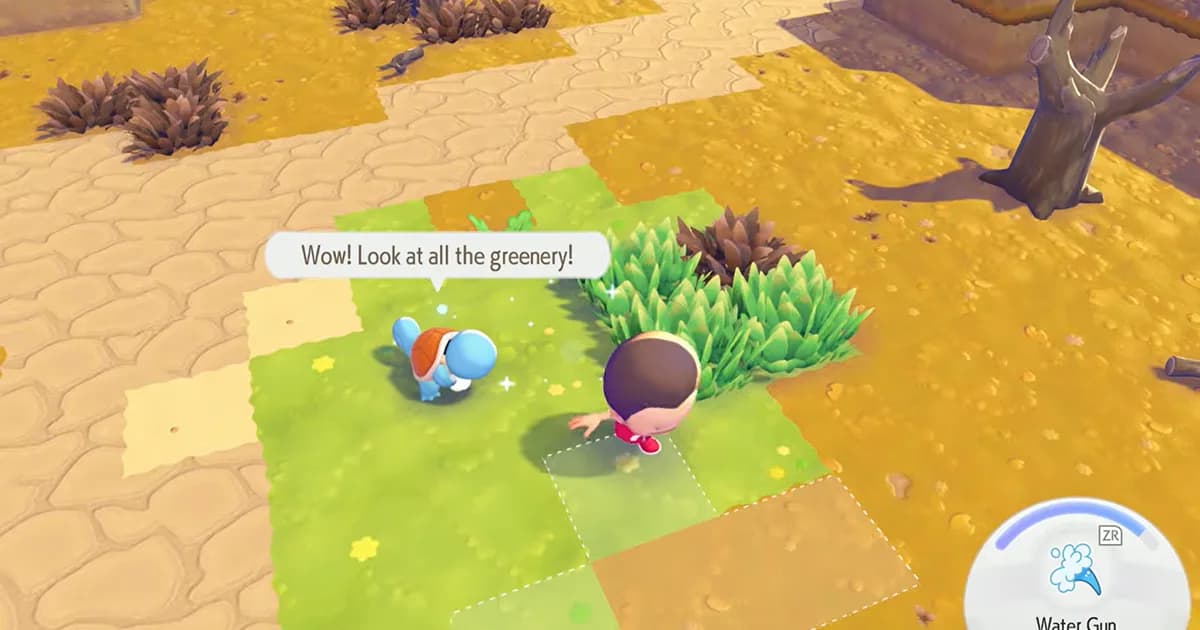
In every other Pokémon game, the creatures fight for you. Here they teach you. Because you are a shapeshifter, learning a move from a Pokémon you have befriended is not a gameplay conceit bolted onto the fiction, it is the most canonically sensible thing that could possibly happen. Bulbasaur gives you Leech Seed and now you can grow grass. Squirtle gives you Water Gun and now you can put moisture back into dead soil. Scyther gives you Cut, Hitmonchan gives you Rock Smash, and Magikarp gives you Splash, which turns out to be how you jump. That last one is very funny and also genuinely useful, which sums the whole game up.
Progression is therefore social rather than mechanical. You do not level up. You meet somebody, do them a favour, and walk away able to reshape the world in a way you could not before. It reframes the entire franchise: these are not tools you own, they are neighbours who taught you something, and the game never once lets you forget which of those it is.
How It Flows
Every hour of Pokopia is some version of this circle, and it tightens rather than loosens the longer you play.
Habitats are not menus. A Pokémon will move in only if the elevation, light level, humidity and nearby objects are right, so first you have to work out what a place currently is.
Arrange the right things close enough together. Sometimes that is grass and water. Sometimes it is furniture and lamps. The game gives you a hint about what is wanted and leaves you to find it.
Get it right and a new Pokémon appears and settles. There is no capture, no ball, no fight. They just decide the place is acceptable.
Befriending usually means a request. Bring fruit. Build a light. Make a house. Small errands that make the relationship feel earned rather than transactional.
Now you can copy their move, or call on them for the things you cannot copy — Scyther milling logs into lumber, Charmander lighting fires, Slowpoke making it rain.
Your new ability opens terrain that was closed. Which creates habitats you could not build before. Which brings in Pokémon you had not met. Back to the start.
The hothead next door
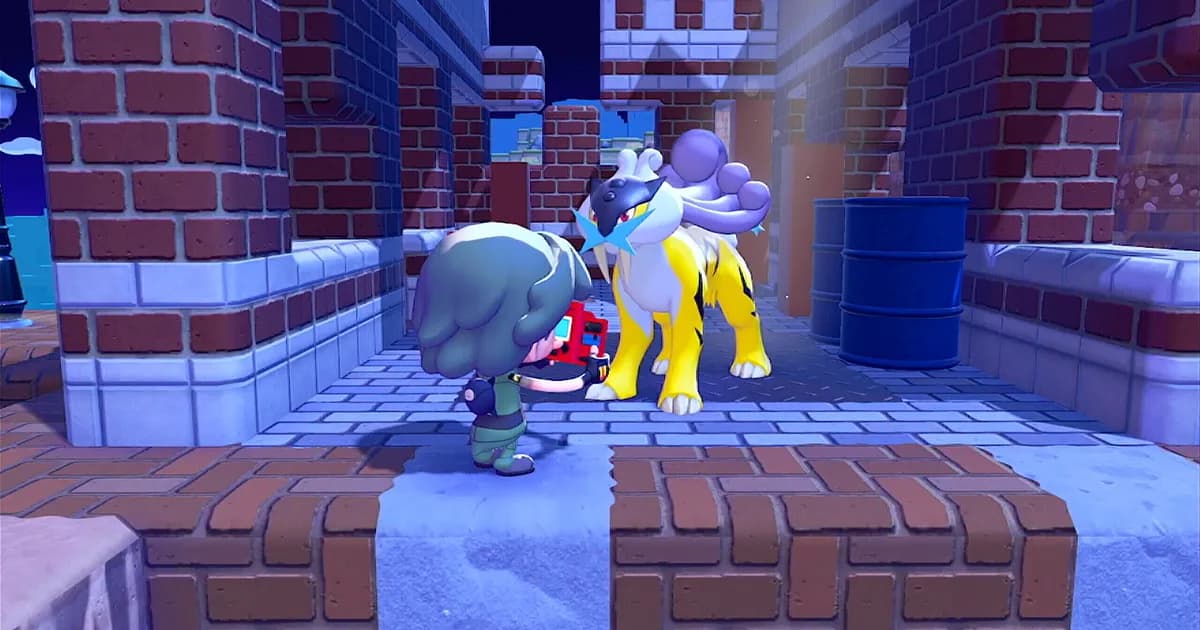
Exactly as short-tempered as thirty years of design have implied, and the game commits to it. Charmander, meanwhile, is the one you fetch when something needs setting on fire.
Training partners
They work out together. That is it. We lost a genuinely embarrassing amount of time to standing still and watching two fighting Pokémon use a punching bag in shifts.
Relentlessly enthusiastic
Teaches you Water Gun, which is the ability that unlocks most of the early map. Also never stops moving, which is a nice counterweight to everything else being so calm.
Doing its best, eventually
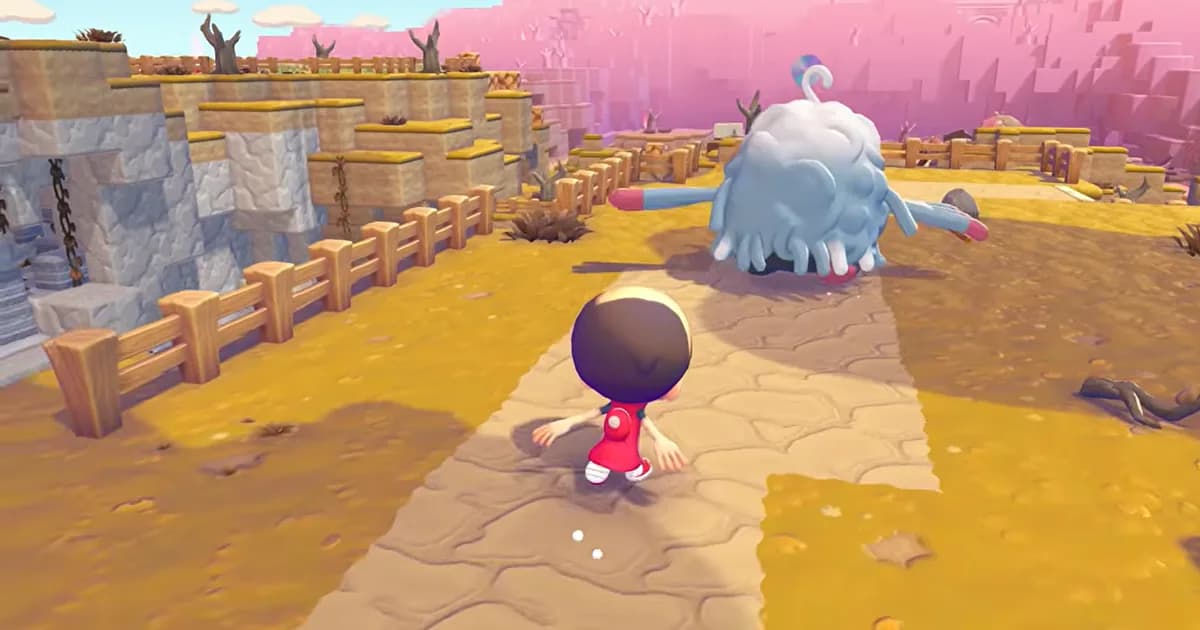
Takes its time with everything, in a game where taking your time is the entire point. It can also make it rain, which makes it one of the most practically useful neighbours you will get.
Self-appointed professor
Your guide, and the closest thing to a story character. Gave itself the title. Nobody has challenged it, because there is nobody left to challenge it.
Omega Force made Dragon Quest Builders 2, and it shows in the best way. Everything is blocks — wood, sand, grass, soil, stone — and you break them down and suck them up with a vacuum ability that is both very Kirby and, given that you are a Ditto, entirely reasonable. The interface is Builders-like, which means it is far more approachable than Minecraft while still letting you do essentially whatever you want.
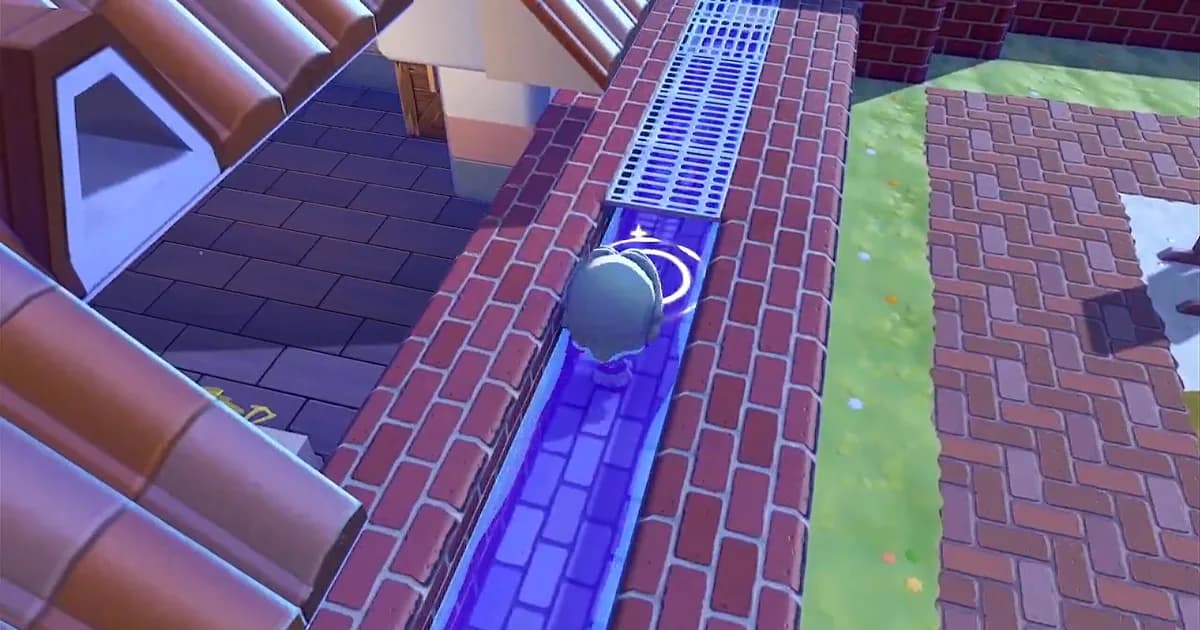
The campaign moves you from map to map, each one hand-built rather than generated, with abandoned structures that feel like somebody lived in them and left. You can strip those buildings for parts and take the parts home. Then, once the story has run its course, the game hands you a large open map with no objectives at all and lets you go. That is where most of the hundreds of hours people are putting into this are going.
There is a genuine tension in here between two design philosophies, and Pokopia mostly resolves it. One half wants to give you daily tasks, timers and requests. The other half wants to hand you a shovel and get out of the way. It manages both by keeping the structured half as the campaign and the free half as everything after, and the join is much smoother than it has any right to be.
The real-time timers are the big one. Set a building in motion and it takes actual hours, so you close the game and come back. Certain activities are once per day and that is that. Some people will find this a pleasant reason to put the console down. We found it a handbrake, especially early on when you are still learning the systems and every interesting thing is behind a wait. This is a mechanic borrowed from Animal Crossing and it is the one thing we would have left behind.
Inventory is the other persistent annoyance. Storage boxes fill with junk fast, there is no automatic sorting, and you cannot pull materials out of storage while building. Every crafting game of the last five years has solved this and Pokopia simply has not, so you will spend real time shuffling things between boxes in a game explicitly designed to be relaxing.
Beyond that it is a pile of small things. Placing objects is fiddly. Watering and rock-breaking are less precise than they should be. The middle of the game opens up so fast that you can drown in side objectives with nothing telling you what matters. And the music, which is doing the standard gentle-Nintendo-piano thing, is so low-energy that after twenty hours it stopped soothing us and started grating.
The worst of them, because it stops momentum rather than adding challenge. Worst in the opening hours, when you have the least to do while waiting.
Constant, low-grade and entirely solvable. You cannot draw from storage while building, so organising boxes becomes its own unpaid job.
The mid-game opens up so wide that focusing on anything is hard. Some people will love the freedom. If you need a next step, you will feel adrift.
Four players, game share support, and a shared world you can build in asynchronously — but no co-op campaign, and the free-build town is smaller than it should be.
Watering, breaking rocks and lining up objects are all slightly less precise than you want. Mouse mode on Switch 2 helps considerably.
Deliberately sleepy, and it works for a while. The classic Pokémon remixes scattered through it are lovely. The default wallpaper music is not.
Pokopia's physical version is a game key card rather than a full cartridge, which means the card is essentially a licence and the game downloads. That is worth knowing before you buy a box, particularly at this price, and it is a genuinely odd choice for a Nintendo-published title when Nintendo's own first-party releases have generally kept full physical media. On the other hand, game share support is excellent here: one copy can host four players, and Switch 1 owners can join a Switch 2 host. For a family, that is a much better deal than the price tag suggests.
"For thirty years this series has asked what a Pokémon can do for you in a fight. This is the first one that asks what they would do if nobody was fighting."
Our Verdict
A life sim and a block-builder sharing one beautifully judged world, held together by the smartest idea Pokémon has had in years — making you a Ditto who learns from its neighbours instead of a trainer who commands them.
What Works
What Concerns Us
Who It's For
Anyone who has ever lost a weekend to Animal Crossing, Stardew Valley or Dragon Quest Builders, and every Pokémon fan who has quietly felt the mainline games have been running on autopilot. It is also one of the best games on the system for a family, given the game share support.
Who Should Wait
People who want Pokémon battles, because there essentially are not any. Anyone who finds real-time waiting mechanics infuriating rather than relaxing, since this game leans on them. And if you need a game to tell you what to do next, the middle section will lose you.
How We Reviewed This
This is a review of the finished, released game. We played through the campaign, spent time in the post-story sandbox, and tested multiplayer including game share. The opinions here are ours and the wording is ours. Reactions to this game have been unusually positive across the board, so where we differ from the general view — chiefly on the real-time waiting mechanics and the soundtrack — we have said so plainly rather than rounding up to the consensus. The game's own spelling is used for creature and place names throughout. Prices and the physical release format are accurate at the time of writing. All images on this page are in-game screenshots captured from the released version during our review. We have not used AI-generated artwork or promotional renders in place of gameplay.
Reviewer
Time with the released version on Switch 2
Official
In-game notes, habitat requirements and post-story sandbox
Store
Storefront listings, pricing and physical release format
Community
Player discussion around real-time waits and multiplayer
Opinions reported by other reviewers and players are attributed as theirs. Read our review process for how we handle games we cannot test ourselves.
Game Reviews
Seven months into 2026 and the year looks nothing like the one everybody predicted in January. Here are the seven games that actually mattered, why the lists and the players disagreed so badly, and what else is worth your time.
Game Reviews
Yacht Club Games followed Shovel Knight with a gothic top-down adventure that some people scored a 9 and others could not wait to finish. Both reactions are right, and the reason why is the most interesting thing about it.
Game Reviews
Requiem splits itself between a terrifying stealth game as Grace Ashcroft and a chainsaw-swinging action game as Leon Kennedy. Both halves are excellent. Whether they belong in the same game is the real question.
Game Reviews
IO Interactive built a Bond game on Hitman's foundations and then made sure it plays nothing like Hitman. A review of the stealth, the improvised brawling, the Q Lab, and the one thing everybody argues about.
Continue Exploring
Browse more game coverage, jump into browser games, or test yourself in Quiz Arena.