Step 01
Launch
Open the game and confirm that it becomes playable rather than stopping at a loading screen or error.
No games found
Unihfy Games
Loading identity...
Quick Access
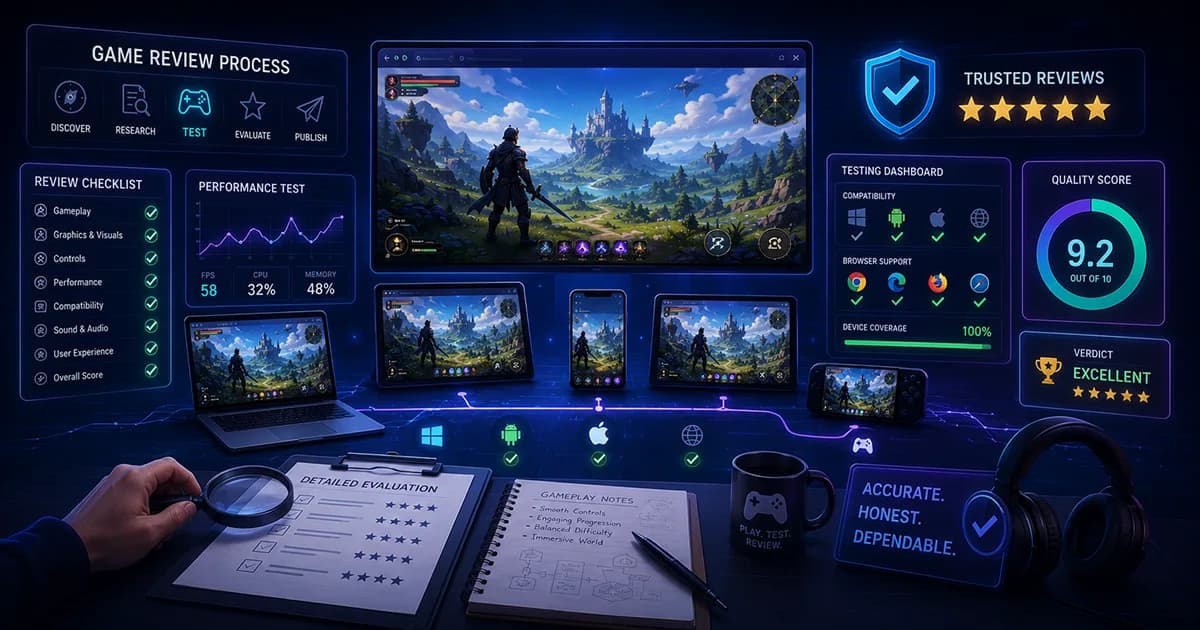
Learn how Unihfy Games tests browser games by checking first launch, controls, gameplay, objectives, progression, browser behavior, and the accuracy of player-facing information before publishing guides and reviews.
Format
In-Depth Guide
Reading Time
10 min read
Published
July 2, 2026
Written by
Founder · Writer
Nikunj Hirpara founded Unihfy Games and decides what the site works on next. He writes the explanatory guides about how browser games work, and the geography and sports quizzes.
View Author ProfileBehind the Scenes
Every browser game begins its journey with a simple click on the Play button, but that's only the beginning of the work behind a useful guide or review. A game that loads successfully has not automatically been understood. Before writing descriptions, explaining controls, or answering common player questions, we need to discover what the game is actually asking players to do. That means observing how it starts, trying its controls, following its gameplay, noticing how it behaves in the browser, and checking whether the information we publish matches the real experience. The exact process varies from one game to another, but the goal remains the same: provide practical, accurate information that helps players know what to expect.
Why opening a browser game is only the first step of the review process.
How gameplay observations gradually become useful player-facing information.
What practical checks help reviewers understand controls, objectives, progression, and browser behavior.
Why published information sometimes needs to be revisited and updated as games change.
How It Flows
Every game follows its own path, but most reviews move through these practical stages before information is published.
Open the game and confirm that it becomes playable rather than stopping at a loading screen or error.
Identify the player's objective and determine what the game is actually asking the player to accomplish.
Try the available controls instead of relying only on instructions or assumptions.
Repeat the core gameplay loop to observe mechanics, progression, and changes over time.
Check practical player-facing details such as browser behavior, controls, progression, and useful gameplay information.
Turn verified observations into descriptions, guides, FAQs, and other information that players can trust.
Chapter 01
The first launch provides important clues, but it does not complete the review. We begin by checking whether the game opens successfully, reaches a playable state, and presents a clear path into gameplay. We look for obvious start buttons, menus, loading behavior, and any instructions that appear before the first interaction. If something immediately prevents normal play, that deserves attention. However, a successful launch simply means the investigation can continue—it does not prove the rest of the experience is equally clear, enjoyable, or accurately described.
Myth vs Reality
The Myth
Testing means every game must be completed from beginning to end.
The Reality
Different games require different depths of play. A reviewer aims to understand the core experience rather than claiming every possible challenge or ending has been reached.
The Myth
If the game launches successfully, the review is finished.
The Reality
Launching only confirms that the game can begin. Controls, objectives, progression, and player-facing information still need careful examination.
The Myth
Every browser game follows exactly the same testing checklist.
The Reality
Short arcade games, endless score chasers, strategy titles, and progression-heavy games raise different questions, so the review adapts to the experience.
The Myth
A reviewer must discover every hidden mechanic before publishing anything.
The Reality
The goal is to understand the practical experience players are most likely to encounter, while remaining open to updating information if new discoveries become important.
The Myth
Testing guarantees that a game has no bugs.
The Reality
A practical review cannot promise a bug-free experience. It reflects what was observed during testing, not a formal certification of every possible situation.
Chapter 02
A game's visual style is not always the best guide to understanding what players are actually trying to achieve. Two games may both feature racing cars or fantasy characters while asking players to complete very different tasks. The review therefore moves beyond appearances and focuses on the real objective. We look for what counts as success, what causes failure, which actions repeat throughout the experience, and how the game encourages players to improve or continue playing. Understanding these fundamentals makes every later explanation more accurate.
The Big Picture
Before writing about a game, we break the player experience into a few practical elements that explain how the game actually works from the player's point of view.
The first question is what the player is trying to accomplish, whether that means reaching a finish line, solving puzzles, surviving longer, earning points, or completing missions.
Every game expects players to perform actions such as moving, aiming, matching, building, or making decisions. These repeated actions reveal the heart of the gameplay.
The game establishes limits, rewards, penalties, and conditions that shape how players succeed or fail. Recognizing these rules helps explain the experience clearly.
Visual effects, sounds, score changes, animations, and messages tell players whether their actions are helping or hurting their progress.
Some games unlock new content, increase difficulty, introduce fresh mechanics, or simply challenge players to improve their performance over repeated attempts.
Review Desk Check
By this stage, the review is no longer focused on whether the browser game simply opens. We have started identifying what the player is expected to achieve, how the experience is structured, and which parts deserve closer attention during deeper gameplay testing.
The game launches successfully, but launching alone is never enough for a complete review.
The player's real objective is identified from gameplay rather than assumptions based on the game's theme.
Core elements such as actions, rules, feedback, and progression provide a framework for understanding the experience.
The next stage is to verify how the controls actually behave during real play instead of relying only on on-screen instructions.
Continue the journey
Chapter 03
Control instructions are only useful if they match what the player experiences. Instead of copying key bindings from a menu or assuming familiar controls, we interact with the game directly. Keyboard input, mouse movement, touch controls, or alternative control schemes are tried in the situations where the game expects them to be used. A button responding once is not enough. We also pay attention to whether actions feel understandable, whether feedback is clear, and whether new players are likely to interpret the controls correctly without unnecessary confusion.
Under the Surface
Verifying controls is a gradual process that moves from basic functionality to practical usability from the player's perspective.
The expected keyboard keys, mouse actions, touch gestures, or other inputs are available and can be used to interact with the game.
Pressing a key or performing an action produces a response from the game instead of being ignored or behaving unpredictably.
The result of each input matches what the player reasonably expects and agrees with any instructions provided by the game.
Animations, sounds, visual indicators, or score changes help confirm whether the player's action succeeded or failed.
Even if the controls technically work, we consider whether they remain understandable and comfortable during normal gameplay rather than only during the first few seconds.
Chapter 04
After understanding the controls, the next task is discovering the rhythm of the game itself. Every browser game has a loop that players repeat, whether it lasts a few seconds or several minutes. We observe which actions are repeated, what rewards progress, what causes failure, and how the game encourages another attempt. A short arcade game may reveal its structure almost immediately, while a progression-focused game may require more time before its systems become clear. The review continues only until there is enough evidence to accurately explain the player's experience rather than making assumptions from a single attempt.
How It Flows
A single attempt rarely reveals everything about a browser game. Repeating the gameplay loop helps uncover progression, changing mechanics, and player expectations that may not be obvious at first.
Perform the main actions the game expects, using the available controls to pursue the objective rather than experimenting randomly.
Watch how the game responds by noting scoring, animations, rewards, penalties, instructions, and other feedback that helps explain the player's experience.
Determine what leads to success, what causes failure, and whether new mechanics, challenges, or objectives appear as play continues.
Experience what happens after failure or success. Some games immediately restart, while others save progress, unlock new stages, or offer additional choices.
Repeated play reveals patterns, difficulty adjustments, and gameplay systems that are easy to overlook during a single attempt.
Chapter 05
Once the core gameplay loop is understood, attention shifts to how the experience develops over time. Some games introduce new mechanics, increase difficulty, unlock additional levels, or reward longer play, while others intentionally remain simple from beginning to end. We also observe practical browser behavior when it matters. Certain games are designed for keyboard input, others for touch screens, and some adapt differently depending on screen size or device orientation. These checks are guided by the type of game rather than assuming every title should be tested in exactly the same way across every possible browser and device.
Defining Moments
Different observations become important at different stages of practical testing. These milestones help build a complete picture of the player's experience.
Confirm that the game becomes playable, presents understandable goals, and gives players enough information to begin interacting with confidence.
Observe how quickly players understand the controls, rules, and immediate objectives during the opening moments of gameplay.
Repeated play highlights the core loop, common player decisions, and mechanics that may not be obvious during the first attempt.
Watch for increasing difficulty, new mechanics, unlocks, or changes that reward continued play and keep the experience engaging.
Consider whether the game remains understandable, whether progress is handled clearly, and whether practical information for returning players should be included in the published guide.
Chapter 06
Playing a browser game is only part of the review process. The next step is translating those observations into information that genuinely helps players. Descriptions should explain what the game is actually about rather than repeating promotional language. Control guides should reflect inputs that have been tried, how-to-play sections should match the real gameplay flow, and FAQs should answer practical questions that naturally arise while playing. The purpose is not to make a page longer with extra text, but to replace guesswork with information based on direct experience so players know what to expect before they begin.
Quick Overview
Descriptions, feature summaries, and guides become more useful when they are based on real observations instead of assumptions or marketing text.
Input instructions are checked through actual interaction because controls that appear obvious on paper can behave differently during play.
A quick arcade game and a progression-heavy adventure reveal their important mechanics at different speeds, so the review process adapts accordingly.
The goal is to explain what players are likely to ask about objectives, gameplay, progression, and controls rather than filling pages with unnecessary details.
Chapter 07
Publishing a guide does not freeze a browser game in time. Developers may adjust controls, rebalance gameplay, redesign menus, or update the version embedded on a website. Browser behavior can also change over time, and player feedback may highlight something that deserves another look. For that reason, review work sometimes continues after publication. Revisiting a game when needed and correcting outdated information helps keep guides useful without claiming that every title is constantly monitored or that every future change will be detected immediately.
The Big Picture
Publishing is an important milestone, but it is not the end of responsible editorial work. Browser games can change over time, so useful information sometimes needs to be checked and updated.
The review begins with practical gameplay, building an understanding of how the experience works from the player's perspective.
Notes are taken on objectives, controls, progression, browser behavior, and anything else that could help players understand the game.
Those observations are transformed into descriptions, guides, control instructions, feature summaries, and FAQs that reflect the actual gameplay experience.
The reviewed information is presented so players can quickly understand what the game offers and how to begin playing.
If a game changes or reliable feedback suggests something has become inaccurate, the information can be reviewed again and corrected where necessary.
Guide Complete
Testing a browser game is not a single pass-or-fail event. It is a practical process of gradually understanding the experience from the player's point of view. A successful launch opens the investigation, but meaningful review work continues through examining objectives, verifying controls, following the gameplay loop, observing progression, checking practical browser behavior, and turning those observations into clear information for players. Because games can change over time, responsible editorial work also includes correcting information when it no longer reflects the real experience. The goal is not to claim perfection, but to provide guides that are accurate, practical, and genuinely helpful.
A browser game loading successfully starts the review process but does not complete it.
Objectives, controls, progression, and gameplay mechanics are understood through practical interaction rather than assumptions.
Descriptions, how-to-play guides, feature summaries, and FAQs become more valuable when they reflect what the game actually does.
When browser games change or published information becomes outdated, revisiting and correcting content helps keep it useful for future players.
Guides
Discover why browser games can run without traditional downloads or installation. Learn what the browser actually loads, how game resources are delivered, how browser caching works, and how browser games differ from installed software.
Guides
Discover what happens behind the scenes when an HTML5 browser game loads and runs. Learn how the browser downloads files, renders graphics, processes player input, plays audio, saves progress, and communicates with online services in this beginner-friendly guide.
Guides
Explore the complete history of browser games, from the earliest web experiments and Java applets through the Flash era, online game portals, HTML5, WebGL, WebAssembly, mobile browsers, and the technologies shaping modern browser gaming.
Guides
Learn the fundamentals of puzzle games with this beginner-friendly guide. Discover the main puzzle types, practical solving strategies, common mistakes to avoid, and simple habits that help you improve over time.
Continue Exploring
Jump into browser games or challenge yourself in Quiz Arena. There's always something new to discover.