01
Browser games evolved alongside the web.
Every major improvement in browser technology expanded what developers could build, making browser gaming a reflection of the internet's own growth.
No games found
Unihfy Games
Loading identity...
Quick Access
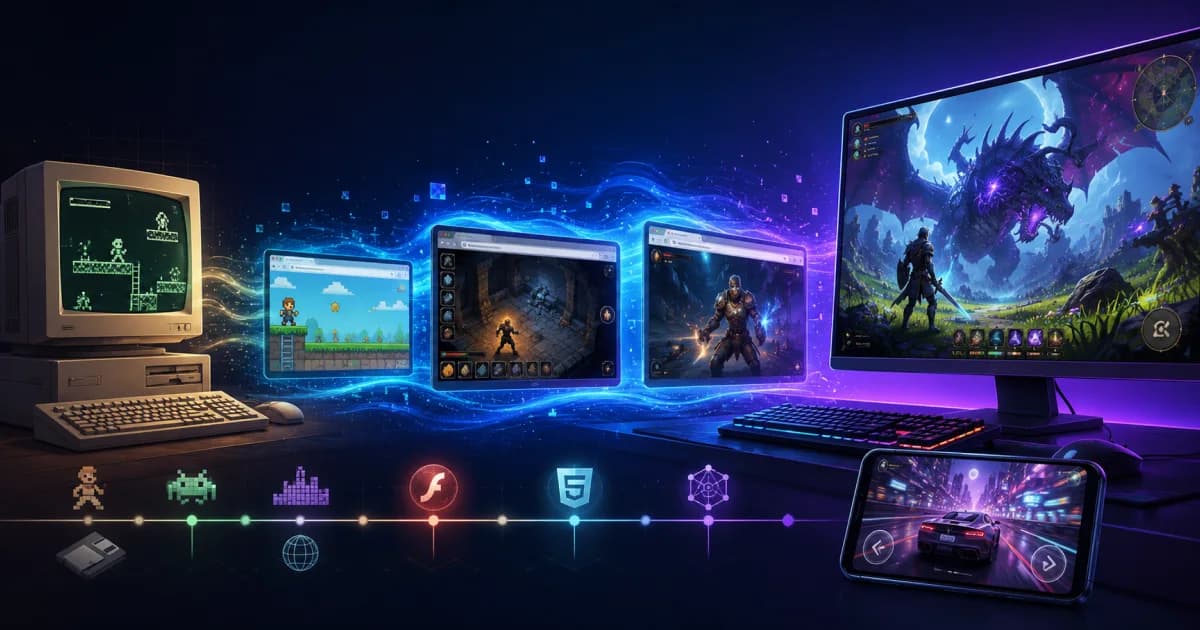
Explore the complete history of browser games, from the earliest web experiments and Java applets through the Flash era, online game portals, HTML5, WebGL, WebAssembly, mobile browsers, and the technologies shaping modern browser gaming.
Format
In-Depth Guide
Reading Time
18 min
Published
June 30, 2026
Written by
Developer · Game Reviewer
Kaushik Hirpara is a full-stack developer and game reviewer at Unihfy Games. He does most of the work of bringing games to the site — adapting them to run properly in a browser, getting them working on phones, playing them, and writing up what players need to know.
View Author ProfileInteractive Web History
Browser games have entertained millions of people for more than three decades, yet their story is also the story of the modern web itself. As browsers became faster and more capable, games evolved from tiny interactive experiments into rich multiplayer experiences that can rival downloadable titles in many situations. This guide follows that journey from the earliest days of static web pages through Java applets, Flash, browser game portals, social gaming, HTML5, WebGL, WebAssembly, and today's cross-device experiences. Along the way, you'll discover not only which technologies made browser games possible, but also why each generation emerged, what problems it solved, and how those innovations continue to influence modern online gaming.
What defines a browser game and how it differs from downloadable software
How early internet technologies made interactive games possible
Why Flash became the dominant platform for web games
How browser game portals created a global gaming audience
Why plugins disappeared and HTML5 became the new standard
How modern browsers now support advanced 2D and 3D gaming experiences
Quick Overview
Every major improvement in browser technology expanded what developers could build, making browser gaming a reflection of the internet's own growth.
Java applets, Flash, JavaScript, HTML5, WebGL, and WebAssembly each played different roles, and many of them overlapped rather than replacing one another overnight.
The ability to play instantly without lengthy installations attracted millions of casual players and helped browser games reach audiences around the world.
Modern web standards allowed developers to build faster, safer, and more portable games without depending on browser plugins.
Modern browsers support hardware acceleration, advanced graphics, responsive interfaces, online multiplayer features, cloud services, and increasingly sophisticated game engines.
The Beginning
Before exploring the history of browser gaming, it's important to understand what actually defines a browser game. While the technology has changed dramatically over the years, the central idea has remained surprisingly consistent: games that run directly inside a web browser with little or no installation required.
The Big Picture
Browser games combine several ideas that together create an experience focused on accessibility and convenience rather than traditional software installation.
Players usually begin playing immediately after opening a webpage, greatly reducing barriers compared with downloading large applications.
The browser provides the environment where game code executes, handles graphics, receives user input, and communicates with online services.
Many browser games can work across Windows, macOS, Linux, ChromeOS, and mobile operating systems with relatively few platform-specific changes.
Because browsers are built for the internet, browser games naturally support online leaderboards, multiplayer features, cloud saves, and regular content updates.
Unlike physical software releases, browser games often improve continuously as developers update servers and web applications without requiring players to reinstall the game.
The Early Internet
When the World Wide Web became publicly accessible during the early 1990s, web pages were designed primarily to display text, simple images, and hyperlinks. Browsers focused on presenting information rather than delivering rich interactive applications. Internet connections were slow, computers had limited processing power, and browser standards were still developing. Although people were excited about the possibilities of the web, the environment simply wasn't designed for games as we know them today. Even so, the desire to make websites more interactive encouraged developers to experiment with new programming techniques that gradually transformed browsers into capable software platforms.
Through Time
Browser gaming did not appear overnight. Several technological milestones gradually transformed static websites into interactive applications capable of supporting games.
Early 1990s
Early websites focused on sharing information through text, hyperlinks, and simple graphics. Interactivity was extremely limited, making traditional games impractical inside browsers.
Mid-1990s
As internet adoption increased, developers began experimenting with scripts, animations, and embedded technologies that could respond to user actions instead of simply displaying documents.
Interaction became an important design goal.
Late 1990s
Improvements in scripting, browser capabilities, and internet infrastructure made increasingly complex web applications possible. Developers started exploring games that could run directly inside web pages rather than requiring separate software.
Technology Overlap
Rather than one clear winner, several technologies—including Java applets, browser plugins, and evolving JavaScript capabilities—coexisted for years as developers searched for better ways to deliver interactive experiences.
Browser gaming evolved through overlapping technologies rather than a single linear progression.
The First Interactive Era
As browsers became more capable during the second half of the 1990s, developers searched for ways to move beyond static pages. Several technologies emerged at roughly the same time, each offering a different approach to adding interactivity. Understanding these technologies is important because they are often confused with one another. Although they occasionally appeared together on the same websites, Java, JavaScript, and browser plugins served very different purposes.
Through Time
The first generation of browser games was built using several overlapping technologies rather than one universal solution.
1995
JavaScript allowed webpages to respond instantly to user input without constantly communicating with a server. Early games remained simple, but developers could now build puzzles, quizzes, and lightweight arcade experiences directly within a browser.
JavaScript made web pages feel interactive instead of static.
Late 1990s
Java applets allowed developers to embed small applications inside web pages. They were capable of delivering graphics, sound, animation, and more complex gameplay than standard HTML pages could provide at the time.
Late 1990s
Various browser plugins appeared to deliver multimedia content that browsers could not yet support natively. These technologies paved the way for richer online entertainment and increasingly ambitious browser games.
Early 2000s
Developers selected different technologies depending on their goals. Some relied primarily on JavaScript, others built Java applets, while many experimented with plugin-based solutions that offered stronger graphics or multimedia support.
There was no single standard for browser games during this period.
Under the Surface
Each technology solved a different problem, and together they gradually expanded what browser games could achieve.
Provided the structure of web pages and displayed text, images, and layout, but offered almost no native game functionality.
Added dynamic behaviour, allowing webpages to react to player input, update game states, and create simple interactive experiences without reloading the page.
Delivered more sophisticated applications inside browsers, enabling richer graphics and gameplay than browsers could normally provide during the era.
Expanded browser capabilities by supporting multimedia features such as animation, audio, and more advanced rendering techniques that standard browsers lacked.
The Flash Era
Although several technologies competed to power browser games, Adobe Flash eventually became the platform that defined an entire generation of web gaming. Flash simplified development, reduced compatibility problems, and gave creators a practical way to publish interactive games that worked consistently across many computers. For more than a decade, Flash transformed browser gaming from a technical curiosity into a mainstream form of entertainment.
How It Flows
Flash succeeded because it simplified nearly every stage of creating and distributing browser games.
Developers created games using Flash development tools rather than building separate versions for every browser.
The completed project was packaged into a Flash file that browsers could display through the Flash Player plugin.
Game creators uploaded their work to websites where players could launch it almost instantly with a single click.
Games spread rapidly across forums, blogs, schools, and dedicated gaming websites because they were easy to embed and distribute.
Ratings, comments, competitions, and player feedback encouraged developers to improve games and inspired thousands of independent creators to join the growing browser gaming community.
Defining Moments
Flash shaped browser gaming not because it was perfect, but because it lowered barriers for both developers and players.
Individuals and small studios gained the ability to publish games without needing physical distribution or expensive publishing deals.
Simple puzzle, action, strategy, and skill-based games attracted millions of players who wanted quick entertainment during short breaks.
Developers tested unusual gameplay ideas because browser distribution reduced financial risk compared with producing traditional commercial games.
Gaming websites attracted enormous global audiences, making browser games a familiar part of internet culture for students, office workers, and home users alike.
Checkpoint 1
The first decades of browser gaming were defined by experimentation. Static webpages gradually evolved into interactive applications through JavaScript, Java applets, and browser plugins. Flash then unified many of these ideas into a platform that was easier to develop for and easier to access, allowing browser gaming to become a worldwide phenomenon.
Early browsers were designed for information rather than entertainment.
JavaScript and Java applets served different purposes and should not be confused.
Plugin technologies expanded what browsers could display.
Flash made browser games easier to create, distribute, and discover.
By the end of the Flash era, browser gaming had become a major part of internet culture.
Continue the journey
The Golden Age
As Flash became widely supported, dedicated browser game portals emerged across the internet. Instead of visiting individual developer websites, players could browse thousands of games in one place. These platforms made discovering new games easier, encouraged independent developers to publish their work, and helped browser gaming reach audiences that had never considered themselves traditional gamers.
The Big Picture
Game portals created an ecosystem that benefited both players and developers by simplifying discovery, distribution, and community interaction.
Thousands of games across many genres were available from a single website, making it easy to discover something new.
Independent developers could publish games without physical media or expensive publishing agreements.
Ratings, comments, favorites, and leaderboards helped popular games spread quickly through word of mouth.
Many portals generated revenue through advertising, allowing players to enjoy games for free while supporting developers.
A single click could launch a new game, encouraging experimentation with genres players might never have purchased traditionally.
Defining Moments
Browser games gradually became ongoing online experiences instead of isolated activities.
Players could save progress online instead of starting from the beginning every time they visited a website.
Global scoreboards motivated players to improve and compete with others across different countries.
Many games introduced cooperative groups, encouraging long-term participation and stronger online communities.
Social platforms exposed browser games to millions of users who might never have searched for gaming websites directly.
A Major Transition
Although Flash and other browser plugins dominated web gaming for years, the internet was changing rapidly. Smartphones became increasingly important, browser security expectations improved, and web standards evolved. Plugin-based technologies that once solved browser limitations gradually became obstacles to future development rather than enabling it.
Through Time
Several independent trends contributed to the gradual decline of browser plugins.
Growing Security Concerns
Frequent security vulnerabilities encouraged browser vendors to reduce reliance on third-party plugins.
Mobile Computing
Many mobile browsers did not fully support traditional plugins, encouraging developers to seek technologies that worked across all devices.
Modern Web Standards
Browsers increasingly included graphics, audio, animation, and multimedia capabilities that previously required external plugins.
End of an Era
After years of declining usage, browser vendors and Adobe ended support for Flash, marking the close of one of browser gaming's most influential chapters.
The end of Flash represented a technological transition rather than the end of browser gaming.
Myth vs Reality
The Myth
Browser gaming ended when Flash disappeared.
The Reality
Browser gaming continued to grow using HTML5, JavaScript, Canvas, WebGL, and other modern web technologies.
The Myth
Flash was a bad technology from the beginning.
The Reality
Flash solved important problems during its time and helped browser gaming become globally popular before newer standards became practical.
The Myth
Every browser game used Flash.
The Reality
Many browser games relied on JavaScript, Java applets, server-side technologies, or other approaches throughout browser gaming history.
The Myth
Plugins disappeared because developers stopped using them.
The Reality
Changing browser standards, improved security, mobile compatibility, and native web technologies all contributed to their decline.
Checkpoint 2
By the early 2010s, browser gaming had changed dramatically. Dedicated game portals had built enormous communities, multiplayer features became common, and modern web standards were beginning to replace plugins. Rather than disappearing, browser gaming entered a new technological era focused on openness, compatibility, and long-term sustainability.
Game portals introduced millions of people to browser gaming.
Social features increased long-term engagement.
Plugin technologies gradually became outdated.
Mobile devices accelerated the transition to modern web standards.
The future belonged to technologies built directly into browsers.
Continue the journey
The Modern Web
The decline of browser plugins did not leave a gap in browser gaming. Instead, it encouraged the web platform itself to become more powerful. Rather than relying on external software like Flash or Java applets, browsers gradually introduced native technologies that allowed developers to build games using open web standards. HTML5 became an umbrella term for this new generation of browser capabilities, although modern browser games actually rely on several complementary technologies working together.
Under the Surface
Modern browser games combine multiple web technologies instead of depending on a single platform. Each layer contributes a different capability that together creates rich gaming experiences.
Provides the structure of web applications and introduces modern browser features that make interactive content easier to build without external plugins.
Handles gameplay systems, player input, artificial intelligence, networking, user interfaces, and countless other game mechanics that bring browser games to life.
Canvas enables efficient 2D rendering while WebGL provides hardware-accelerated graphics for increasingly sophisticated 3D environments and visual effects.
Allows browsers to generate, process, and play complex sound effects and music with far greater flexibility than early web technologies.
Modern APIs provide access to storage, networking, input devices, fullscreen modes, gamepads, and many other features expected by contemporary games.
How It Flows
Unlike the plugin era, today's browser games rely primarily on standardized browser technologies supported by major web browsers.
Developers build games using HTML5, JavaScript, CSS, and supporting browser APIs rather than proprietary plugins.
Images, audio, animations, and scripts are compressed and optimized to reduce loading times across different internet connections.
The completed game is uploaded to web servers where browsers can download the required files whenever a player opens the game.
Supported browsers execute the game's code directly without requiring separate plugin installations.
Developers can improve gameplay, fix bugs, and release new content simply by updating the web application on the server.
Modern Capabilities
Modern browser games are dramatically more capable than their early predecessors. Faster JavaScript engines, improved graphics technologies, better hardware, and standardized browser APIs have enabled experiences that would have seemed impossible during the early years of the web. Although not every browser game uses cutting-edge technology, developers now have access to tools capable of supporting surprisingly ambitious projects.
Under the Surface
Several important innovations have increased the visual quality and technical sophistication of browser games over the last decade.
Provides hardware-accelerated rendering that allows browsers to display detailed 3D graphics by using the computer's graphics processor.
Allows certain performance-critical code to execute more efficiently within browsers. It complements JavaScript rather than replacing it completely.
Many popular game engines and frameworks now support exporting projects for browser deployment, reducing the effort required to create web versions of games.
Improvements in processors, memory, graphics hardware, and browser optimization have enabled richer browser gaming experiences across many devices.
Defining Moments
The transition to open web standards continued expanding what developers could achieve inside a browser.
Native browser technologies became capable enough to support a wide variety of browser games without proprietary plugins.
Hardware acceleration enabled increasingly detailed environments, lighting effects, and smoother rendering within supported browsers.
Developers gained additional tools for optimizing demanding workloads while continuing to use JavaScript alongside compiled code where appropriate.
Modern browser games range from lightweight casual titles to visually rich multiplayer experiences that run across desktop and mobile browsers.
Gaming Everywhere
One of the greatest strengths of browser games has always been accessibility. As smartphones and tablets became everyday computing devices, developers increasingly designed games that could adapt to different screen sizes, input methods, and hardware capabilities. Modern browser games are no longer built solely for desktop computers. Instead, many are designed to provide a consistent experience across laptops, tablets, and mobile phones while taking advantage of each platform's unique strengths.
The Big Picture
Modern browser games are designed around flexibility rather than a single type of hardware. Responsive layouts and browser standards allow developers to reach players across many devices.
Offer larger displays, precise mouse control, full keyboards, and more powerful hardware, making them well suited for strategy games, simulations, and graphically demanding experiences.
Provide a balance between portability and performance, allowing players to enjoy browser games almost anywhere with minimal setup.
Touchscreens encourage intuitive controls for puzzle, educational, and casual games while still offering relatively large displays.
Responsive interfaces, touch gestures, and efficient loading make browser games accessible even during short play sessions away from home.
Many modern browser games synchronize progress through online accounts, allowing players to continue their experience across compatible devices.
The Present Day
Today's browser gaming landscape is far more diverse than the Flash era. Modern browsers support everything from lightweight educational games and quick puzzles to competitive multiplayer titles, creative sandbox experiences, business simulations, and visually impressive 3D worlds. Not every browser game aims to rival large downloadable releases, but the variety available demonstrates how far browser technology has progressed over the past three decades.
The Big Picture
Browser games now serve many different audiences, platforms, and purposes while continuing to benefit from instant accessibility.
Short sessions remain one of browser gaming's greatest strengths, making puzzle, arcade, and card games consistently popular.
Many browser games now include matchmaking, rankings, seasonal events, and persistent player profiles that encourage long-term engagement.
Schools, universities, and training platforms frequently use browser games because they are easy to access without installing software.
Modern browser technologies support drawing tools, simulations, sandbox experiences, and user-generated content alongside traditional games.
The ability to begin playing almost immediately continues to distinguish browser games from many traditional gaming platforms.
Looking Ahead
Predicting the future of technology is never certain, but current trends provide useful clues about where browser gaming may continue to evolve. Rather than relying on proprietary plugins, the future is expected to build upon open web standards, improved browser performance, faster internet connections, and increasingly capable hardware. Some developments are already well established, while others remain possibilities rather than guaranteed outcomes.
How It Flows
The next stage of browser gaming is likely to build upon technologies that already exist rather than replacing the modern web platform entirely.
Browser vendors continue improving JavaScript engines, graphics performance, security, and standards support, allowing developers to build increasingly capable web applications.
Game engines, frameworks, and browser APIs continue to mature, reducing development time and improving compatibility across devices.
Responsive design and cloud-connected services are expected to make moving between desktop and mobile devices even more seamless.
Advances in WebGL, WebAssembly, browser optimization, and future web standards may enable increasingly sophisticated browser applications over time.
Regardless of future technological advances, quick access through a web browser is likely to remain one of browser gaming's defining advantages.
Quick Reference
Understanding these terms makes the history of browser gaming much easier to follow.
A game that runs inside a web browser instead of requiring installation as traditional desktop software.
Additional software installed into a browser to provide features that were not originally supported natively.
A small Java program embedded within a webpage that allowed interactive applications to run inside supported browsers.
A multimedia platform widely used for browser games, animations, and interactive content before its retirement.
Modern web standards that provide many capabilities needed for interactive web applications and browser games.
An HTML element that enables efficient rendering of graphics for many 2D browser games.
The primary programming language used to create interactive behavior and gameplay within modern browsers.
A browser technology that enables hardware-accelerated 2D and 3D graphics rendering.
A binary instruction format that helps improve performance for certain browser applications while working alongside JavaScript.
A browser API that provides advanced audio processing and playback capabilities for modern web applications.
Using a device's graphics processor or specialized hardware to improve rendering performance.
An approach to web development that allows interfaces to adapt to different screen sizes and device types.
Guide Complete
The history of browser games closely mirrors the history of the web itself. From simple experiments on static websites to sophisticated HTML5 applications running across desktops and mobile devices, browser gaming has continuously adapted to new technologies, changing user expectations, and improved internet infrastructure. While Java applets, Flash, and other plugin-based solutions each played important roles during different periods, modern browser gaming is built upon open standards that emphasize compatibility, security, and long-term growth. The ability to play instantly without lengthy installations remains the defining strength of browser games, ensuring they continue to be an important part of the broader gaming ecosystem.
No single technology defined every era; JavaScript, Java applets, Flash, HTML5, WebGL, and WebAssembly all contributed in different ways.
Instant access through a web browser continues to attract players across a wide range of devices and experience levels.
Today's web technologies support experiences that were unimaginable during the earliest years of browser gaming.
As browsers and web standards continue to improve, browser games will likely remain an important and evolving part of interactive entertainment.
Guides
Discover what happens behind the scenes when an HTML5 browser game loads and runs. Learn how the browser downloads files, renders graphics, processes player input, plays audio, saves progress, and communicates with online services in this beginner-friendly guide.
Guides
Discover why browser games can run without traditional downloads or installation. Learn what the browser actually loads, how game resources are delivered, how browser caching works, and how browser games differ from installed software.
Guides
Learn how Unihfy Games tests browser games by checking first launch, controls, gameplay, objectives, progression, browser behavior, and the accuracy of player-facing information before publishing guides and reviews.
Guides
Learn the fundamentals of puzzle games with this beginner-friendly guide. Discover the main puzzle types, practical solving strategies, common mistakes to avoid, and simple habits that help you improve over time.
Continue Exploring
Jump into browser games or challenge yourself in Quiz Arena. There's always something new to discover.