Ranking Football Fans By Toxicity Level: From Wholesome Supporters To Full-Time Chaos Merchants
A hilarious and relatable ranking of football fans by toxicity level. Explore football fan psychology, rivalries, social media wars, match reactions, emotional meltdowns, and the behaviors every supporter secretly recognizes.
Format
Curated Article
Reading Time
7 min read
Published
June 19, 2026
Last Updated
August 4, 2026
Written by
Omik Babariya
Developer · Quiz Editor
Omik Babariya is a full-stack developer and quiz editor at Unihfy Games. He writes most of the quiz questions, works on the sports and entertainment articles, and has built and tested a number of the games on the site.
View Author ProfileAverage Match Overreactions
37
Deleted Tweets Per Defeat
Countless
Rival Fans Muted
Unlimited
Toxicity During Derbies
Maximum
Friendships Tested
Every Season
Football Fandom Is A Beautiful Disaster
Every football fan starts their journey believing they will be different. They imagine themselves as calm supporters who appreciate good football, respect opponents, and analyze matches rationally. Then their team concedes a controversial penalty in stoppage time and suddenly they are writing a five-paragraph essay about corruption, injustice, and why the referee should never be allowed near a football pitch again. Football has an incredible ability to transform ordinary people into emotional creatures powered almost entirely by passion and caffeine.
The funny thing is that most football fans are convinced that their rivals are the toxic ones. Their own behavior feels completely justified. Their angry messages are passionate. Their social media rants are objective analysis. Their celebration posts are harmless fun. Meanwhile, rival supporters are apparently ruining the sport. This strange double standard exists in every football community on Earth. Nobody believes they are part of the problem. Everyone believes they are reacting normally to unreasonable circumstances.
Football rivalries create a fascinating psychological environment. The same event can produce completely opposite realities depending on which team someone supports. One fan sees a heroic tackle. Another sees a criminal offense. One supporter sees tactical genius. Another sees pure luck. Football is not just a sport. It is a giant emotional filter that changes how people interpret reality.
Social media has somehow made everything even better and worse at the same time. A dramatic goal no longer causes celebrations in stadiums alone. It creates thousands of memes, arguments, victory laps, apology forms, and screenshots within minutes. The final whistle is often just the beginning. The real match continues online where supporters compete to deliver the most devastating banter possible.
Of course, toxicity in football fandom exists on a spectrum. Some supporters are harmless. Some become unbearable after every victory. Others seem to treat football arguments like a full-time profession. So for scientific purposes, and definitely not because football fans enjoy ranking everything, let's explore the different levels of football fan toxicity.
The Most Common Types Of Football Fans
The Friendly Supporter
Actually enjoys football discussions.
The Statistics Warrior
Argues using spreadsheets and charts.
The Meme Specialist
Communicates entirely through banter.
The Referee Investigator
Questions every decision.
The Social Media Gladiator
Never misses an argument.
The Overreaction Expert
Every match changes everything.
The Trophy Historian
Brings up ancient achievements.
The Chaos Merchant
Lives for football drama.
The Emotional Journey Of A Toxic Football Fan
Pre-Match Confidence
Easy win incoming.
Early Trash Talk
The predictions begin.
Unexpected Concern
This is uncomfortable.
Referee Blaming
The excuses arrive.
Conspiracy Creation
Interesting theories emerge.
Victory Flexing
The timeline suffers.
Screenshot Collection
Evidence is saved.
Meme Warfare
No rival is safe.
Temporary Peace
Until the next match.
Cycle Repeats
Football never rests.
"Football fans don't have enemies. They just have people who support the wrong club."
— The Internet
Why Football Creates Tribal Behavior
Football fandom is one of the strongest examples of tribal psychology in modern life. Humans naturally enjoy belonging to groups. We create identities around communities, traditions, and shared experiences. Supporting a football club provides all of that. Fans wear the same colors, celebrate the same victories, remember the same heartbreaks, and develop a sense of belonging that can last an entire lifetime. The connection becomes much bigger than the sport itself.
Once people strongly identify with a group, something fascinating happens. Victories feel personal. Defeats feel personal. Criticism aimed at the club starts feeling like criticism aimed at the supporter. This explains why football arguments can become surprisingly intense. To outsiders, people are debating a game. To fans, they are defending a part of their identity.
This tribal instinct becomes especially powerful during rivalries. Derby matches are rarely just about three points. They are cultural events. Entire cities split into emotional camps. Friends stop talking. Family group chats become dangerous places. Supporters spend weeks preparing emotionally because the outcome influences bragging rights for months.
The internet amplifies these instincts dramatically. Decades ago, fans could celebrate locally. Today, celebrations reach global audiences instantly. Rival supporters are no longer across town. They are one notification away. Every result becomes a worldwide discussion, and every discussion creates opportunities for banter, arguments, and occasional chaos.
Most of this behavior is harmless fun. Football would lose much of its personality without passionate rivalries. The challenge begins when passion evolves into permanent hostility. That is usually where toxicity levels start increasing rapidly.
The Golden Age Of Overreaction
Modern football fans live in an era where every match feels historically important. A team wins three games and supporters start discussing dynasties. A team loses twice and suddenly everyone is predicting disaster. Social media rewards dramatic opinions, which means calm and balanced analysis rarely receives the same attention as complete emotional chaos.
Football supporters have become masters of the instant conclusion. One young player scores and becomes the future of the sport. One mistake turns a star into a liability. Managers alternate between genius and fraud depending on the previous ninety minutes. The speed of these emotional swings would be impressive if it were not so exhausting.
The funniest part is that fans are fully aware of this behavior. Everyone jokes about overreactions while actively participating in them. Supporters know declaring a season finished in September is irrational. They do it anyway. They know predicting championships after one victory is ridiculous. They still post the message. Football somehow turns exaggeration into a community activity.
Part of the appeal comes from emotional investment. Supporters care deeply, so every result feels significant. Rational perspective struggles to compete with passion. A neutral observer sees one match. A fan sees a sign of destiny. The emotional lens changes everything.
This constant overreaction culture is not necessarily toxic on its own. In fact, it can be incredibly entertaining. The real toxicity appears when supporters stop enjoying the joke and start treating every football discussion like a personal battle.
Football Fan Toxicity Levels
The Wholesome Fan
Enjoys football and respects everyone.
The Friendly Rival
Loves banter but keeps it fun.
The Occasional Troll
Appears after big victories.
The Meme Addict
Lives for football jokes.
The Debate Machine
Argues every football topic.
The Screenshot Collector
Never forgets predictions.
The Rival Watcher
Knows more about rivals than own team.
The Full-Time Chaos Merchant
Football drama is their primary hobby.
The Strange Joy Of Football Banter
Despite all the complaints about toxicity, football banter remains one of the most entertaining parts of sports culture. A dramatic upset can create enough jokes to power the internet for days. Fans become comedians, graphic designers, detectives, and historians simultaneously. The creativity displayed after major football results is honestly impressive.
Good banter works because it comes from shared understanding. Everyone knows the pain of a last-minute defeat. Everyone understands the embarrassment of a rival celebration. The jokes land because supporters recognize the emotional experiences behind them. Even rival fans secretly appreciate quality banter when it is delivered creatively.
The healthiest football communities understand this balance. They celebrate victories, mock defeats, and exchange jokes while remembering that everyone is participating in the same hobby. The sport becomes more enjoyable when rivalry exists without genuine hostility.
Problems arise when football becomes someone's entire personality. Supporters who tie all self-worth to results often struggle with perspective. Every defeat becomes catastrophic. Every criticism becomes offensive. Every discussion becomes confrontational. At that point, football stops being entertainment and starts becoming emotional labor.
Fortunately, most fans eventually recognize that football is supposed to be fun. Even the most passionate supporters often laugh at their own behavior. Self-awareness may not eliminate toxicity completely, but it certainly helps.
Events That Instantly Increase Football Fan Toxicity
Losing A Derby
Pain 10/10Social media becomes unbearable.
Controversial VAR Decision
Pain 9/10Arguments last for weeks.
Last-Minute Winner By Rivals
Pain 10/10Maximum emotional damage.
Penalty Shootout Defeat
Pain 10/10Perspective disappears temporarily.
Transfer To A Rival Club
Pain 9/10Trust issues activated.
Being Eliminated From A Tournament
Pain 9/10Online patience evaporates.
Losing After Dominating
Pain 10/10Football feels unfair.
Seeing Rival Fans Celebrate
Pain 8/10A uniquely painful experience.
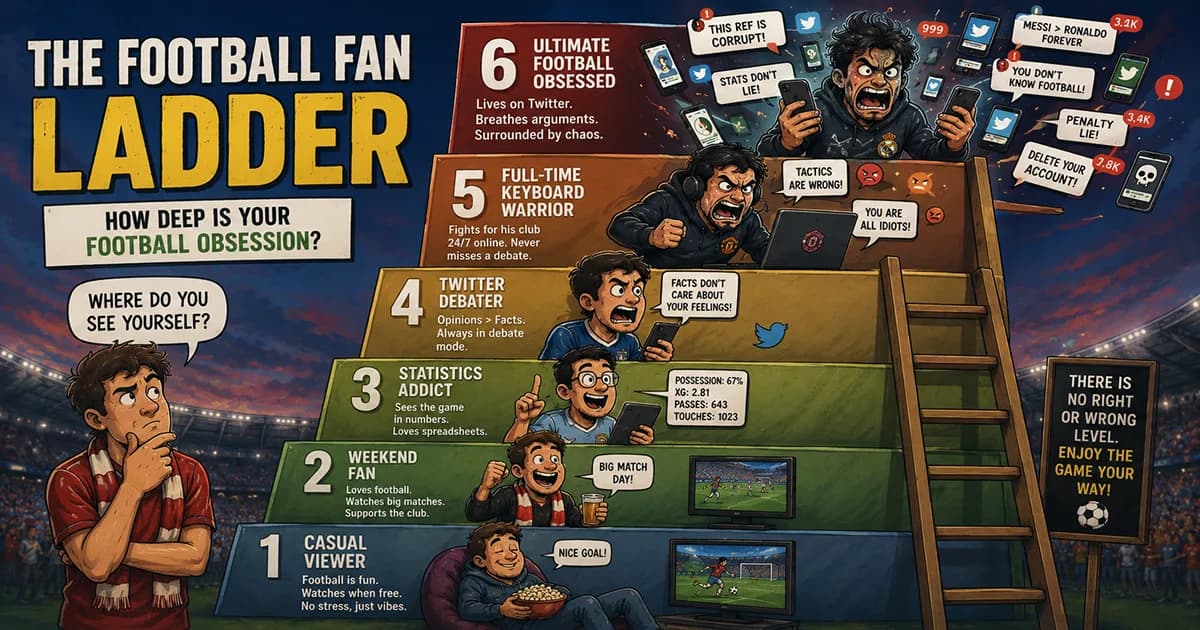
Ranking Football Fans By Toxicity Level
The Football Enjoyer
Just happy to watch the game.
The Respectful Supporter
Can compliment opponents.
The Friendly Banter Fan
Jokes without crossing lines.
The Matchday Troll
Gets louder after wins.
The Debate Champion
Argues every football topic.
The Rival Obsessor
Tracks rival failures constantly.
The Conspiracy Theorist
Nothing is ever accidental.
The Timeline Terror
Posts through every emotion.
The Professional Instigator
Creates chaos intentionally.
The Nuclear Football Fan
Treats football discussions like warfare.
Sports Psychology Fact
Fans often defend their teams more aggressively because group identity influences how people process criticism, success, and rivalry-related information.
Important Reminder
If you have ever celebrated a rival's defeat almost as much as your own team's victory, you may already be further up this ranking than you would like to admit.
Final Verdict: We're All A Little Bit Toxic Sometimes
The truth is that almost every football fan has displayed at least one toxic trait at some point. Maybe it was an overreaction after a defeat. Maybe it was an unnecessary argument online. Maybe it was celebrating a rival's misfortune with suspicious enthusiasm. Football creates powerful emotions, and powerful emotions occasionally produce questionable decisions.
What makes football culture enjoyable is not perfection. It is passion. Fans care deeply. They invest time, energy, memories, and emotions into their clubs. That investment creates incredible atmospheres, unforgettable celebrations, and communities that last for generations. The same passion that causes occasional toxicity is also responsible for much of what makes football special.
The healthiest supporters understand that football is a shared experience. Rivals are necessary. Banter is part of the fun. Arguments are inevitable. But everyone is ultimately participating in the same emotional adventure. The opposition fan suffering today will probably be celebrating tomorrow. The cycle never ends.
Deep down, most football supporters are remarkably similar. They panic during big matches. They overreact after results. They believe impossible comebacks are achievable. They create strange superstitions. They promise never to care this much again before immediately caring even more next week.
So whether you are a wholesome football enjoyer or a certified chaos merchant, remember one thing. The reason football fans can be so dramatic, irrational, emotional, and occasionally toxic is because they care. Sometimes far more than they probably should. And honestly, that is exactly why football remains impossible to quit.
Quick Picks
Games Guaranteed To Start An Argument
If the section on banter and rivalry felt a little too familiar, here is the browser equivalent. Play these with people you like, carefully.

Shooting
Rooftop Snipers
Two players, one keyboard, and physics ridiculous enough to make every single defeat feel unjust.
Strategy
Classic Ludo
The original board game for falling out with people. Nothing about it has improved since.
Strategy
Chess
Still the most civilised method ever invented for being extremely rude to a friend.
Related Articles
Sports
Why We Keep Watching Football Even When It Hurts: The Addictive Power Of Uncertainty
Football fans threaten to quit after every painful defeat and never actually do it. Here is what keeps pulling them back: the unpredictability that makes every kickoff genuinely unknowable, the hope that quietly returns a few days later, and the matchday rituals that end up mattering more than the results.
Sports
Ranking Cricket Fans By Panic Level: From Chill Spectator To Full-Time Emergency Broadcaster
A hilarious and relatable ranking of cricket fans based on panic levels during matches. Explore fan psychology, emotional reactions, superstitions, heartbreaks, last-over stress, and why every cricket fan slowly transforms into a nervous wreck.
Sports
Every Football Fan Has Experienced These 10 Emotions At Least Once
From last-minute winners to penalty shootout heartbreaks, discover the 10 emotions every football fan experiences. A deep dive into football psychology, fandom, rivalries, celebrations, and emotional chaos.
Sports
Why Sports Fans Take Losses Personally: The Social Identity Behind Saying "We Lost"
You never faced the bowler or missed the penalty, so why does the defeat feel like yours? An explanation of social identity and why supporters instinctively say "we lost", the expectation gap that turns hope into pain, and the reason a defeat to a rival keeps stinging for weeks afterwards.
Continue Exploring
Ready For More?
Jump into browser games or challenge yourself in Quiz Arena. There's always something new to discover.