Ranking Cricket Fans By Panic Level: From Chill Spectator To Full-Time Emergency Broadcaster
A hilarious and relatable ranking of cricket fans based on panic levels during matches. Explore fan psychology, emotional reactions, superstitions, heartbreaks, last-over stress, and why every cricket fan slowly transforms into a nervous wreck.
Format
Curated Article
Reading Time
9 min read
Published
June 29, 2026
Last Updated
August 4, 2026
Written by
Omik Babariya
Developer · Quiz Editor
Omik Babariya is a full-stack developer and quiz editor at Unihfy Games. He writes most of the quiz questions, works on the sports and entertainment articles, and has built and tested a number of the games on the site.
View Author ProfileAverage Mood Changes
37 Per Match
Times Fans Say 'It's Over'
12+
Heart Rate During Final Over
Maximum
Emergency Predictions
Unlimited
Superstitions Activated
100%
Every Cricket Match Is Secretly A Panic Simulator
Cricket fans love to describe themselves as logical people. They talk about strike rates, bowling averages, pitch conditions, matchups, and tournament scenarios. They sound calm before the first ball. They sound reasonable during the toss. They sound intelligent while discussing team selection. Then the match begins. Suddenly the same people who spent hours analyzing statistics are staring at the television like they are defusing a bomb. One wicket changes everything. A dropped catch becomes a national emergency. A missed yorker feels like the end of civilization. Cricket has an incredible ability to transform perfectly normal adults into emotional chaos generators within minutes.
The funniest part is that panic rarely arrives all at once. It sneaks in gradually. At first there is mild concern. Then a few quiet calculations. Then somebody starts checking required run rates every thirty seconds. Then someone else starts predicting disaster. By the time the match reaches a tense phase, fans are making speeches, changing seats, muting notifications, and acting as if the outcome will personally affect their life expectancy. Somehow a sport becomes an emotional roller coaster powerful enough to ruin lunch, improve dinner, and completely control an entire weekend.
This phenomenon is not limited to cricket. Football fans experience similar emotional breakdowns during penalty shootouts. Basketball fans suffer during final possessions. Tennis fans age visibly during championship tiebreakers. But cricket offers something uniquely cruel. The tension often stretches for hours. Fans have enough time to imagine every possible outcome. The brain starts creating victory celebrations and heartbreak documentaries simultaneously. It is psychological warfare disguised as entertainment.
What makes it even more relatable is that almost every fan believes their panic is completely justified. A neutral observer might see a team needing sixty runs from ten overs with seven wickets remaining and think everything looks manageable. The fan sees seventeen different ways the chase can collapse. The neutral viewer sees opportunity. The fan sees incoming disaster. That emotional overreaction is not a bug in sports fandom. It is one of the defining features.
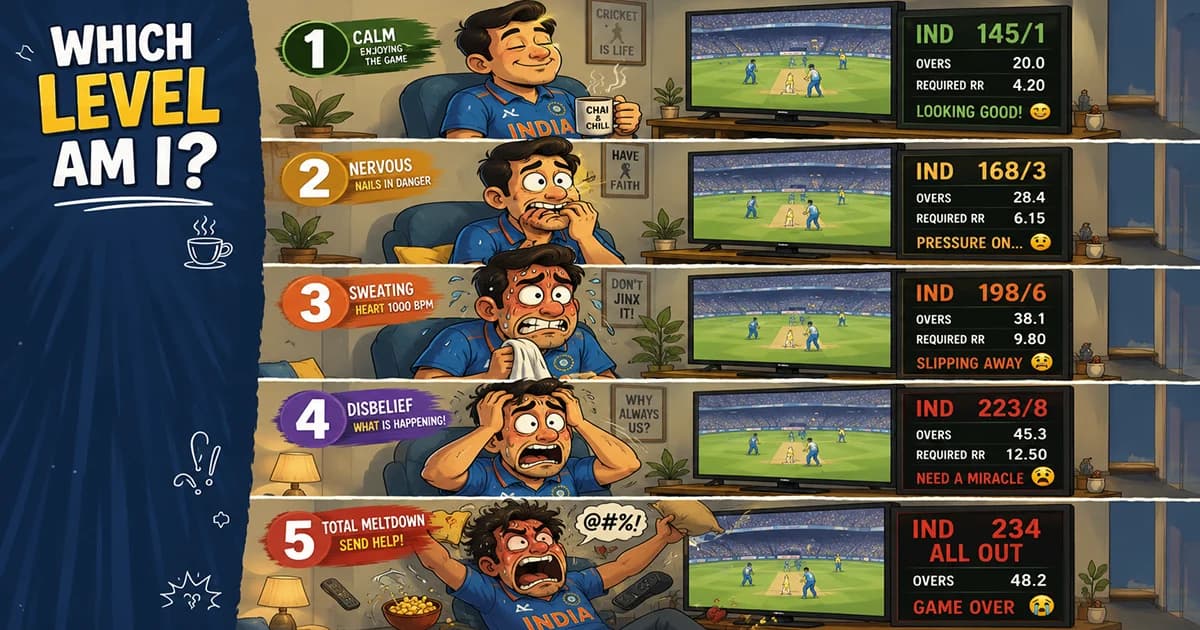
So let us do what every sports fan secretly loves doing. Let us rank cricket supporters by panic level. From the rare human beings who remain calm no matter what happens to the fans who begin preparing apology messages to friends after a single dot ball, this is the complete ladder of cricket-induced anxiety.
The Main Species Of Panicking Cricket Fans
The Zen Master
Remains calm until the very last moment and somehow survives every thriller.
The Overthinker
Calculates twelve possible match scenarios after every over.
The Group Chat Prophet
Predicts doom every five minutes.
The Ritual Specialist
Believes changing seats affects the scoreboard.
The Panic Broadcaster
Provides nonstop commentary about impending disaster.
The Angry Analyst
Responds to stress by criticizing every decision.
The Emotional Veteran
Has experienced too many heartbreaks to trust happiness.
The Catastrophe Expert
Assumes every match is moments away from collapse.
The Typical Emotional Journey During A Close Match
Confident Start
Easy win. Nothing to worry about.
Comfort
The team seems in control.
Minor Concern
That wicket was slightly annoying.
Nervous Math
Fans begin calculating outcomes.
Visible Stress
Required rates suddenly matter.
Panic Mode
Nobody breathe.
Superstition Phase
Don't move from your chair.
Complete Chaos
Every ball changes reality.
Euphoria
Best team ever.
Heartbreak
Sports are cruel.
"A cricket fan can go from 'we've got this' to 'it's over' in the time it takes a ball to reach the boundary."
— Match-Day Psychology
Why Cricket Creates More Panic Than We Ever Admit
One reason cricket creates such intense panic is because fans become emotionally invested long before the match starts. People carry memories into every game. They remember lost finals, shocking collapses, miracle victories, and painful tournament exits. A simple run chase is never just a run chase. It becomes connected to years of emotional baggage. When a team loses early wickets, fans are not just reacting to the current scoreboard. They are reacting to every previous disaster that looked suspiciously similar.
Sports psychologists often talk about emotional ownership. Fans begin feeling like part of the team. They celebrate wins as personal achievements and experience losses as personal setbacks. That is why a missed catch can ruin someone's evening despite having absolutely no direct impact on their actual life. The brain treats the event as important because identity has become attached to the outcome. The more passionate the fan, the stronger the emotional reaction becomes.
Cricket also provides something panic absolutely loves: time. There are pauses between deliveries, overs, innings, and strategic moments. Every pause allows the brain to imagine future disasters. In football, action moves quickly. In cricket, fans can spend thirty seconds visualizing three wickets, a collapse, a run-out, and a rain interruption before the next ball is even bowled. The imagination becomes an undefeated opponent.
Social media has made things even worse. Years ago, fans panicked with family members or friends nearby. Today millions panic together in real time. One nervous tweet becomes ten thousand nervous tweets. One pessimistic prediction spreads instantly. Group chats turn into crisis management centers. Every fan receives a constant stream of emotional reinforcement from other equally stressed supporters. It is basically a giant digital anxiety amplifier.
And yet fans love it. Nobody enjoys the stress while it is happening, but everybody misses it afterward. The emotional highs feel higher because the lows felt possible. The celebrations become unforgettable because panic made victory seem uncertain. Deep down, supporters know these emotional swings are part of what makes sports special.
Cricket Fan Panic Levels Ranked
The Iceberg
Barely reacts even during tense situations.
The Quiet Observer
Feels nervous but hides it well.
The Calculator
Begins tracking every possible scenario.
The Worrier
Sees danger in every over.
The Stress Tester
Cannot sit comfortably anymore.
The Match Prophet
Predicts both victory and defeat every minute.
The Emergency Analyst
Explains why disaster is imminent.
The Human Earthquake
Experiences complete emotional instability.
Ranking The Most Famous Panic Behaviors
At lower panic levels, fans mostly become calculators. They start asking harmless questions. What is the required run rate? How many wickets remain? Which bowler has overs left? It sounds analytical, but everyone knows what is happening. The brain is searching for reassurance. Fans pretend they are gathering information while secretly hoping the numbers will tell them everything is fine. Unfortunately, the numbers rarely provide emotional comfort.
As pressure increases, behavior becomes more creative. Some fans stop watching and start listening from another room. Others stare at score apps instead of live broadcasts because they believe delayed information hurts less. Some continuously refresh statistics websites. Some walk around the house. Some suddenly become extremely interested in kitchen activities during tense overs. These coping mechanisms are surprisingly common because stress demands action, even when no useful action exists.
Then comes superstition territory. This is where panic becomes art. Fans refuse to change television channels. Lucky shirts appear. Certain chairs become sacred. Drinks cannot be moved. Snacks cannot be replaced. Entire families unknowingly participate in rituals created by one stressed supporter. Logic completely disappears. The connection between couch position and batting performance makes absolutely no sense, but emotional brains are not interested in logic during a tense chase.
The highest panic levels are truly spectacular. These fans become emergency broadcasters. Every ball receives immediate analysis. Every mistake triggers dramatic reactions. Every close call is treated like breaking news. Friends receive messages nobody asked for. Group chats become unreadable. The fan experiences every over as a lifetime. Watching them is almost as entertaining as watching the match itself.
Most supporters move through multiple levels during the same game. A calm fan in the first innings can become a walking stress alarm by the final over. Panic is fluid. It adapts to context. And cricket, perhaps more than any other sport, provides endless opportunities for emotional transformation.
Moments That Instantly Increase Panic Levels
Early Collapse
Pain 9/10The dream start disappears immediately.
Dropped Match-Winning Catch
Pain 10/10Fans replay it forever.
Run-Out Confusion
Pain 9/10Everyone saw trouble coming.
Required Rate Rising Fast
Pain 8/10Mathematics becomes terrifying.
Rain Threat
Pain 8/10Weather suddenly becomes important.
Last Over Needed
Pain 10/10Heart rates enter dangerous territory.
Star Player Dismissed
Pain 9/10Confidence leaves instantly.
Losing By One Run
Pain 10/10Maximum emotional damage.
The Emotional Legacy Of Cricket Heartbreak
Veteran fans often panic earlier than newer supporters, and there is a reason for that. Experience. They have seen too much. They remember impossible collapses. They remember miracle comebacks by opponents. They remember finals that slipped away. Every fresh match carries memories from previous years. Younger fans may see a comfortable position. Older fans have witnessed enough chaos to know comfort can disappear without warning.
This explains why some supporters celebrate cautiously. They have learned that sports can be cruel. A football fan who survived a last-minute equalizer or a cricket fan who endured a dramatic collapse develops emotional scar tissue. Hope remains, but it becomes more careful. Optimism exists, but it travels with protective equipment. Every positive moment comes with a small voice whispering that the story might still change.
Oddly enough, these painful memories also make victories more meaningful. When fans finally witness redemption after years of frustration, the celebration becomes unforgettable. The emotional release is enormous because anxiety spent months or years accumulating. That is why championship wins create tears, laughter, and complete emotional overload. Fans are not just celebrating one match. They are celebrating survival.
Rivalries make everything stronger. A routine victory feels nice. A victory against a historic rival feels life-changing. Likewise, defeats become harder to accept. Every close contest gains extra significance. Panic arrives earlier and stays longer because the emotional stakes feel higher. The scoreboard may show only runs and wickets, but fans experience pride, history, identity, and bragging rights all at once.
In a strange way, panic is evidence of love. Nobody panics about something they do not care about. The stress, the rituals, the overreactions, and the dramatic predictions all exist because fans are deeply invested. It may not always feel enjoyable in the moment, but it is one of the reasons sports create such powerful memories.
Top 10 Panic Statements Every Cricket Fan Has Said
It's Over
Usually said far too early.
Don't Jinx It
A universal fan command.
Why Did He Play That Shot
The classic reaction.
I Have A Bad Feeling
Anxiety speaking loudly.
Nobody Move
Superstition enters the chat.
We're Throwing This Away
Peak stress behavior.
Just One Good Over
The bargaining phase.
I've Seen This Before
Trauma from past matches.
Why Am I Watching This
Asked during every thriller.
Never Doubted Them
Spoken immediately after doubting them.
Fan Psychology Fact
Research on sports fandom consistently shows that emotionally attached supporters experience physiological stress responses during close matches, including increased heart rate and heightened emotional reactions.
The Universal Truth
No matter how calm a cricket fan claims to be, every supporter has a panic threshold. The only difference is how long it takes the match to find it.
Final Verdict: We Are All One Wicket Away From Panic
The truth is that every cricket fan exists somewhere on this panic ranking. Some begin worrying after the toss. Others survive most of the match before finally breaking. A lucky few remain calm until the final over. But eventually every supporter encounters a moment that tests emotional stability. It might be a collapse, a dropped catch, a controversial decision, or a tense chase. The trigger changes. The panic remains universal.
That shared experience is one of the reasons sports fandom feels like a community. Millions of strangers experience the same emotional swings at the same time. They celebrate together, panic together, complain together, and recover together. The reactions may be irrational, exaggerated, and occasionally hilarious, but they create a bond that extends far beyond the game itself.
Years from now, most fans will not remember every statistic from a match. They will remember how it felt. They will remember standing during a final over, shouting at a television, refusing to blink during a catch, or celebrating wildly after a miracle finish. Emotion leaves deeper memories than numbers ever could.
So the next time you catch yourself calculating impossible scenarios, refusing to change seats, predicting disaster after a single wicket, or sending dramatic messages to your group chat, understand that you are participating in one of sports culture's oldest traditions. You are panicking exactly the way generations of fans have panicked before you.
And if you are reading this while confidently claiming that none of these descriptions apply to you, just wait until your team needs twelve runs from the final over in a knockout match. We will see you at Level Eight soon enough.
Quick Picks
Games That Recreate The Panic On Purpose
If you recognised yourself somewhere on that ladder, these produce the same rising dread without needing a run chase to be in progress.

Puzzle
Vortex
Starts calm and accelerates until you are making decisions faster than you can consciously think them.

Arcade
Fruit Slice Frenzy
A single missed swipe finishes the run, which is precisely the dot-ball feeling described above.

Arcade
Neon Catch
You choose the difficulty yourself, and then you immediately regret choosing it.
Related Articles
Sports
Why Every Cricket Fan Becomes A Coach During The Match
Discover the psychology behind why every cricket fan suddenly becomes a coach during live matches. Explore fan emotions, match-day behavior, superstitions, heartbreaks, tactical opinions, and the fascinating culture of cricket fandom.
Sports
The Science Behind Last Over Heart Attacks: Why Sports Fans Age 10 Years In 6 Balls
Explore the psychology and science behind last-over stress in cricket. Discover why fans panic, freeze, scream, create superstitions, and experience emotional chaos during the most dramatic moments in sports.
Sports
Most Painful Ways A Cricket Match Can End: A Complete Guide To Sports Heartbreak
Explore the most painful ways a cricket match can end. From last-ball losses and run-outs to dropped catches and heartbreaking collapses, discover the psychology behind sports pain and why fans never truly recover.
Sports
Every Football Fan Has Experienced These 10 Emotions At Least Once
From last-minute winners to penalty shootout heartbreaks, discover the 10 emotions every football fan experiences. A deep dive into football psychology, fandom, rivalries, celebrations, and emotional chaos.
Continue Exploring
Ready For More?
Jump into browser games or challenge yourself in Quiz Arena. There's always something new to discover.