How Famous Movies Would Have Ended If Characters Used Common Sense
What if movie heroes, villains, detectives, superheroes, and chosen ones made sensible decisions? Explore the hilarious alternate endings that would have shortened some of entertainment's biggest stories.
Format
Curated Article
Reading Time
12 min read
Published
June 25, 2026
Last Updated
August 4, 2026
Written by
Omik Babariya
Developer · Quiz Editor
Omik Babariya is a full-stack developer and quiz editor at Unihfy Games. He writes most of the quiz questions, works on the sports and entertainment articles, and has built and tested a number of the games on the site.
View Author ProfileThe One Thing Missing From Most Blockbusters
Movies are powered by drama, suspense, mystery, chaos, impossible odds, and the occasional explosion that somehow launches a hero into a pile of conveniently soft debris. What movies are not powered by is common sense. In fact, if common sense became a mandatory requirement for protagonists, entire franchises would collapse faster than a cardboard set in a windstorm. The average blockbuster depends on at least one character making a decision that would make real people stare at the screen and ask, 'Why would you do that?'
Think about how often entertainment relies on avoidable problems. Someone ignores a warning. Someone enters the creepy location alone. Someone decides not to explain critical information because the plot needs another forty-five minutes. A villain spends ten minutes delivering a speech instead of finishing their objective. A hero refuses to ask a single follow-up question. These moments are frustrating, but they are also the secret fuel of storytelling.
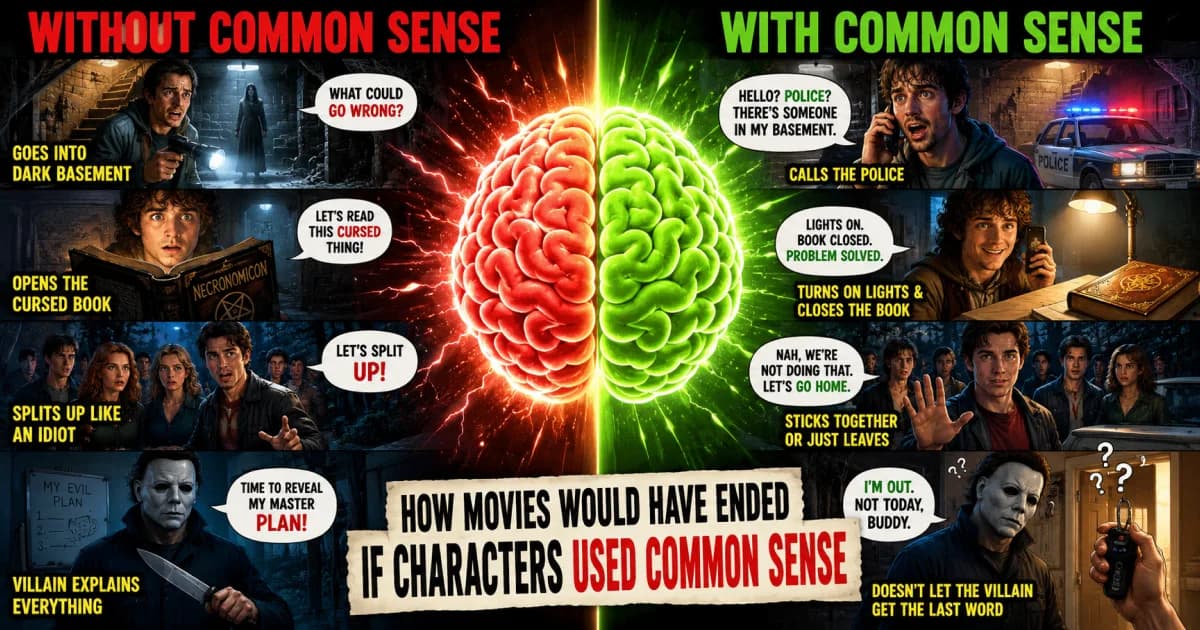
The funny thing is that audiences are fully aware of this arrangement. We know the mysterious glowing artifact should probably be left alone. We know opening the cursed book is a terrible idea. We know splitting up in a dangerous situation has approximately a zero percent success rate. Yet we happily watch because common sense would create very short movies and very bored screenwriters.
That raises a fascinating question. What would happen if famous movie characters suddenly gained the decision-making skills of a reasonably cautious adult? What if they communicated clearly, checked facts, listened to experts, and avoided obviously terrible plans? The answer is both hilarious and surprisingly revealing.
Today we're imagining alternate cinematic universes where characters embrace logic, patience, planning, and basic situational awareness. The result is a collection of stories that end much faster, involve far fewer explosions, and occasionally turn epic adventures into twenty-minute administrative meetings.
"Half of movie history exists because someone ignored a perfectly reasonable warning."
— Every Frustrated Viewer Ever
The Mysterious Basement
Setup
A group discovers strange noises coming from a dark basement late at night.
What We Thought
Everyone grabs flashlights, separates into smaller groups, and investigates the danger individually.
What We Realize Now
They call local authorities, turn on every available light, stay together, and wait somewhere safe. Roll credits.
The Horror Genre Would Be Finished By Tuesday
No genre suffers more from common sense than horror. Horror movies often begin with a sequence of decisions that would immediately fail a real-world risk assessment. Strange noises, abandoned buildings, mysterious invitations, suspicious rituals, and ominous warnings are somehow interpreted as exciting opportunities instead of giant flashing danger signs.
Imagine a horror protagonist receiving a message that says, 'Do not go into the forest after midnight.' In movies, that warning functions like a VIP invitation. In real life, most people would stay home, order food, lock the door, and continue watching videos online. The terrifying creature would spend the evening wandering around wondering why nobody showed up.
Then there is the legendary decision to split up. Entertainment has spent decades teaching audiences that separating during danger is a terrible strategy. Yet fictional characters continue treating it as a brilliant tactical innovation. If common sense entered the room, somebody would immediately say, 'Why would we divide our resources and make ourselves easier targets?' Suddenly the survival rate skyrockets.
Communication alone would destroy countless horror plots. Instead of hiding important information for dramatic reveals, people would simply compare notes. The person who saw the strange figure. The person who heard the voice. The person who found the warning. They would sit down, exchange information, identify the threat, and create a plan before things became catastrophic.
The biggest victim would be haunted houses. The moment walls start whispering, furniture starts moving, and shadows start behaving suspiciously, common-sense characters would not investigate further. They would leave. Immediately. Not after one more clue. Not after checking the attic. They would be gone before the opening credits finished.
The Universal Movie Rule
If a character says 'Let's split up,' audience stress levels increase by approximately one thousand percent.
Common Sense Superpower
The most overpowered ability in entertainment isn't super strength or flight. It's asking one extra question before making a life-changing decision.
Superheroes Would Spend More Time In Meetings
Superhero stories often celebrate courage, sacrifice, and determination. They also occasionally celebrate launching into battle with approximately three percent of the available information. If superheroes embraced common sense, many climactic conflicts would be replaced by planning sessions, strategy reviews, and surprisingly productive team discussions.
Picture a city-threatening crisis emerging on the horizon. Instead of individual heroes rushing in separately and creating misunderstandings, everyone joins a briefing. They share intelligence. They verify assumptions. They identify weaknesses. They establish communication channels. The final battle becomes significantly shorter because somebody prepared a spreadsheet.
Many superhero misunderstandings exist because people refuse to have thirty-second conversations. Entire conflicts emerge from incomplete information, secret identities, misplaced trust, or assumptions that could be clarified immediately. Common-sense heroes would sit down, exchange facts, and eliminate half the tension before lunchtime.
Villains would face unexpected challenges as well. Elaborate schemes often depend on heroes behaving predictably or emotionally. Rational decision-making would ruin countless master plans. The evil mastermind reveals a trap. The heroes acknowledge the trap. Then they simply avoid walking directly into it. Suddenly years of villainous preparation disappear.
Of course, this would produce fewer dramatic rooftop confrontations. On the other hand, it would produce more competent heroes, healthier teamwork, and significantly lower property damage. Insurance companies everywhere would celebrate.
Would Common Sense Improve Superhero Movies?
Yes, Absolutely
- ✓ Heroes would make smarter decisions.
- ✓ Conflicts would feel more realistic.
- ✓ Teamwork would replace avoidable misunderstandings.
Not So Fast
- ✕ Many iconic stories rely on mistakes.
- ✕ Perfect decisions can reduce tension.
- ✕ Audiences enjoy watching flawed characters grow.
"A shocking number of fictional disasters could be prevented by a group chat."
— Modern Pop Culture Logic
Detective Stories Would Become Shockingly Efficient
Detective movies and mystery thrillers often revolve around brilliant investigators uncovering clues hidden beneath layers of deception. Yet many investigations become difficult because people refuse to share information, ignore obvious evidence, or wander into danger without backup.
Imagine a detective receiving a threatening message from an unknown source. Instead of dramatically investigating alone, they immediately notify colleagues, document everything, and create a secure plan. The mysterious antagonist suddenly loses a major advantage.
One of the funniest recurring movie habits is the refusal to communicate discoveries. A character uncovers a crucial clue and decides to tell nobody until they can reveal it at the most dangerous possible moment. Common-sense detectives would send emails, upload evidence, and create backups before leaving the room.
Technology would also shorten many plots. The number of fictional mysteries that could be accelerated by sharing photos, comparing timelines, reviewing records, or simply checking available data is astonishing. Entire investigations would move from months to days.
This doesn't mean mysteries would disappear. Real puzzles are still fascinating. But the genre would become less about surviving avoidable mistakes and more about solving genuinely difficult problems. The detective would still look brilliant. They would simply look organized too.
The Villain's Monologue
Setup
The villain finally captures the hero and prepares to explain the entire plan.
What We Thought
A lengthy speech provides enough time for the hero to escape dramatically.
What We Realize Now
The villain says nothing, contacts the authorities anonymously, and accidentally defeats themselves by removing the plot device.
Most Dangerous Movie Phrase
The words 'I'll explain later' have caused more fictional chaos than almost any villain.
Romantic Comedies Would Last About Fifteen Minutes
Few genres depend on poor communication more than romantic comedies. Entire relationships rise and fall because someone overhears half a conversation, misunderstands a situation, or refuses to explain something that would take twenty seconds to clarify.
Imagine the classic misunderstanding. One person sees something confusing and immediately assumes the worst. In the movie version, this creates ninety minutes of emotional chaos. In the common-sense version, they ask a simple question. The confusion disappears. Everyone enjoys dessert together.
Many romantic leads spend astonishing amounts of time avoiding direct conversations. They send mixed signals, make assumptions, and interpret silence as certainty. Realistically, healthy communication would eliminate most of these obstacles before they evolved into dramatic crises.
The funniest consequence is that romance itself would actually improve. Instead of watching people stumble through preventable misunderstandings, audiences would see compatibility, honesty, trust, and genuine connection. Less dramatic? Perhaps. More emotionally mature? Definitely.
Of course, entertainment thrives on complications. But it is difficult not to laugh when a fictional couple spends two hours resolving a problem that could have been solved during a three-minute coffee break.
The Common Sense Cinematic Universe
The Planner
Creates backup plans before trouble begins.
Usually prevents disasters before they become movie-worthy.
The Communicator
Shares important information immediately.
Accidentally destroys entire plot twists.
The Exit Expert
Leaves dangerous situations instantly.
Has the shortest screen time and highest survival rate.
The Researcher
Checks facts before acting.
Ruins ancient curses, conspiracies, and secret villain plans.
The Greatest Plot Twist
Imagine a character receiving suspicious instructions from a stranger and responding with, 'That doesn't sound safe.' The movie industry would tremble.
Action Heroes Would Discover The Magic Of Preparation
Action movies love momentum. Heroes sprint toward danger because hesitation can feel boring. Yet if action protagonists embraced common sense, preparation would become the real star of the show. Surprisingly, that might make them even more impressive.
Think about how many action heroes succeed despite terrible odds, limited information, and impossible circumstances. Their victories are entertaining, but they often depend on extraordinary luck. Common-sense heroes would reduce their reliance on luck and increase their reliance on planning.
Before entering dangerous territory, they would gather intelligence. Before confronting powerful opponents, they would analyze risks. Before attempting impossible missions, they would establish backup options. The result would be fewer dramatic close calls and more strategic victories.
This approach actually mirrors many real-world success stories. Great achievements rarely happen because people charge forward blindly. They happen because preparation creates opportunities. The movie version may involve fewer last-second escapes, but it would showcase competence in a different way.
Ironically, audiences often love highly capable characters. Watching someone solve problems intelligently can be just as satisfying as watching them survive chaos. The difference is that common-sense heroes earn their victories before the action begins.
Which Is More Entertaining?
Brilliant Planning
- ✓ Competence is satisfying to watch.
- ✓ Smart victories feel earned.
- ✓ Strategic storytelling can be thrilling.
Glorious Chaos
- ✕ Mistakes create tension.
- ✕ Unexpected disasters are memorable.
- ✕ Audiences love impossible recoveries.
What Happens In Movies vs Real Life
Fantasy
A stranger offers a mysterious opportunity with no details.
Reality
Most people ask questions before agreeing.
Fantasy
Critical information is withheld for dramatic reasons.
Reality
Good communication solves problems quickly.
Fantasy
Dangerous locations deserve immediate investigation.
Reality
Many people prefer staying alive.
Fantasy
A risky plan is the only option.
Reality
There is usually a safer alternative.
Why We Secretly Don't Want Common Sense To Win
After all this joking, an interesting truth emerges. Audiences constantly complain about bad decisions, yet those decisions are often responsible for the stories we love. Remove every mistake, misunderstanding, impulsive choice, and emotional reaction, and many beloved narratives disappear completely.
Human beings are not perfectly rational. We make assumptions. We panic. We hesitate. We overreact. We trust the wrong people. We ignore advice. These flaws create conflict, and conflict creates stories. Fiction exaggerates these tendencies because perfect decision-making is surprisingly difficult to dramatize.
There is also something deeply relatable about watching imperfect characters struggle. We may laugh at their mistakes, but we recognize pieces of ourselves in them. Nobody gets through life making flawless choices. Seeing characters stumble and recover can be strangely comforting.
The best stories often strike a balance. Characters make mistakes, but they learn. They face consequences, adapt, and grow. Common sense eventually arrives, but not before the journey teaches something meaningful. That growth is often more satisfying than immediate perfection.
In other words, common sense might save fictional worlds, but bad decisions create unforgettable entertainment. The trick is making those decisions believable enough that audiences stay invested instead of throwing popcorn at the screen.
The Ultimate Alternate Ending
Let's imagine the ultimate common-sense blockbuster. The hero receives accurate information. The team communicates effectively. The villain's plan is identified early. Experts are consulted. Risks are evaluated. Backup plans exist. Emergency contacts are informed. Nobody enters suspicious buildings alone. Nobody ignores obvious warnings.
The first act becomes a planning session. The second act becomes efficient problem-solving. The third act becomes a carefully coordinated resolution with minimal collateral damage. The credits roll forty minutes early and everyone arrives home safely.
Would it be realistic? Surprisingly, yes. Would it be entertaining? Maybe not in the traditional blockbuster sense. Audiences love spectacle, uncertainty, and emotional stakes. They enjoy wondering whether characters will overcome impossible situations. Perfect choices remove much of that suspense.
Yet imagining these alternate endings remains endlessly funny because it highlights how storytelling works. The giant battles, dramatic reveals, shocking twists, and emotional confrontations often exist because someone made one questionable decision at exactly the wrong moment.
So the next time you're watching a movie and a character ignores every available warning sign, remember that you're witnessing the engine of entertainment at work. Common sense may be practical, but cinematic chaos is unforgettable. And somewhere in a parallel universe, a very sensible hero solved the entire plot in fifteen minutes and nobody bought a ticket.
Quick Picks
Games Where Thinking Ahead Actually Works
The whole article imagines films in which characters stop and use common sense. These are games that reward precisely that.


Related Articles
Entertainment
If Superheroes Had Normal Jobs
What would happen if superheroes traded world-saving adventures for regular nine-to-five careers? A hilarious deep dive into the workplaces that might be perfect for people with extraordinary abilities.
Entertainment
Childhood Movie Scenes That Hit Different As An Adult
The movie moments that felt fun, exciting, or completely normal as kids suddenly reveal deeper emotions, life lessons, and heartbreaking truths when viewed through adult eyes.
Entertainment
Why Everyone Thinks They'd Survive A Zombie Apocalypse
From overconfidence and movie logic to survival fantasies and everyday delusions, here's why almost everyone believes they'd thrive during a zombie apocalypse.
Entertainment
Movie Endings That Still Start Arguments
Some movie endings refuse to stay in the theater. Years later, fans still debate what happened, what it meant, and whether the ending was brilliant or frustrating.
Continue Exploring
Ready For More?
Jump into browser games or challenge yourself in Quiz Arena. There's always something new to discover.