01
Step 01
Stand inside the right box
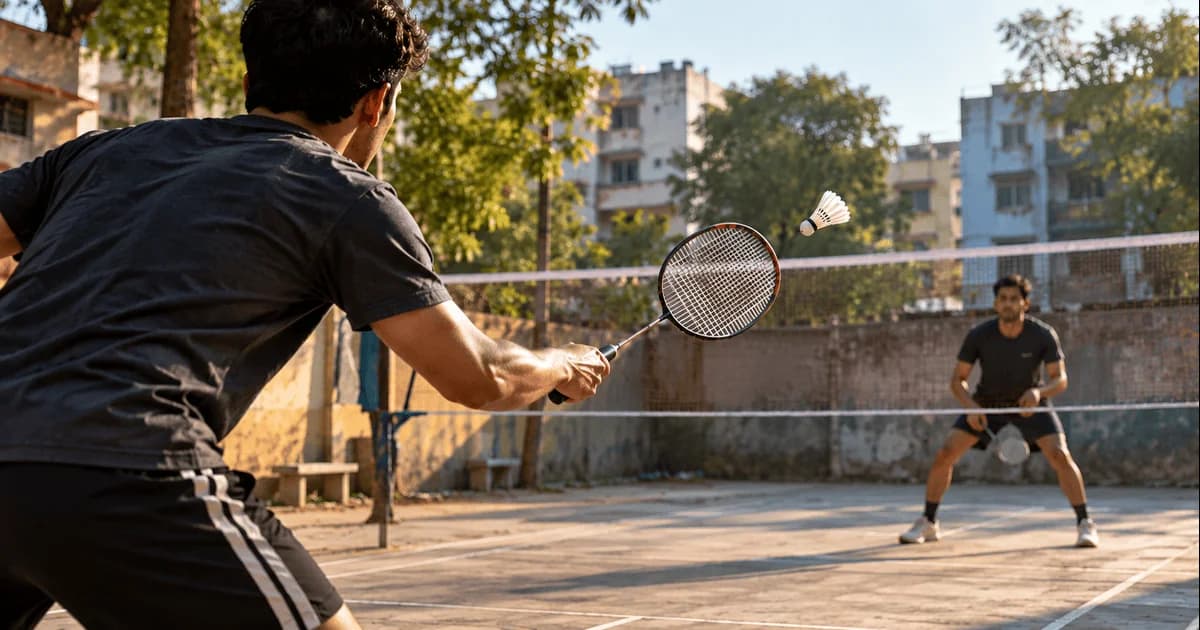
Both you and the receiver stand inside your service courts, diagonally across from each other, without touching the lines.
No games found
Unihfy Games
Loading identity...
Quick Access
Badminton rules explained simply: how scoring to 21 works, where to stand when you serve, the 1.15 m serve rule, singles and doubles courts, the faults most street players never learned, why a shuttle flies so strangely, and how to put it all into practice in Gully Badminton.
Format
Curated Article
Reading Time
13 min read
Published
October 27, 2026
Written by
Developer · Game Reviewer
Kaushik Hirpara is a full-stack developer and game reviewer at Unihfy Games. He designs and builds every game on the site, gets them playing well on phones, and writes up what players need to know.
View Author ProfileAlmost everyone who grew up playing badminton in a lane, on a terrace or in a society compound remembers the argument. The shuttle lands right on the chalk line. One side shouts 'out', the other shouts 'in', a cousin who was not even watching gives a verdict, and the game carries on with somebody sulking.
Street badminton runs on house rules. The washing line is a let, the neighbour's wall is out, and whoever owns the racket gets to serve first. That is half the fun. But it also means plenty of people have played for years without ever learning how the real game is scored, where you are meant to stand when you serve, or which of their favourite tricks are actually faults.
This guide covers the official rules in plain words, the ones that settle the arguments. Then it shows how to practise them in our street badminton game, where the court is a lane and the net is a dupatta on a rope.
Points to win a game
21
Games in a match
Best of 3
Net height at the centre
1.524 m
Highest point for a serve
1.15 m
Badminton uses rally point scoring. Every rally gives a point to someone, whichever side served. This is different from the older system some people still play at home, where only the serving side could score. The world body for the sport, the Badminton World Federation (BWF), switched to rally scoring in 2006.
A game goes to 21 points, and a match is the best of three games. If the score reaches 20-all, you have to win by two clear points, so a game can end 22-20 or 25-23. It cannot go on forever, though: at 29-all, the next point wins, and the game ends 30-29.
There are two short breaks. When the leading side reaches 11 points in a game, players get up to 60 seconds of rest, and there are up to two minutes between games. Players change ends after each game, and in a third game they change again when the leader reaches 11, so neither side spends the whole decider with the light or the draught in their favour.
Shorter formats, including games to 11 and games to 15, have been trialled and debated over the years, but 21 is still the standard you will find in tournaments.
The serve is where most street players go wrong without knowing it, so it is worth taking slowly. Each half of the court is split into a right and a left service court. The server stands in one and serves diagonally across the net into the opposite one, and the receiver waits in that box.
Which side you serve from depends on your own score. When it is even (and zero counts as even), you serve from the right. When it is odd, you serve from the left. Win the rally and you serve again, from the other side. Lose it and the serve passes over.
Doubles uses the same even-and-odd rule, based on the serving side's score. Only one player serves at a time. While your side keeps winning, the same player keeps serving and switches between right and left. When your side wins the serve back, you do not swap places first: whoever is standing in the right box or left box, depending on the score, is the one who serves.
How It Flows
Under the BWF Laws of Badminton, a serve is only good if all of these are true. Breaking any one is a fault, and unlike tennis, you do not get a second try.
Both you and the receiver stand inside your service courts, diagonally across from each other, without touching the lines.
Part of both feet must stay on the ground, and not move, from the start of the serve until the shuttle is hit. A little shuffle or a step forward is a fault.
Your racket has to strike the base of the shuttle, the cork, rather than the feathers.
At the moment you hit it, the whole shuttle must be below 1.15 m from the floor. This fixed height replaced the old 'below the waist' rule in top-level play, because a waist is not the same height on every player. Many local games still use the waist.
Once you start the swing, keep it going. Pausing halfway or faking a serve to catch the receiver out is not allowed.
The serve has to pass the short service line and land inside the receiver's service court. A shuttle that lands on a line counts as in.
A full court is 13.4 m long and 6.1 m wide, and it is covered in lines that confuse almost everyone at first. The trick is that not every line is used in every game.
In singles, the court is long and narrow. You ignore the outer side strip, so the court is 5.18 m wide, but a serve can go all the way to the back line. In doubles, it is the other way round when serving. The outer sidelines are in, so the serving box is wider, but there is a second line 76 cm in front of the back line, and a serve that lands beyond it is out. Once the serve has been returned, the whole doubles court is in play right to the back.
The short service line, 1.98 m from the net, is the same in both. A serve that does not reach it is a fault. It is a good line to remember if you are chalking a court yourself.
If the shuttle touches your body or your clothes, you lose the rally, even if it was flying out. Ducking out of the way of a shot that is going long is the smart move.
Your racket, body or clothes must not touch the net or its posts while the shuttle is in play. Brushing it in the excitement of a kill still counts if the shuttle has not yet hit the floor.
You must hit the shuttle on your own side of the net. Your racket may follow through over the net after the hit, but reaching across to hit it early is a fault.
The same player cannot hit the shuttle twice in a row, and in doubles you and your partner cannot both hit it on the same side. Catching and slinging it on the strings is also a fault. A shot that clips the frame and the strings in one swing, though, is fine.
Deliberately distracting an opponent, by yelling or waving just as they hit, is a fault. Calling 'mine' or 'leave it' to your own partner is fine.
A shuttle that touches the ceiling, the walls, or anything else outside the court is a fault against the player who hit it. In a gully, every balcony, wire and tree needs a house rule agreed before you start.
A let means the rally is cancelled and the same serve is taken again, with no point to anyone. It is used when something unexpected interrupts play, such as a shuttle flying in from the next court, or when the server serves before the receiver was ready. One thing that is not a let: a serve that clips the top of the net and still lands in the right box is simply a good serve.
Myth vs Reality
The Myth
01A shuttle that lands on the line is out.
The Reality
The line is part of the court, so a shuttle that lands on any part of it is in.
The Myth
02If your serve hits the net, you take it again, like in tennis.
The Reality
There is no net let in badminton. If it clips the net and lands in the right box, it is in. If it falls on your side, it is a fault.
The Myth
03You get two serves.
The Reality
You get one. A faulty serve hands the rally, and the point, to the other side.
The Myth
04Only the server can win a point.
The Reality
That was the old scoring. Since 2006, every rally wins someone a point.
The Myth
05The game ends at 21, whatever happens.
The Reality
From 20-all you need a two-point lead, up to a cap of 30. At 29-all, the next point wins.
The Myth
06A high, overhead serve is a power move.
The Reality
Serves are underarm. The shuttle must be below 1.15 m when you hit it, so any overhead serve is a fault.
If you have ever misjudged a clear and watched it drop just behind you, you have met the strangest thing about badminton. A shuttle is 16 feathers fixed into a rounded cork, weighing about five grams. It leaves the racket faster than the ball in almost any other racket sport, and then it brakes harder than any of them.
In 2015, a team of French physicists published a paper called 'The physics of badminton' that described exactly this. Because the feathers catch so much air, a shuttle's flight is not the smooth arc a ball makes. It rises, slows sharply, and then falls almost straight down, as if it had hit an invisible wall. The same paper explains why the shuttle always turns over to fly cork first, however it is hit.
The speed at the start can be startling. In 2023, India's Satwiksairaj Rankireddy set a Guinness World Record with a smash measured at 565 km/h. Yet the same shuttle, hit softly, can barely clear the net and die. That is why reading the shuttle, knowing where it will drop rather than where it is going, matters more than raw speed for beginners. Good players get under the shuttle early and wait for it.
A high, deep shot that lands near the back line. It pushes your opponent away from the net and gives you time to get back into position. Use it when you are under pressure.
A soft shot that falls just over the net. It works best when your opponent is standing deep, expecting another clear.
A shot that travels low and level across the net. Good from the middle of the court, when the shuttle is too low to smash and too high to lift.
A steep, hard hit down into the other court. Save it for a shuttle that is high and not too deep, and aim for the floor, not the opponent's racket.
Badminton has deep Indian roots. In the 1860s and 1870s, British army officers stationed in India played a version of the game, and it was often called 'Poona' after the city where it was popular. The name that stuck came later, from Badminton House, an estate in Gloucestershire, England, where the game was played.
Whatever the history books say, the version most Indians know best was never played on a proper court. It was played in the evening, between two houses, with a string for a net, until it was too dark to see the shuttle or somebody's mother called them in for dinner.
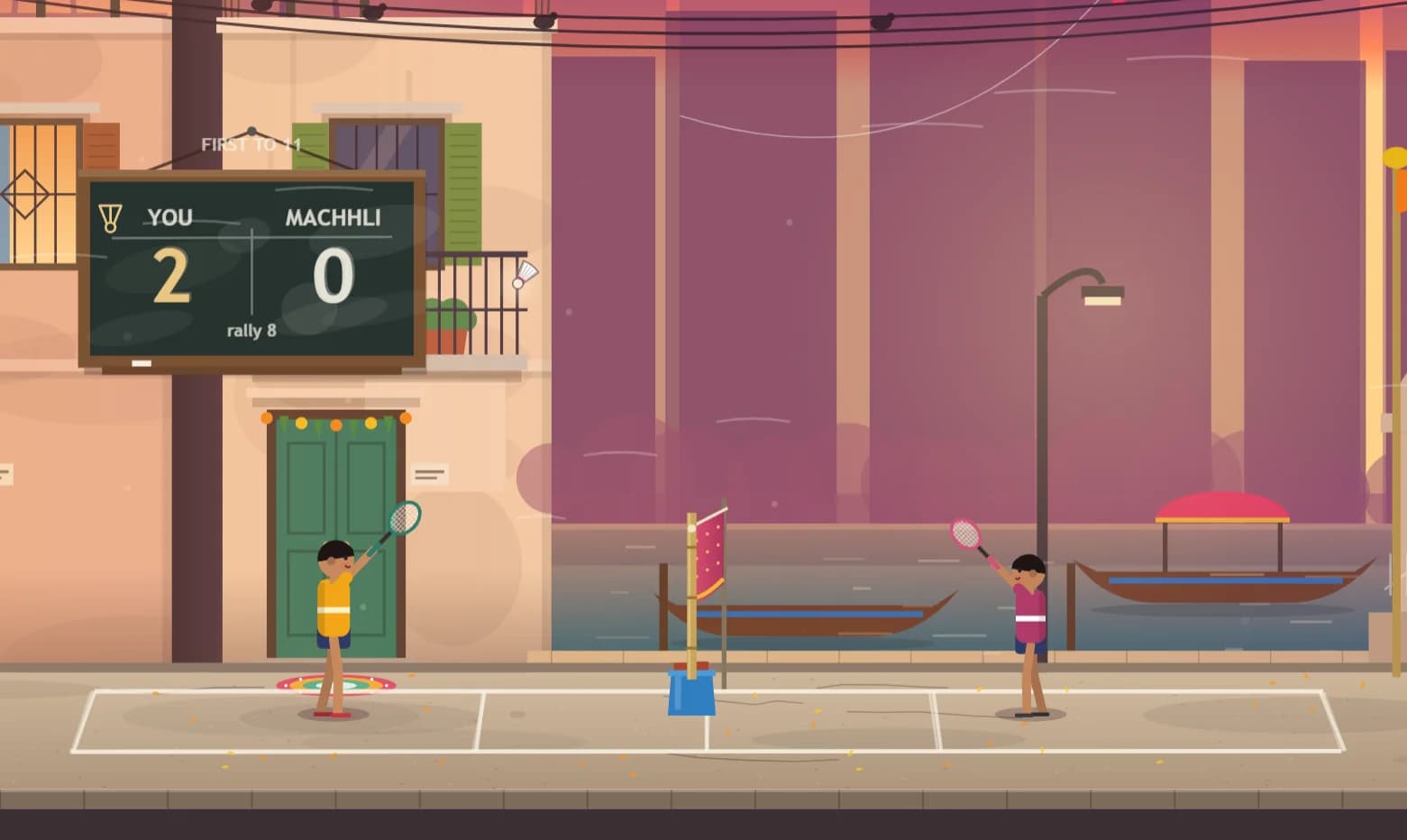
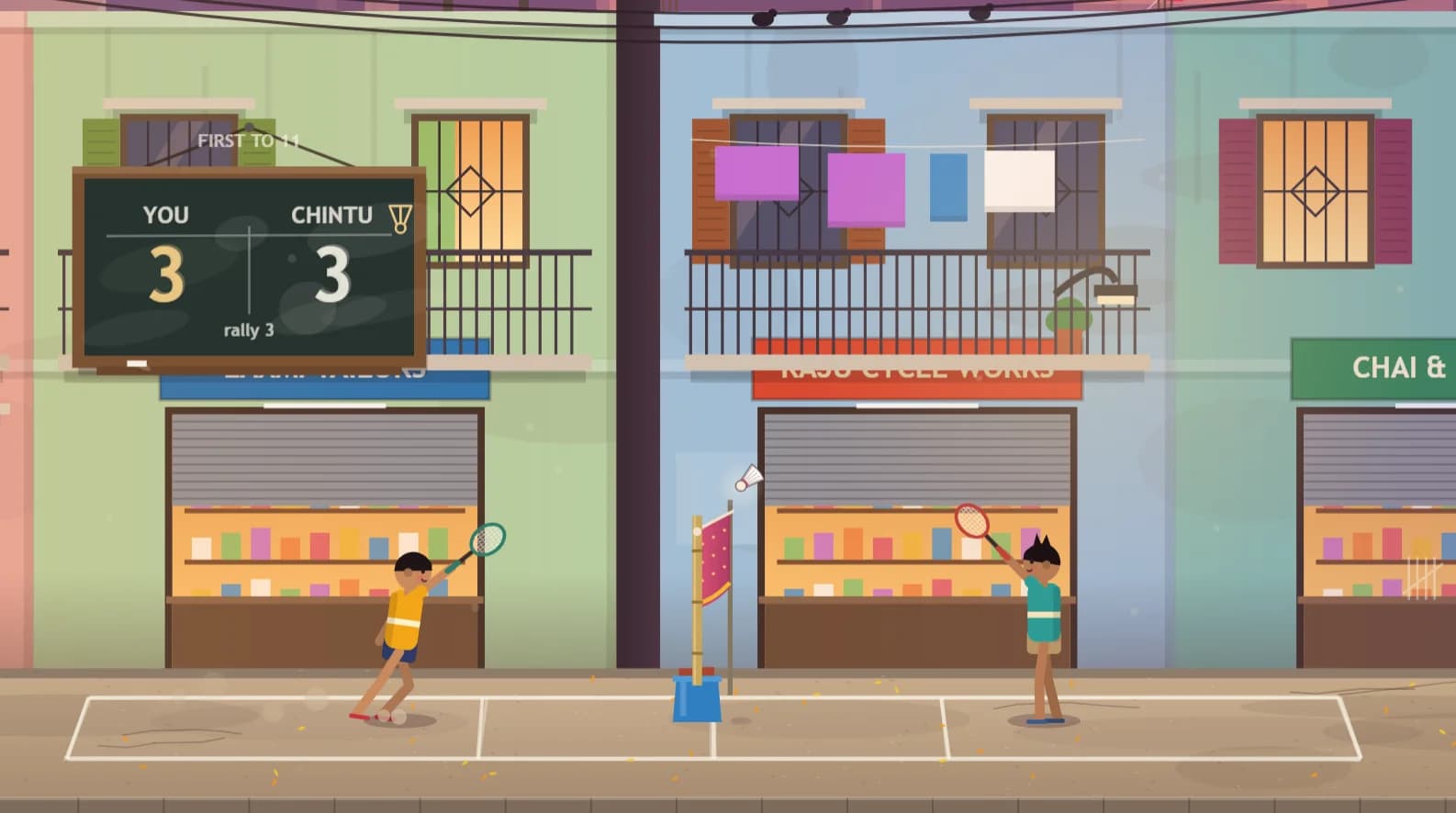
We built Gully Badminton, a free street badminton game that runs in the browser, around exactly that kind of evening. You play side-on in an Indian neighbourhood: the court is chalked on the lane, a dupatta tied on a rope between two balconies is the net, and the score is chalked on a small blackboard hanging on the wall.
The rules are the real ones, shortened for quick matches. Most matches are first to 11, and the champs play to 15. You still need to win by two, up to a cap where the next point decides it, and the game calls deuce, match point and golden point as they come. Every rally scores a point, just as in rally scoring.
The serving rules from this guide are in there too. You serve from your box, and moving while you serve is a foot fault, just like the real rule about keeping both feet still. A serve that lands short of the line is a fault. You can choose a short serve that drops just over the rope or a high one to the back, the same two serves players use on a real court.
Most importantly, the shuttle behaves the way the physicists described: a quick start, a hard brake, then a near-vertical fall. So the skill the game asks for first is the same one a coach would teach on day one, which is to judge where the shuttle will come down and get there before it does.
How It Flows
It plays on a keyboard, with a mouse, or on a phone. The controls below cover both, and each opponent and place adds something new as you go.
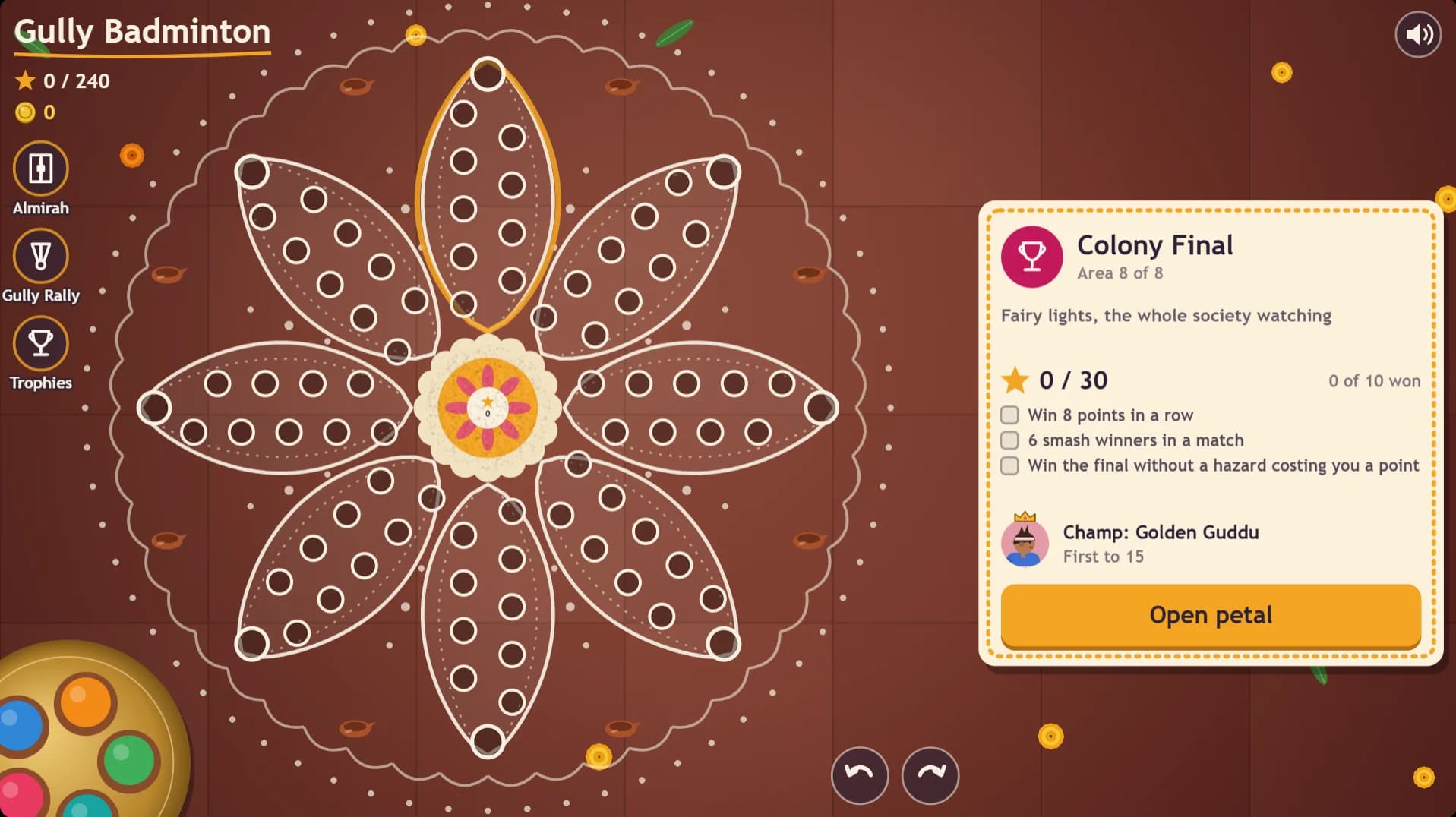
The match select is a rangoli with eight petals, one for each place in the neighbourhood, and ten opponents set round each petal. Each card names the opponent and the habit to watch out for.
A cork is tossed to decide who serves first. Stand still in your box, then press Space (or tap) for a short serve, or W (or swipe up) for a high one.
Use A and D or the arrow keys to run. On a phone, hold the two run pads at the bottom left. Try to be under the shuttle a moment early, with it coming down just in front of you.
Swipe up for a clear, down for a smash, across for a drive, or tap for a drop. On a keyboard it is W, S, E and Space, or I, K, L and J.
Your swipe picks which shot you play, but your timing decides its quality. Catch the shuttle on the sweet spot for a perfect hit that travels quicker and straighter. Mistime it and the frame takes it, and the shot drifts up softly for your opponent.
Any win earns a star, and keeping your opponent's score low earns more. In a match to 11, holding them to 6 or fewer gives two stars and 3 or fewer gives three. One star opens the next match.
There are 80 matches across eight places, from the Gully Lane to the Colony Final, with ten opponents in each. The tenth in every place is its champ. What makes them useful for learning is that each one has a habit, and each habit has a real badminton answer.
The Smasher hits anything above the rope, so you learn to keep the shuttle low with drives and drops instead of feeding them high clears. The Net hugger stands right at the rope, which is exactly when a clear over their head works. The Lobber keeps sending it sky-high to your back line, so you learn to move back early. The Chappal steady is slow on their feet but never misses, so the answer is to make them run from front to back. The Retriever gets to everything and teaches patience, and the Ace server puts tricky serves right on the lines.
Two are about the score rather than the shuttle. The Slow starter is sleepy at first, so you win the early points while you can. The Fighter plays best when behind, so you learn to close a game out instead of easing off. Real players learn the same lessons; here, each opponent teaches one at a time.
In the Gully Lane, the clothes hanging over the court trap any shuttle sent into them, and the point goes against the player who sent it. It is the gully version of hitting the ceiling.
Later in the lane, a neighbour's window sticks out above your half. Clip it and out comes the uncle with a telling-off, and the point is gone too.
Up on the Rooftop Terrace, wind shoves the shuttle off its line. Watch the bunting: it flutters just before a gust arrives, so you can aim a little into it.
Under the School Ground verandah, a spinning fan knocks down anything hit too high, and that point is lost. Flatter clears keep you safe.
When a scooter cuts through the Market Chowk, the rally stops and the point is played again. That is a let, exactly as the real rules call it.
When the rain reaches the Railway Colony, the soaked shuttle gets heavier and lands shorter than you expect, and the wet ground makes every first step and every stop a little slower.
By the river, high shots drift with a breeze that keeps changing direction, and a small flag tells you which way. It shows why real tournaments are played indoors.
In the Colony Final, the electricity can cut out mid-rally. The balconies light up with phone torches, and you keep your eye on the pale shuttle in the dark until the generator brings the lights back.
Every place has three side goals, listed on its card on the rangoli, and many of them are the same drills a coach would set. A rally of 10 shots trains consistency: keeping the shuttle in play instead of going for a winner too early. Eight perfect hits in a match trains timing, getting under the shuttle before you swing. Two aces trains the serve. Winning from 4 points down trains the calm needed to come back.
Gully Rally is good practice for consistency too. It is an endless rally against Chintu, your first opponent, where every clean return scores a point and a winner scores three, and you have three lives. As your score climbs, Chintu sharpens and the lane gets busier, so it rewards steady, safe returns more than wild smashes.
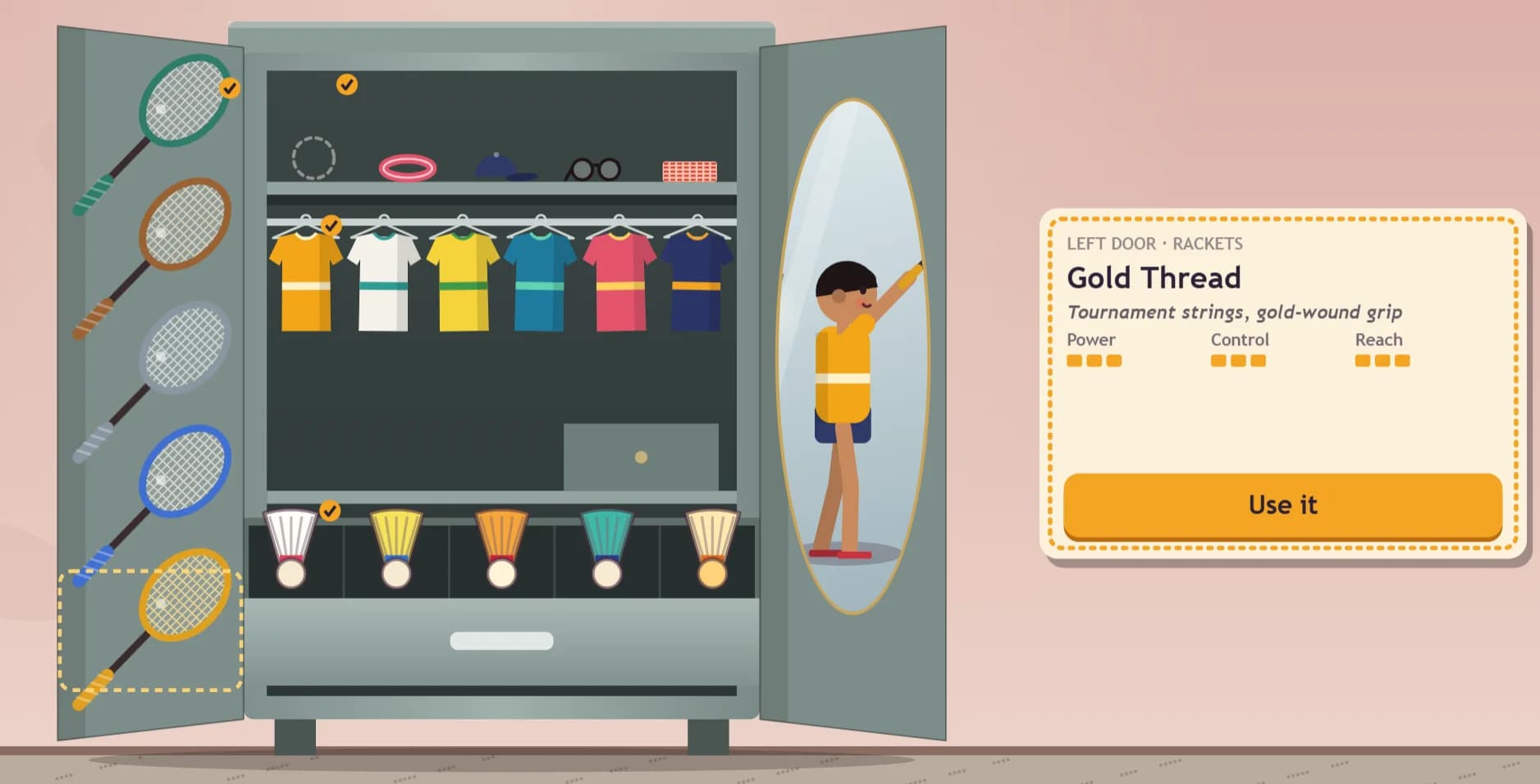
Stars, wins and side goals all pay coins, and the place to spend them is the Steel Almirah, the kind of steel cupboard found in many Indian homes. Its five rackets are rated on power, control and reach, which are the same trade-offs players weigh when they buy a real racket. More power means a harder, steeper smash. More control means fewer mishits. More reach means fewer shuttles just out of range.
You begin with the balanced Lane Racket. If your shots keep floating, the Wooden Classic is the control pick. The Steel Frame suits players who like to smash, the Long Reach helps when the far corners keep beating you, and the Gold Thread, the most expensive, is strong at everything. The caps, tees and shuttle colours change only how you look, never how the shuttle flies.
If you are setting up a real game in a lane or on a terrace, tie the rope at about 1.55 m, which is a little over five feet and the height of a real net at the posts. Chalk a short service line about two metres from it. And before the first serve, agree on the house rules: what happens when the shuttle hits a wire, a wall or a balcony. It saves the argument for later.
Quick Reference
The scoring system in which every rally wins a point for one side, whoever served.
The box you serve from or receive in. Each half of the court has a right and a left one.
The line 1.98 m from the net. A serve must pass it to be good.
A rally that is cancelled and replayed with no point given, usually because of an unexpected interruption.
Any break of the rules, such as hitting the net or serving too high. The other side wins the rally.
A high, deep shot that lands near the opponent's back line.
A soft shot that falls just over the net.
A flat, fast shot that travels low across the net.
A steep, powerful shot hit downward into the opponent's court.
A common name for a tied score near the end of a game, when one side must pull two points ahead to win.
Quick Picks
Our sports games were made in-house at Unihfy Games, and each one is built around a different real skill. All of them run in the browser with nothing to install.
Sports
Street badminton in an Indian neighbourhood, with 80 matches, real shuttle flight and a dupatta for a net.
Sports
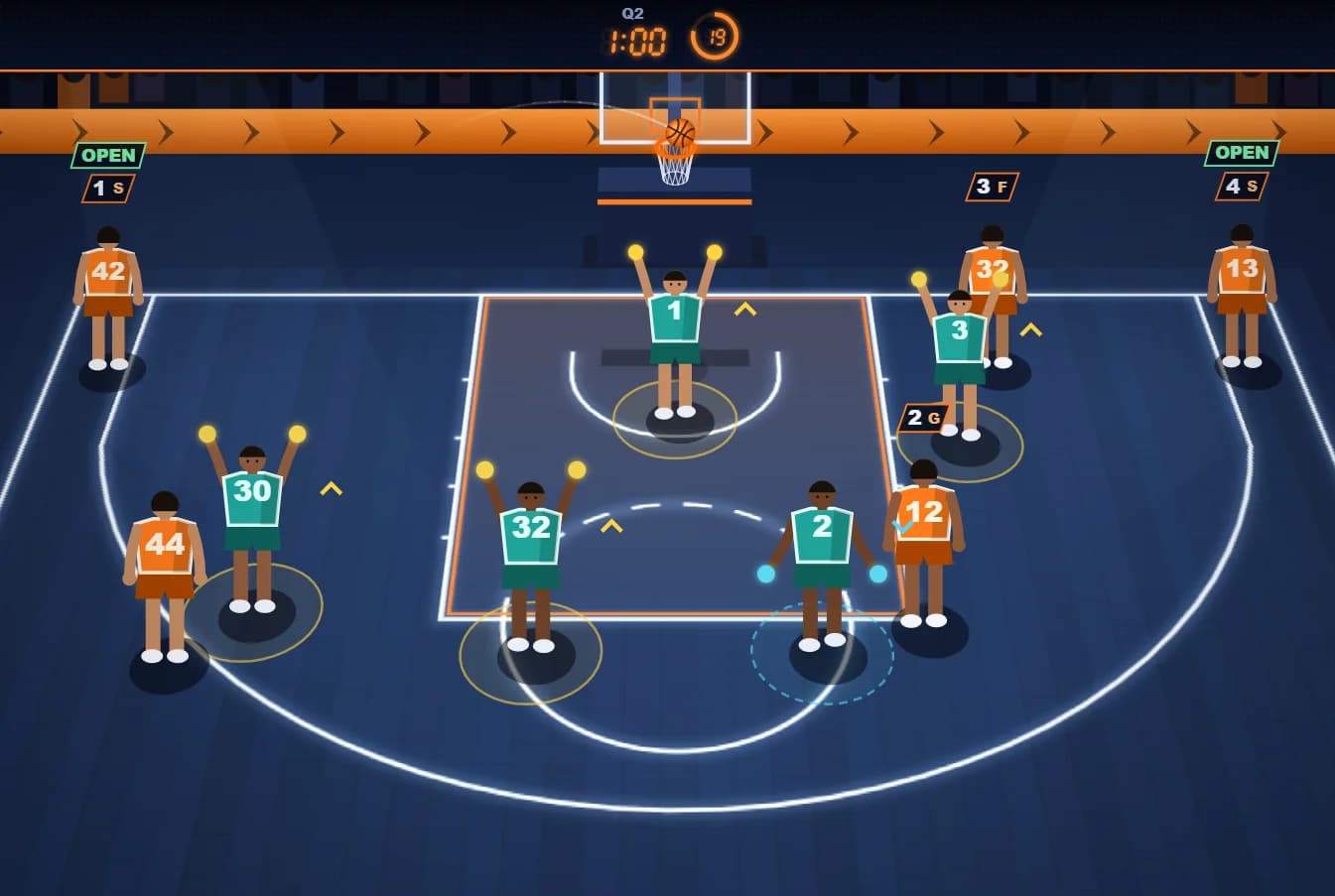
A basketball season where good ball movement grows the green on your release meter, so passing pays off.
Sports
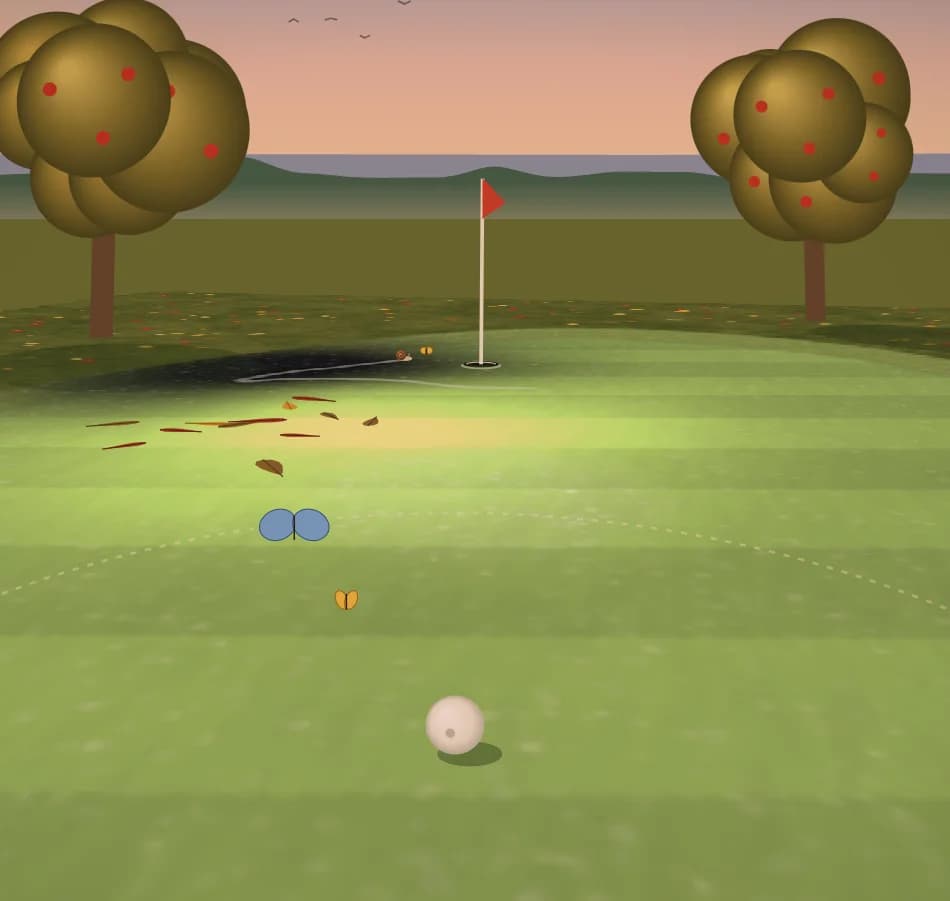
A putting game played from a low view behind the ball, where you brush ahead of a rolling putt to steer it.
Action
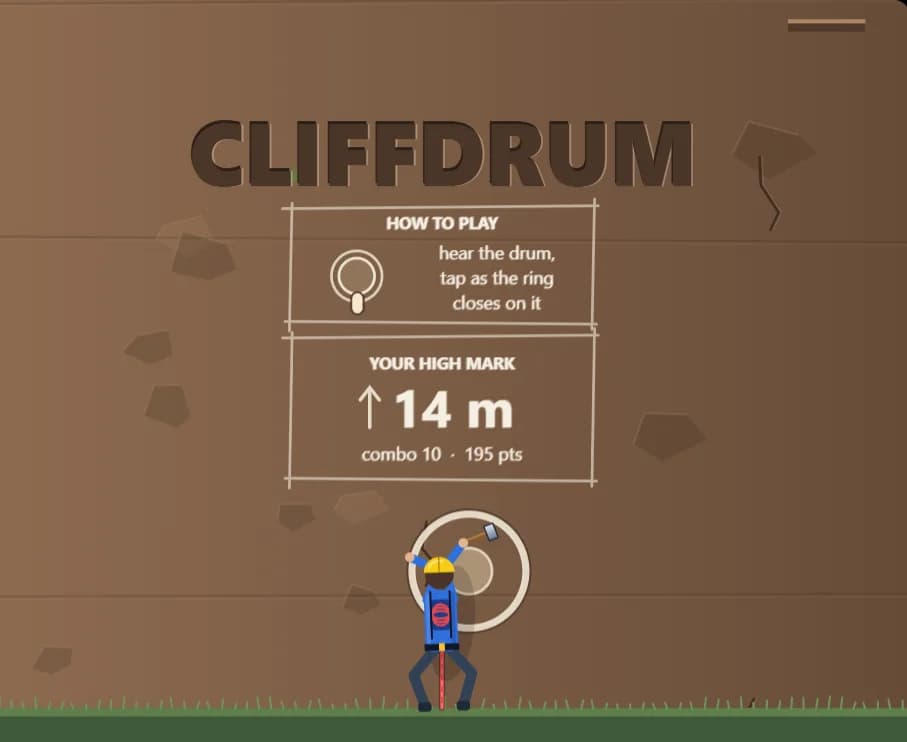
A one-tap rhythm climb, good for the same sense of timing a perfect badminton swing needs.
Badminton is scored to 21 with a point on every rally, best of three games, and a two-point lead needed from 20-all up to a cap of 30. Serve underarm from the right box on an even score and the left on an odd one, with both feet still and the shuttle below 1.15 m. A shuttle on the line is in, a shuttle that hits you is your fault, and a serve that clips the net and lands in is good. Learn those, and most gully arguments are settled before they start.
Sports
Basketball rules explained simply: how many steps count as traveling, what a double dribble really is, how the 24-second shot clock works and why it exists, how NBA and international rules differ, and how to play Unihfy Basketball Season, our free passing game.
Sports
Golf scoring terms explained simply: what par means, every score name from condor to triple bogey, why golf names its good scores after birds, how bogey went from a good score to a bad one, how to read a leaderboard and a TV scorecard, and how to practise par on the putting greens of Unihfy Golf Greens.
Sports
Discover the psychology behind why every cricket fan suddenly becomes a coach during live matches. Explore fan emotions, match-day behavior, superstitions, heartbreaks, tactical opinions, and the fascinating culture of cricket fandom.
Sports
A hilarious and relatable ranking of cricket fans based on panic levels during matches. Explore fan psychology, emotional reactions, superstitions, heartbreaks, last-over stress, and why every cricket fan slowly transforms into a nervous wreck.
Continue Exploring
Jump into browser games or challenge yourself in Quiz Arena. There's always something new to discover.