Unihfy Games

Gully Badminton

Gully Badminton

SportsBadmintonStreetTimingSwipe ControlsEndless ModeSingle Player

Games > Gully Badminton

Play Gully Badminton • Free

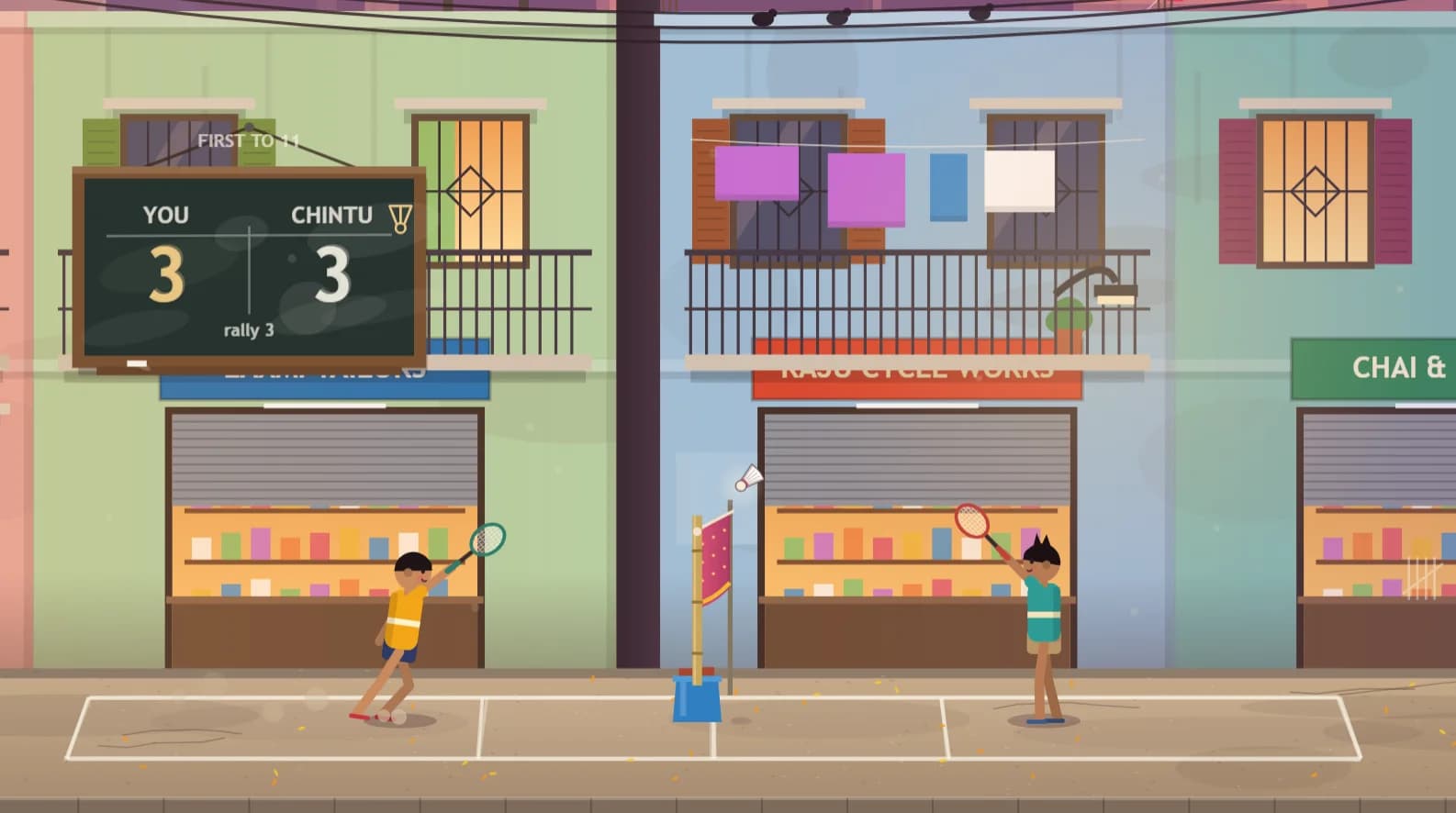
A street badminton game set in an Indian neighbourhood at dusk. A dupatta tied on a rope between two balconies is the net, the court is chalked on the lane, and the neighbourhood is waiting for a game. You see the court from the side: run under the shuttle, time your swing, and swipe up for a clear, down for a smash, across for a drive, or tap for a soft drop. The shuttle floats and slows like a real one, so reading where it will fall is half the game. Play 80 matches across eight places, from the Gully Lane outside the blue door to the Colony Final under fairy lights, against ten opponents in each, every one with a habit of their own and the tenth the area's champ. Each place plays differently, with a washing line over the court, an uncle's window, rooftop gusts, a peepal tree, a ceiling fan, a wandering cow, the local train, monsoon rain, a river breeze and power cuts. Win with a big lead for three stars, chase three side goals in every area, spend your coins in the Steel Almirah on rackets that change how you play, try for a best score in the endless Gully Rally, and fill a trophy shelf with cups and medals.

Genre: Sports

Difficulty: Easy to start against Chintu in the lane, then sharper opponents, matches to 15 against the champs, and more hazards in every place up to the Colony Final

About Gully Badminton

Reading the shuttle

A shuttle does not fly like a ball. It leaves the racket fast, slows down sharply as its feathers catch the air, and then drops almost straight down. A clear goes high and lands near the back line, a drop dies just over the rope, a drive stays flat and fast, and a smash comes down steep. Watching how a shot leaves the racket tells you where to run.

Your swing reaches a little in front of and behind you, and up above your head. The best spot is just in front of you, so try to be under the shuttle a moment early rather than chasing it. When it flies above the top of the screen, a small arrow at the top shows where it is.

The neighbourhood and its opponents

Each of the 80 opponents has a habit. The All-rounder plays steady rallies with no tricks. The Smasher hits anything above the rope, so keep it low. The Lobber sends it sky-high to your back line, and the Net hugger stands at the rope, so clear it over their head. The Chappal steady is slow on their feet but never misses, so make them run. The Driver hits flat, fast drives at you, and the Retriever gets to everything, so be patient. The Trickster mixes deep clears with sneaky drops, and the Ace server puts tricky serves right on the lines. The Slow starter is sleepy at first, so win the early points; the Fighter plays best when behind, so close it out; and the Show-off jump-smashes everything but misses some.

Every area has ten opponents, and the tenth is its champ, who plays to 15: Pappu Dada, king of the gully; Chhotu Chacha on the terrace; Mahant-ji in his chappals at the temple; PT Sir, whistle and all, at the school; Lala-ji, who owns half the market; TT Sahab, who checks every line, at the railway colony; Ghat Dadi, grandma of the ghat; and Golden Guddu, the colony champion. Beat a champ and a diya lights up on the rangoli.

Eight places, each with its own trouble

Gully Lane: washing hangs over the court from the third match. A shuttle that flies into the clothes is caught, and whoever hit it loses the point. From the sixth match a neighbour's window juts out over your side, and a shuttle that hits it brings the uncle out to scold you, which also costs the hitter the point.

Rooftop Terrace: gusts sweep across the roofs and push the shuttle sideways. The bunting and a wind tag at the top of the screen warn you just before. Later matches hang washing on the terrace too.

Temple Courtyard: an old peepal tree leans over the court. A shot into its leaves drops straight down, and now and then one sticks, losing the hitter the point. In later matches the branches reach over your side as well.

School Ground: the verandah's ceiling fan swats anything that flies into it, and whoever hit it loses the point. A second fan turns on your side later on.

Market Chowk: a cow ambles through the court between the vegetable carts. A shuttle that lands on her back bounces off and stays in play. From the fifth match scooters cut through as well, and the rally stops and the point is played again.

Railway Colony: when the local train rushes past behind the court, its wind pushes the shuttle the way the train is going, and the signal turns green just before. From the fourth match the monsoon arrives: a wet shuttle is heavy and falls short, and the lane is slippery, so you are slower to start and to stop.

River Ghat: a steady breeze off the water drifts the high shots, and a pennant shows which way it blows. It changes now and then, and later matches add gusts on top.

Colony Final: the whole society is watching under fairy lights, and the power can go out for a few seconds at a time. The lights flicker first, phone torches come on in the balconies, and the white shuttle is what you follow until the generator kicks in. Each match in the final adds a mix of the earlier troubles.

The first time a hazard turns up, the lane dims, a spotlight falls on it, and a card explains what it does while a ghost shuttle shows it off. The opponents have to deal with the hazards too, and a shot of theirs that goes into the washing or the fan is your point.

Side goals and coins

Every area has three side goals, which you can meet in any of its matches. They ask for things like a rally of 10 shots, 3 smash winners in a match, 2 aces, 8 perfect hits, 5 points in a row, winning from 4 points down, holding an opponent to 4 points or fewer, making the fan swat 2 of their shots, or winning without a hazard costing you a point. The goals are listed on each area's card on the rangoli.

Coins come from three places: 10 for each new star, 5 for every win, and 50 for each side goal the first time you meet it. Gully Rally pays 1 coin for every 5 points you score.

The Steel Almirah

Coins are spent at the Steel Almirah, a tall steel cupboard whose doors swing open to show what is inside. Rackets hang on the left door and a mirror is on the right, caps sit on the top shelf, tees hang on the rail, and shuttles are kept in the drawer. Pick an item and its paper tag shows what it does and what it costs, with Buy or Wear.

The five rackets change how you play, each rated for power, control and reach. The Lane Racket you start with is even all round. The Wooden Classic has the most control, for cleaner hits. The Steel Frame hits hardest, with a steeper smash. The Long Reach gets to the far ones, and the Gold Thread is top in all three.

Everything else is for looks: a sweatband, a cricket cap, round specs or a gamcha over the shoulder; six tees from Marigold to Night Navy; and five shuttles, from plain white feathers to the Diya Glow, which leaves a warm streak of light. The shuttles all fly the same.

Gully Rally

Gully Rally is an endless rally in the lane against Chintu, your first opponent. Every clean return you make scores a point, and a winner he cannot reach scores three. Losing a point costs one of your three lives. As your score climbs, Chintu gets sharper and the play gets quicker; at 25 points the washing comes out over the court, and at 60 the uncle's window joins it.

Your best score is kept, and shown on a plaque on the trophy shelf.

The trophy shelf

The trophy shelf keeps what you have won. Each area has a cup that grows as you play there: bronze for beating its champ, silver for winning all ten of its matches, and gold for three stars on every one. Every side goal you meet hangs a medal on the shelf, and the Gully Rally plaque shows your best score. Pick any of them to read what it is for.

Sound and what the game keeps

All the sound is made in code: the swish of the racket, the pock of the shuttle, the chalk on the board, the cheers from the balconies, and each place's own air, from rooftop wind and rain to the ceiling fan, the train, the generator, crickets, market chatter and the river. Each area has its own tune on tabla, tanpura and a lead such as flute, harmonium, santoor or shehnai. The speaker button or the M key turns it off, and the game follows the site's mute as well.

Your stars, coins, side goals, the gear you own and wear, your Gully Rally best, the hazards you have already met and your sound setting are saved on Unihfy Games in this browser.

Reviewed By
Kaushik Hirpara

Developer · Game Reviewer

Kaushik Hirpara is a full-stack developer and game reviewer at Unihfy Games. He does most of the work of bringing games to the site — adapting them to run properly in a browser, getting them working on phones, playing them, and writing up what players need to know.

View Profile
Game Created By

Unihfy Games

Gully Badminton is an original game created and published by Unihfy Games. We continue to improve it with new features, gameplay enhancements, and platform optimizations.

Designed and built in-house by Kaushik Hirpara at Unihfy Games. All code, art and sound are original.

Proprietary SoftwareAll game credits

How to Play

  • Pick an opponent on the rangoli. Each of its eight petals is one area of the neighbourhood, with ten opponents set round it like medallions. Turn to an area, open it, choose a face and press Play. Each opponent's card shows their name, a line about them and the habit to watch out for.
  • A cork is tossed at the start and points at whoever serves first. To serve, stand still in your service box and tap (or press Space) for a short serve, or swipe up (or press W) for a high one. Moving while you serve is a foot fault, and a serve that lands short of the line is a fault too.
  • In a rally, run so the shuttle comes down just in front of you, and swing as it arrives. Swipe up for a clear that sails to the back, down for a steep smash, across for a flat drive, or tap for a soft drop over the rope. A swing timed right meets the shuttle in the middle of the strings for a perfect hit, with more pace and a truer line; a late or early one catches the frame and floats.
  • The point goes to whoever made the other miss. A shuttle that lands in the other court, or that the other side hits into the rope or out, wins it. The score is chalked on a blackboard hanging on the wall, rubbed out and written again after every point.
  • Most matches are first to 11, and the champs and a few tough opponents play to 15. At the end you must win by two, up to a cap (15 for a match to 11, 21 for a match to 15) where the next point takes it. The game calls deuce, match point and golden point as they come.
  • Win to earn a star, and keep the opponent's score low for more: in a match to 11, holding them to 6 or fewer earns two stars and 3 or fewer earns three. A star opens the next match. The results card shows your stars, a tip for the next one, and your longest rally, perfect hits, smash winners and aces.

Gameplay Preview

Features

Side-view street badminton with a dupatta on a rope for a net
Swipe or key shots: clears, smashes, drives and drops, plus short and high serves
Floaty shuttle flight that slows and drops like a real one
Timed swings for perfect hits off the middle of the strings
80 matches across eight places, from the Gully Lane to the Colony Final
Ten opponents in each place, every one with their own habit, and a champ to finish
Matches to 11 or 15 with deuce, match point and golden point calls
One to three stars per match, from how few points you give away
Washing lines, an uncle's window, gusts, a peepal tree, a fan, a cow, scooters, the local train, rain, a river breeze and power cuts
The Rangoli match select, with a petal for each area and diyas for each champ beaten
Three side goals in every area
The Steel Almirah: five rackets that change how you play, plus caps, tees and shuttles
Gully Rally, an endless mode with lives and a best score
A trophy shelf of cups, medals and a rally plaque
Music and sounds for every place, all made in code
Keyboard and mouse on desktop, run pads and swipes on phones

FAQs

How do I hit different shots?

Swipe up for a clear, down for a smash, across for a drive, or tap for a soft drop. On a keyboard, W is a clear, S a smash, E a drive and Space a drop (or I, K, L and J). The direction you choose decides the shot; when you swing decides how well you hit it.

How do I get perfect hits?

Be under the shuttle a moment early, with it coming down just in front of you, and swing as it arrives. A well-timed swing meets it in the middle of the strings for a perfect hit, which goes faster and truer. Swinging too early or too late catches the frame and the shot floats.

Why did I lose the point when I served?

Two things count as faults on a serve: moving while you serve (a foot fault) and a serve that lands short of the service line. Stand still in your box, then tap for a short serve or swipe up for a high one.

How do the stars work?

You need to win for any stars. Then the fewer points the opponent scored, the more stars you get. In a match to 11, holding them to 6 or fewer gives two stars and 3 or fewer gives three. In a match to 15 it is 8 or fewer for two and 4 or fewer for three. One star opens the next match.

My opponent keeps beating me. Any tips?

Read their card on the rangoli: it names their habit. Keep the shuttle low against a smasher, clear over a net hugger's head, make a slow but steady opponent run, and win the early points against a slow starter. A racket from the Steel Almirah can help too, for example the Long Reach if you keep just missing the far ones.

Why did the shuttle get stuck or bounce oddly?

That is the place's hazard. Washing lines, the uncle's window, the peepal leaves and the ceiling fan catch the shuttle, and whoever hit it loses the point. A cow's back bounces it back into play, and a scooter makes the point be played again. Each hazard is explained on a card the first time you meet it.

What do the rackets do?

Each is rated for power, control and reach. Power makes your shots faster and your smash steeper, control makes your hits cleaner, and reach lets you get to shuttles a little further away. Caps, tees and shuttles only change how things look.

How do I get coins?

Each new star pays 10 coins, every win pays 5, and each side goal pays 50 the first time you meet it. Gully Rally pays 1 coin for every 5 points. Spend them in the Steel Almirah from the rangoli.

What is Gully Rally?

An endless rally against Chintu in the lane. Every return you make scores 1 point and every winner scores 3, and you have three lives. Chintu gets better and the lane busier as your score climbs. Your best score is kept on the trophy shelf.

What happens if I leave the game in the middle of a match?

The game pauses and the sound stops. When you come back, the pause card is waiting with the score exactly as it was: choose Resume to carry on, Start over to play the match again from 0–0, or Leave match to go back to the rangoli.

Can I play on my phone?

Yes. Hold the two run pads at the bottom left to run, and swipe or tap anywhere else to play a shot. The pause and sound buttons sit at the top right, below the site's close button.

Is my progress saved?

Yes. Your stars, coins, side goals, gear, Gully Rally best and sound setting are kept in this browser on Unihfy Games. Clearing your browser data removes them.

Who made Gully Badminton?

Gully Badminton was designed and built in-house at Unihfy Games by Kaushik Hirpara. Its code, art and music are all original, the places, people and gear are invented, and everything you see and hear is generated by the game itself.

Ready for a New Challenge?

Take on exciting quizzes, improve your general knowledge, earn XP, collect rewards, maintain your daily streak, and compete with players on the Quiz Arena leaderboard.

Go to Quiz Arena