Unihfy Games

Cliffdrum

Cliffdrum

ActionOne TouchRhythmTimingClimbingEndlessHigh ScoreSingle Player

Games > Cliffdrum

Play Cliffdrum • Free

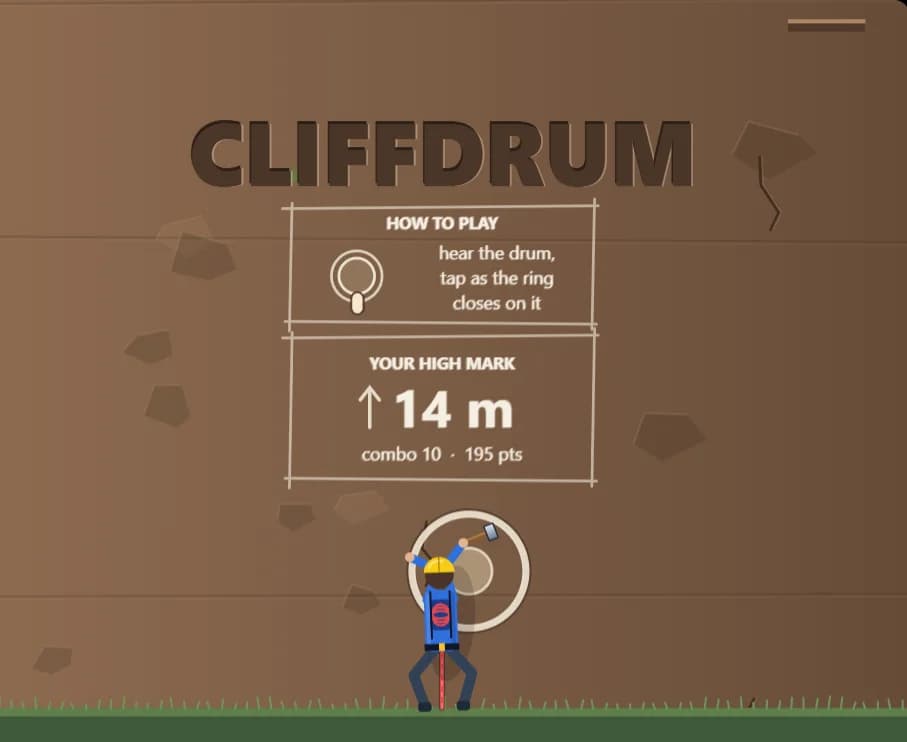
A climber in a yellow helmet scales a sheer cliff, one steel piton at a time, to the beat of a drum. A ring closes on the spot where the next piton goes, and you tap exactly as it lands: the hammer comes down, the piton bites, and the climber hitches a metre higher. Tap on the beat and the combo builds, the drum track builds with it and the score multiplier climbs. Tap off the beat and the boots slip on the rock. Slip twice before you steady yourself, or miss the beat by a mile, and you fall. Loose rock tightens your timing, gusts of wind push the beat around and cracks ask you to press on one beat and hold through to the next. The light changes as you rise, from warm gold at the foot of the cliff to a cool blue day and, near your best height, pale frost.

Genre: Action

Difficulty: Easy at the foot, with a slow drum and clean rock, then a faster beat and loose rock, gusts and cracks that get longer, closer together and harder up to around 250 metres, where it settles at a hard level

About Cliffdrum

A drum you can feel and see

Cliffdrum is a rhythm game with one input. There is no menu of songs: the cliff is the song. The drum keeps a steady four-beat bar, with a deep boom on the first beat and a lighter tom on the others, and everything you do is judged against it.

The beat is shown as well as heard. The closing ring, the pulsing dots, the flash across the rock and the pulse around the screen edge all land on the beat, so you can play on a train with the sound off. The timing is worked out from the exact moment you touch the screen, not from the frame the game was drawing, so a slow frame doesn't make you late.

Gusts, loose rock and cracks

Gusts are the biggest change to the rhythm. The wind can swing the beat (long, short, long, short), stall it for half a beat every bar, drag it slower or, further up, rush it faster or scramble it so every gap is different. The beat never gets closer than a third of a second, and the ring and the drum always agree, so the answer is always to follow the ring.

Loose rock is the test of accuracy. Inside it, the windows for Perfect and Good shrink to about four fifths of their size at first and about three fifths at the top, and there is no Close call to fall back on. Stones trickle off the rock and the piton throws up grit.

Cracks add a second kind of tap. A hold takes the beat you press on and the beat you let go on, and the climber pulls slowly up through it. Finishing a hold earns a bonus on top of the height. If you let go early, the hold breaks, you slip, and the beat you should have let go on becomes a normal tap.

From gold to frost

The light follows your climb. Low down the cliff is warm and golden with moss on the stones, a low sun and distant ridges. Further up the sky turns a cool blue, with clouds drifting past and mist hanging on the rock. Near your best height the rock goes pale and frosty, with snow on the ledges, icicles and an iced edge. Each time you beat your best, the frost line moves up with it. The change is only for looks, and the obstacles play the same in every light.

Three layers of mountains slide down behind the cliff at different speeds as you rise, and the climber, the pitons and the rope are all drawn in detail: a steel piton with a clipped carabiner, a hammer arm that winds up as the beat comes near, boots that scrabble on a slip and arms that flail when you fall.

Sound and what the game keeps

All the sound is made in code: the taiko and tom drum track, the clang of the hammer on steel, the scrape of gravel, the rush and thud of a fall, the wind that grows with height, and the chimes as your multiplier steps up. The drum track grows with your combo and strips back when you slip. The game follows the site's sound switch.

Your best height, longest combo and best score are saved on Unihfy Games in this browser. Your score for a run is sent to the site when you fall.

Reviewed By
Kaushik Hirpara

Developer · Game Reviewer

Kaushik Hirpara is a full-stack developer and game reviewer at Unihfy Games. He does most of the work of bringing games to the site — adapting them to run properly in a browser, getting them working on phones, playing them, and writing up what players need to know.

View Profile
Game Created By

Unihfy Games

Cliffdrum is an original game created and published by Unihfy Games. We continue to improve it with new features, gameplay enhancements, and platform optimizations.

Designed and built in-house by Kaushik Hirpara at Unihfy Games. All code, art and sound are original.

Proprietary SoftwareAll game credits

How to Play

  • Cliffdrum starts at base camp, at the foot of the cliff. Tap, click or press Space to start. A drum counts you in with four beats, and the word Ready, then 3, 2, 1 and Climb appear on the rock.
  • A ring closes in on the spot where the next piton will go and lands on it exactly on the beat. Tap as it lands. The climber swings the hammer, the piton bites into the rock, and a hitch of one metre takes them up to the next spot. Four dots at the bottom of the screen show where you are in the bar, and the edges of the screen pulse on every beat, so you can play with the sound off.
  • How close you tap decides what happens. Inside a tight window you get a Perfect, which scores a bonus. A little wider is Good. A little wider again is a Close call: you still climb, but the combo is cut in half. Further out than that is a slip, and well outside the beat is a fall.
  • A slip slides you down half a metre, breaks your combo and leaves you shaky; three dots over the helmet show how many clean hits you still need. Three clean hits in a row steadies you again. A second slip while still shaky, or a tap nowhere near any beat, is a fall and ends the run. A beat that goes by with no tap at all counts as a slip, so keep tapping through a wobble.
  • Every hit adds to your combo. At 8, 16, 30 and 50 in a row the multiplier steps up to x2, x3, x4 and x5, and the drum track builds up with it, adding a shaker, a plucked bass line, a clap and then bells. You score points for every metre of new height, times the multiplier, plus a bonus for each Perfect. Climbing back up after a slip earns nothing until you pass your highest point.
  • The drum gets faster the higher you climb, from 84 beats a minute at the foot to a top speed of 132. The tempo only changes on the first beat of a bar, so it never lurches under your finger.
  • Three kinds of obstacle turn up on the way, each announced by a sign on the rock and a banner at the top of the screen as you near it. Loose rock is a pale band of rubble: the timing windows shrink, close calls don't count, and a slip slides you a full metre. A gust is a band of wind streaks: the beat is pushed around, so the gaps between beats swing long and short, stall, drag or rush, and the ring turns blue to show it. Watch the ring, not the clock. A crack is a dark split in the rock where some beats are holds: press on the beat, keep holding while the sling fills, and let go on the next beat. Let go early and you slip.
  • Obstacles start easy, short and far apart. They grow longer and closer together as you climb, they get harder up to around 250 metres, and higher up two kinds can share the same stretch of rock.
  • When you fall, the route log drops in on a piton: your height, longest combo and score, the tempo you reached and what went wrong, and a little sketch of your climb up to a red X. New bests get a rubber stamp. Tap to climb again straight away, or go back to base camp, where your high mark is chalked on the rock.

Gameplay Preview

Features

One-tap rhythm climbing: tap on the beat to drive in a piton
A ring that closes on every piton spot, plus beat dots and screen pulses, so it plays with the sound off
Perfect, Good and Close timing, with a combo multiplier up to x5
A drum track that builds with your combo: shaker, bass, clap and bells
Loose rock that tightens your timing, gusts that push the beat around and cracks that need a hold
Tempo that speeds up with height, from 84 to 132 beats a minute
Endless climbs with obstacles that get longer, closer and harder up to about 250 metres
Light that changes from warm gold to cool blue to pale frost as you rise
Parallax mountains, drifting clouds and mist, with a detailed climber, pitons and rope
A route log after every fall, with a sketch of your climb and stamps for new bests
Instant retries and saved bests for height, combo and score
Every sound made in code, with no downloads
Plays with touch, mouse or keyboard, on phones and desktops

FAQs

How do I play Cliffdrum?

Tap, click or press Space in time with the drum. A ring closes on the spot where the next piton goes, and the best moment to tap is exactly when it lands. Each hit climbs one metre, and every metre of new height scores points.

Can I play with the sound off?

Yes. The ring that closes on the piton spot lands on the beat, four dots at the bottom of the screen show the bar, and the rock and the screen edge pulse on every beat. The sound helps, but you don't need it.

What counts as a Perfect, a Good and a Close call?

Perfect is a tap very close to the beat, with a bonus. Good is a slightly wider window and climbs as normal. A Close call is a bit wider again: you still climb, but your combo is cut in half and it doesn't count towards steadying you. Anything wider than that is a slip.

What happens when I slip?

You slide down half a metre, lose your combo and become shaky, shown by three dots over your helmet. Three clean hits in a row steady you. If you slip again while still shaky, or tap far from any beat, you fall and the run ends. A beat that passes with no tap also counts as a slip.

How does the combo work?

Each Perfect or Good hit adds one to your combo. At 8, 16, 30 and 50 the multiplier steps up to x2, x3, x4 and x5, and it multiplies the points you score. A slip or a missed beat resets the combo, and a Close call halves it.

Why did I get no points for climbing after a slip?

Points are for new height only. After a slip you have to climb back to your highest point before you score for height again, though a Perfect still adds its bonus.

What is the blue ring and why is the beat wobbling?

That is a gust. The wind pushes the beat so the gaps between beats are longer or shorter than usual, and the ring turns blue to show it. Follow the ring and the drum, not the tempo you were tapping before.

How do I get through a crack?

Some beats in a crack are holds. Press on the beat, keep holding while the yellow sling fills, and let go on the next beat. You can let go a little before it. If you let go much too early you slip, and the end beat becomes a normal tap.

Does it get harder?

Yes. The drum speeds up from 84 to 132 beats a minute, and the obstacles get longer, closer together and harder up to around 250 metres. Higher up, two kinds of obstacle can share a stretch of rock. After that it stays hard but steady.

Why does the cliff change colour?

The light follows your climb: warm gold at the bottom, a cool blue day in the middle and pale frost near your best height. It is only for looks and doesn't change how the game plays.

Can I play on my phone?

Yes. Tap anywhere on the screen on the beat. For a hold on a crack, press and keep your finger down until the next beat. On a computer, click, or use Space or Enter.

Is my best score saved?

Yes. Your best height, longest combo and best score are kept in this browser on Unihfy Games. Clearing your browser data removes them.

Who made Cliffdrum?

Cliffdrum was designed and built in-house at Unihfy Games by Kaushik Hirpara. Its code, art and sound are all original, and everything you see and hear is generated by the game itself.

Ready for a New Challenge?

Take on exciting quizzes, improve your general knowledge, earn XP, collect rewards, maintain your daily streak, and compete with players on the Quiz Arena leaderboard.

Go to Quiz Arena