Unihfy Games

Splashwright

Splashwright

ShootingPaintballPaintingColour MixingAimingPuzzleArtSingle Player

Games > Splashwright

Play Splashwright • Free

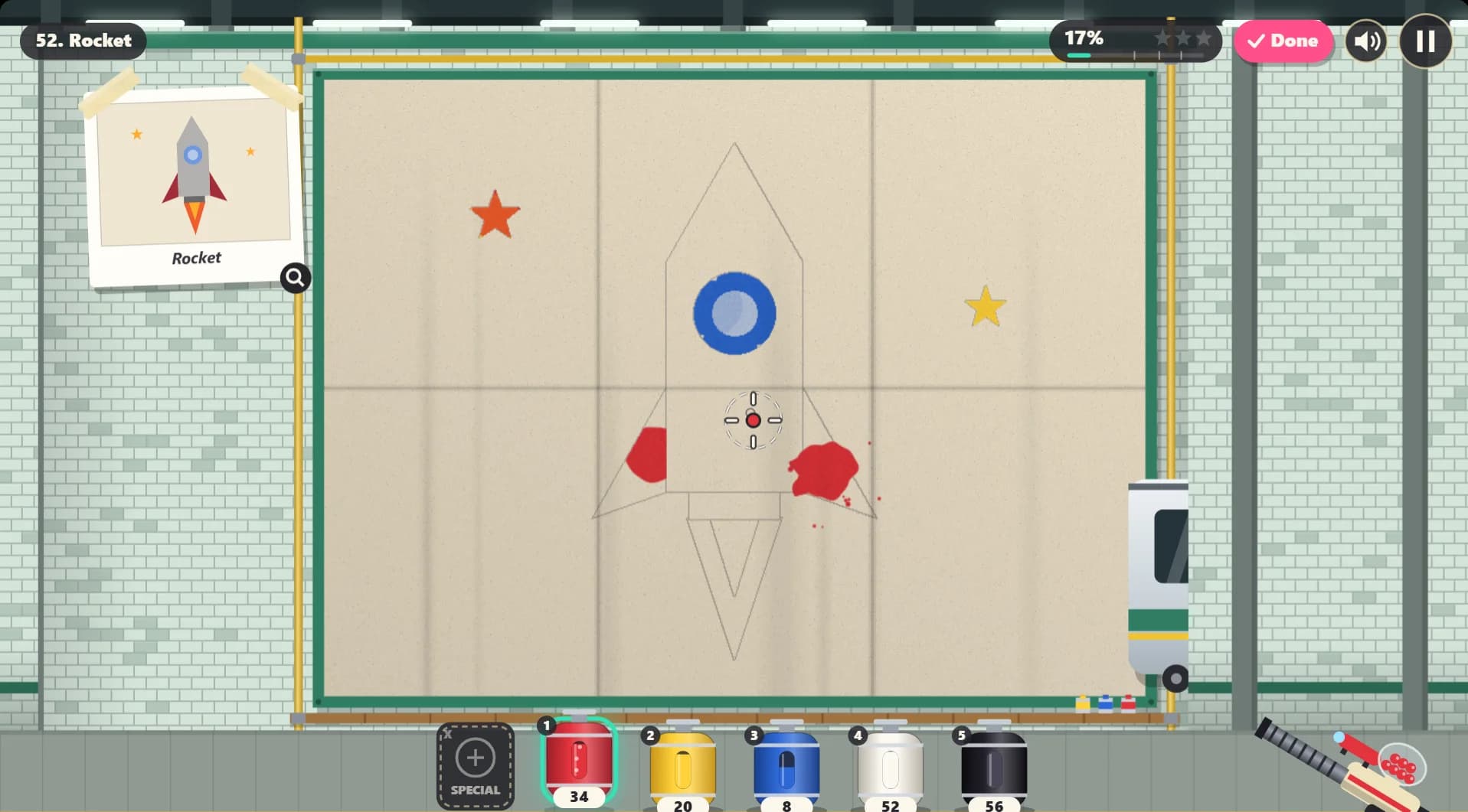
A paintball painting game. A big blank city wall fills the screen, with a small reference mural pinned in the corner, and you copy the mural onto the wall with a paintball gun. You have five tanks of paint, red, yellow, blue, white and black, and every splat mixes half and half with the paint under it, so you make orange, green, purple, pinks, browns and greys by layering one colour over another. Paint is limited, so every ball counts. When the wall is done the floodlights come on, a flash photo is taken, and the wall is scored against the mural with a match percentage and one to three stars. There are 90 murals on ten walls, from the Corner Bakery to the Night Carnival, with pigeons, wind, glass, passing cars, a window robot and gutter rain to work around. Stars earn coins for the Paint Truck, which sells six paint guns and four kinds of special ball, and every wall you paint hangs in your own washing-line gallery.

Genre: Shooting

Difficulty: Easy to start with single colours, then more colours to mix, finer murals, less spare paint and street challenges such as wind, glass and passing trains

About Splashwright

Mixing paint on the wall

Splashwright mixes paint the way paint mixes, not the way light does. Each spot on the wall remembers how much of each of the five paints is in it, and every new splat thins what is there by half and adds its own. That means the order of the coats matters: red then yellow gives an orange that leans yellow, and yellow then red gives one that leans red.

Two coats of the same paint come close to that paint, and three coats are almost pure, so you can always paint a colour back over a mistake. Red, yellow and blue together turn a muddy brown, which some murals ask for. A splash of white softens a colour into a pastel and a splash of black dulls it into a shade, which the Garden Wall, the Desert Town and the Rainy Alley lean on.

When a ball lands on a different colour, a little swatch of the new mix pops out of the splat, so you can see what you made. The mix chip next to the sight shows the same thing before you fire.
Clean shots and neat edges

Every paintball splats. A shot fired while the sight is still swaying throws fingers of paint out from the splat, a ring of little splatter dots, and sometimes a drip that runs down the wall. That is fine in the middle of a big shape, but on an edge it puts paint where the mural has none.

Hold the sight still and it steadies. When the crosshair ticks and the splat ring turn mint, the next shot is a clean one: a neat round splat exactly the size of the ring, with no fingers, no splatter and no drips. Firing kicks the sight, so it takes a moment to settle again. This works with every gun, including the free Street Marker, so a careful painter can always cut a tidy edge.

Each wall is sketched in faint pencil, and a clean shot is taped off: it only paints the one sketched shape it lands on, even if the ring is bigger. Aim a clean shot right on a thin line, like the cross on a kite, and only the line takes the paint, so every mural can be copied exactly.

On a phone, a quick tap fires at once and splashes. To place a clean shot, hold your finger down so the sight lifts above it, keep still until it turns mint, then let go.

How the wall is scored

The wall and the mural are both cut into a grid of small squares, and each square's colour on the wall is compared with the mural, the way your eye would see it. A square scores fully when it is close in colour and well covered. Squares the mural leaves bare should stay bare: paint on them counts against you, so spraying the whole wall never helps.

Squares that match closely shine as perfect, and they twinkle in a sweep across the wall when the floodlights come on. The stars need a higher match as the levels go on, from a little under half for one star on the first wall to well over four fifths for three stars on the last.

Ninety murals on ten walls

The Corner Bakery teaches the basics with single colours. The Market Lane brings in oranges and greens, the Harbour Wall purples and sea blues, the Garden Wall soft tints and the Desert Town deep shades. In the Subway Underpass the order of the coats matters, the Sunset Rooftop uses more colours at once, the Rainy Alley asks for dull, muted tones and the Snowy Square for tints and shades together. The Night Carnival ends the street with murals of up to eight colours.

Each wall has its own setting, time of day and weather, from a sunny bakery corner to a snowy square and a carnival under the lights, and its own music. Later murals have finer parts, more colours to mix and less spare paint in the tanks.

Challenges on the street

From the second wall on, the street joins in. Pigeons land on the wall for a rest, and a ball fired at one is blocked and wasted until it flutters off. Wind pushes every ball sideways, and the windsock beside the meter shows which way and how hard, so aim a little upwind.

Glass panes are set into some walls. Paint will not stick to glass, a ball that hits a pane skips off and lands just past its nearest edge, and the glass is not scored. Subway trains and carnival ride cars roll along the bottom of the wall, catching any ball that hits them, and an amber light warns you before each one. A window-cleaning robot drops down a lane and wipes it clean after the lane lights up, and gutter rain drips and then pours, washing a strip of paint away. Repaint once they have gone.

The first time a challenge appears, a card with a small animated picture explains it before you fire your first ball. Levels with challenges give you a little more paint.

The Paint Truck

Every level pays coins for its stars: 20 for the first star, 30 for the second and 50 for the third, each only the first time you earn it. Spend them at the Paint Truck, parked on the Block Party Street, where guns hang on a pegboard and special balls sit in tubes. Each item has a swing tag that shows what it does and how it rates.

There are six guns, and you carry one at a time. The Street Marker is free and does a bit of everything. The Steadyhand has a long barrel and a scope, and its sight barely sways. The Pinpoint throws small, neat splats for fine details and tight edges. The Bucketmouth's flared muzzle throws big, fat splats. The Quickpump fires twice as fast, which helps round pigeons and passing cars. The Muralist is steady, generous and quick.

Special balls come in packs of three and are spent one a shot. Wide Spray bursts into a fan of six small splats, Roller Shot lays a long flat stripe across the wall, Stencil Shot snaps to the grid and paints a crisp square, and the Primer Ball wipes a patch of wall back to bare primer without using any paint, which is the way to undo a mistake. Load one with the slot before the tanks, or X, and it stays loaded until you switch back or run out.

Your own gallery

Every wall you paint is kept as a photo. The gallery hangs them on washing lines, one pair of lines for each district under that district's sky, and the photos sway as you scroll along. Tap one to lift it up, tap again to turn it over and read the notes on the back, with the mural's district, your stars and your best match, and choose Paint again to have another go at that wall.

Paint, not people

Splashwright is about painting. The paintballs only ever hit a wall, a pane of glass, a passing car or, now and then, a pigeon, which simply flutters off in a puff of feathers. There are no people to aim at and nothing gets hurt.

Sound and what the game keeps

All the sound is made in code: the pop of the gun, splats that move from left to right with where they land, drips, a chime when a new colour mixes, the street's trains, rain and wind, the camera flash, and light lo-fi music with one tune for the street and one for each district. The speaker button or the M key turns it off, and the game follows the site's mute as well.

Your stars, best match and a picture of your best wall for every mural, your coins, guns, special balls and sound setting are saved on Unihfy Games in this browser.

Reviewed By
Kaushik Hirpara

Developer · Game Reviewer

Kaushik Hirpara is a full-stack developer and game reviewer at Unihfy Games. He does most of the work of bringing games to the site — adapting them to run properly in a browser, getting them working on phones, playing them, and writing up what players need to know.

View Profile
Game Created By

Unihfy Games

Splashwright is an original game created and published by Unihfy Games. We continue to improve it with new features, gameplay enhancements, and platform optimizations.

Designed and built in-house by Kaushik Hirpara at Unihfy Games. All code, art and sound are original.

Proprietary SoftwareAll game credits

How to Play

  • Pick a wall on the Block Party Street. Each district of the street is one wall with nine murals, one on each building, and its gateway shows the stars you have earned there. Tap a building to see its ticket, with the mural and your best stars and match, then tap Paint it! to start.
  • Look at the reference mural pinned beside the wall. Tap it, or press C, to lift it up big when you need a closer look.
  • Choose a paint tank, aim and fire. The ring round the sight shows how big the splat will be. The sight sways while you move it and settles when you hold still: when its ticks and ring turn mint, the shot lands clean, as a neat round splat with no splatter and no drips.
  • Every splat mixes half and half with the paint under it. Yellow over red makes orange, yellow over blue makes green and blue over red makes purple. White over a colour makes a lighter tint and black makes a darker shade. The mix chip by the sight shows what the next ball will make where you are aiming.
  • Each tank holds a set number of balls, and tanks the mural does not need start empty. The meter at the top shows the match as you paint, with three stars above it. Press Done when you are happy, or keep going until the paint runs out.
  • The light drops to dusk, the floodlights come on and the camera flashes. The photo develops on the results board next to the mural, the match is counted up, and you earn one, two or three stars. A star opens the next mural, and every new star pays coins.

Gameplay Preview

Features

A paintball gun and a blank city wall to copy a mural onto
Real paint mixing: every splat mixes half and half with the paint under it
Five paint tanks, red, yellow, blue, white and black, with limited balls
Clean shots from a steady sight, with no splatter or drips, for neat edges with any gun
A live match meter, then a dusk reveal under floodlights and a flash photo of your wall
Scoring by colour and coverage, with one, two or three stars for each mural
90 murals on ten themed walls, from the Corner Bakery to the Night Carnival
The Block Party Street level select, with a gateway for each district and thumbnails of your best walls
Pigeons, wind, glass panes, subway trains, carnival ride cars, a window robot and gutter rain
The Paint Truck: six paint guns and four special balls to buy with coins
A washing-line gallery of every wall you have painted
Gun, splat, drip, mixing, weather and music sounds all made in code
Mouse and keyboard on desktop, tap or hold-and-release aiming on phones
No people as targets, and nothing gets hurt

FAQs

How do I mix colours?

Fire one colour over another. Every splat mixes half and half with the paint under it, so yellow over red makes orange, yellow over blue makes green and blue over red makes purple. White makes a colour lighter and black makes it darker. The mix chip next to the sight shows what the next ball will make where you are aiming.

Why does the order of the coats matter?

The newest splat is always half of the mix. Red then yellow leaves more yellow on top, so the orange leans yellow; yellow then red leans red. If a mural's colour looks a little off, try painting the coats the other way round, or add one more coat of the colour it needs more of.

How do I stop paint splashing outside the edges?

Hold the sight still. When the crosshair ticks and the ring around it turn mint, the shot lands clean, as a round splat exactly the size of the ring with no splatter and no drips. Shots fired while the sight is moving throw out splatter and can drip. This works with every gun. On a phone, hold your finger down, wait for the mint ring, then let go.

Can I make a perfect copy?

Yes. Clean shots from a steady sight put paint only inside the ring and only on the pencil-sketched shape they land on, so with patience you can keep every edge tidy using any gun, even the free Street Marker. Mix each colour in the right order of coats, and use a Primer Ball to wipe away a mistake. The Pinpoint gun's smaller splats and the Stencil Shot's crisp squares make fine parts and straight edges easier still.

I painted over the wrong place. Can I fix it?

Paint over it. Two or three coats of a colour cover what was under it almost completely. To take paint off and get bare wall back, fire a Primer Ball from the Paint Truck, which wipes a patch back to primer without using any paint. Paint on parts of the wall the mural leaves bare counts against you, so it is worth fixing.

Why did my tank run out?

Each tank holds just enough balls for the mural with some to spare, and paints the mural does not need start empty. The spare paint shrinks on later walls. Steady, clean shots that don't overlap more than they need to make the paint go further.

How do the stars work?

When the wall is finished it is scored by how closely it matches the mural, as a percentage. Each mural has three targets, and you earn a star for each one you reach. They start low on the Corner Bakery and rise across the street. One star opens the next mural.

How do I get coins?

Stars pay coins: 20 for a mural's first star, 30 for its second and 50 for its third. Each star pays only the first time you earn it, so try to raise your stars on murals you have already painted. Spend coins at the Paint Truck on the Block Party Street.

What do the special balls do?

Wide Spray bursts into six small splats, Roller Shot lays a long flat stripe, Stencil Shot paints a crisp square snapped to the grid, and the Primer Ball wipes paint off the wall. They come in packs of three from the Paint Truck. Tap the slot before the tanks, or press X, to load one; it uses paint from the tank you have chosen, except the Primer Ball, which needs none.

Why did my ball stop before it reached the wall?

Something was in the way: a pigeon resting on the wall, or a train or ride car passing along the bottom. A pink stop ring on the sight warns you when the shot is blocked. Wait for it to move, or paint somewhere else for a moment. A ball that hits glass skips off and lands just past the pane.

What happens if I leave the game halfway through a wall?

The game pauses and the sound stops. When you come back, the pause card is waiting with your wall exactly as you left it: choose Resume to carry on, Fresh wall to start the mural again, or Back to street.

Can I play on my phone?

Yes. A quick tap fires a ball where you tap. Hold your finger down or drag and the sight lifts above your finger so you can see where it points; let go to fire. The tanks are along the bottom of the screen, or down the side when your phone is turned sideways, and the pause and sound buttons are at the top.

Is my progress saved?

Yes. Your stars, best match and best wall for every mural, your coins, guns, special balls and sound setting are kept in this browser on Unihfy Games. Clearing your browser data removes them.

Who made Splashwright?

Splashwright was designed and built in-house at Unihfy Games by Kaushik Hirpara. Its code, murals, art and sound are all original, the places and gear are invented, and everything you see and hear is generated by the game itself.

Ready for a New Challenge?

Take on exciting quizzes, improve your general knowledge, earn XP, collect rewards, maintain your daily streak, and compete with players on the Quiz Arena leaderboard.

Go to Quiz Arena